



 For all latest news, follow the Daily Sun's Google News channel.


Tk8,000cr SPM fuel terminal remains unused 2 years after completion
Daily Sun Report, Chattogram
Published: 18 Apr 2026, 12:00 AM
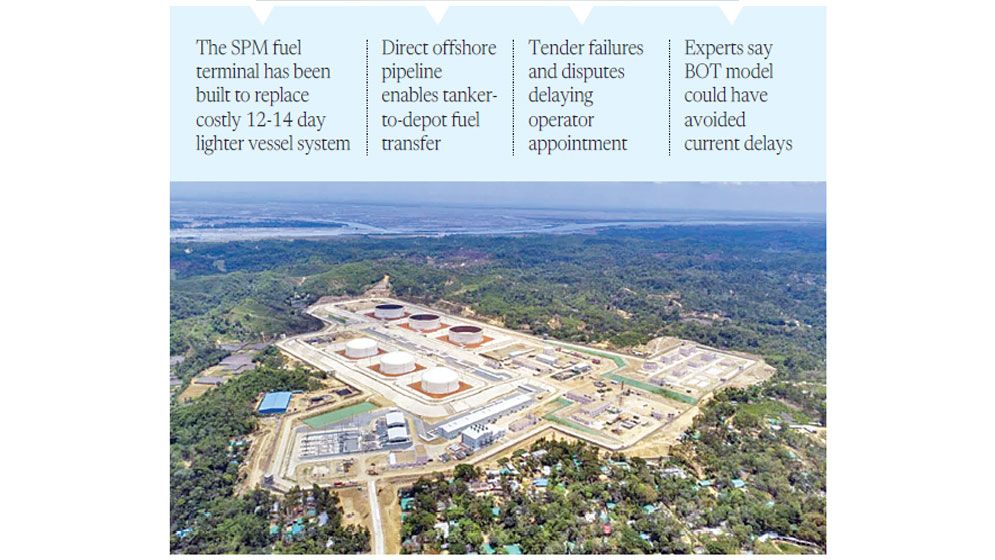
A major fuel infrastructure project at Moheshkhali in Cox’s Bazar, built at a cost of over Tk8,000 crore, has remained largely idle for nearly two years following its completion.
The facility has been hampered by repeated tender failures, allegations of conflicts of interest, and the absence of a qualified operator to run it efficiently, according to sources.
Previously, Bangladesh relied on lighter vessels to offload crude oil and diesel from large “mother vessels” anchored offshore, as deep-draft tankers could not berth directly at port jetties. This process typically took 12 to 14 days, adding significant cost and operational risk.
To address this long-standing bottleneck, the government launched the Single Point Mooring (SPM) project in 2015. The system consists of a floating jetty linked to a 110-kilometre offshore and onshore pipeline network, enabling fuel to be pumped directly from tankers at sea to storage depots in Maheshkhali, thereby eliminating the need for lighter vessels.
Built for Eastern Refinery Limited (ERL), a subsidiary of Bangladesh Petroleum Corporation (BPC), the project includes six large storage tanks with a combined capacity of around two lakh tonnes – enough to meet roughly one month’s crude oil demand and one week’s diesel requirement.
Once fully operational, the SPM system is expected to save the state around Tk800 crore annually in offloading and transportation costs.
Originally estimated at Tk4,936 crore with a completion deadline in 2018, the project was extended three times. Costs rose steadily during implementation, reaching Tk7,125 crore upon completion. With subsequent expenditures, the total cost now exceeds Tk8,000 crore. The project was jointly financed by the Government of Bangladesh and China Exim Bank.
It was implemented under a special fast-track energy law introduced by the then Awami League government, which allowed the direct appointment of a Chinese contractor without competitive tendering. The SPM was officially commissioned in March 2024.
Following commissioning, the government initially moved to appoint the same Chinese contractor as the operator, again bypassing competitive tendering under the special law. However, after the interim government took office and repealed the legislation, the arrangement was cancelled and fresh international tenders were invited. The first tender, floated in November 2024, was later cancelled due to procedural irregularities that limited competition. A second round, prepared with assistance from consulting firm ILF Consulting, was issued in December 2024.
After two deadline extensions, bids were opened on 17 February 2025. Although 11 companies purchased tender documents, only three ultimately submitted bids.
Concerns were subsequently raised over a potential conflict of interest involving ILF Consulting, which had previously worked with the project’s construction contractor on other assignments. It was also noted that the firm prepared the tender documents before receiving formal approval to do so.
The Ministry later instructed a reduction in ILF’s consultancy fees, leaving the firm’s appointment unresolved – and, with it, the evaluation process in limbo. The earlier tender round had also seen more than a dozen companies purchase documents, but only two submit bids. Industry insiders say overly restrictive tender conditions have effectively excluded experienced global SPM operators who might otherwise have competed.
Energy experts argue that the SPM could have played a crucial role during Bangladesh’s recent fuel supply disruptions. Had it been fully operational, it would have significantly reduced both the time and cost of fuel offloading during shortages, while its storage capacity could have provided a vital buffer.
Given Bangladesh’s lack of domestic experience in operating SPM systems, experts suggest the project would have been better structured as a Build-Operate-Transfer (BOT) arrangement. Under such a model, the contractor would operate the facility for a set period before handing it over to the state – an approach they say could have helped avoid the current deadlock.
Captain Md Anam Chowdhury, president of the Bangladesh Merchant Marine Officers Association, echoed this view, saying the construction firm should have been tasked with operating the facility for a year to demonstrate competence before any handover. Repeated attempts to contact the project director, the BPC general manager for planning and development, and the organisation’s chairman for comment were unsuccessful.