


 For all latest news, follow the Daily Sun's Google News channel.


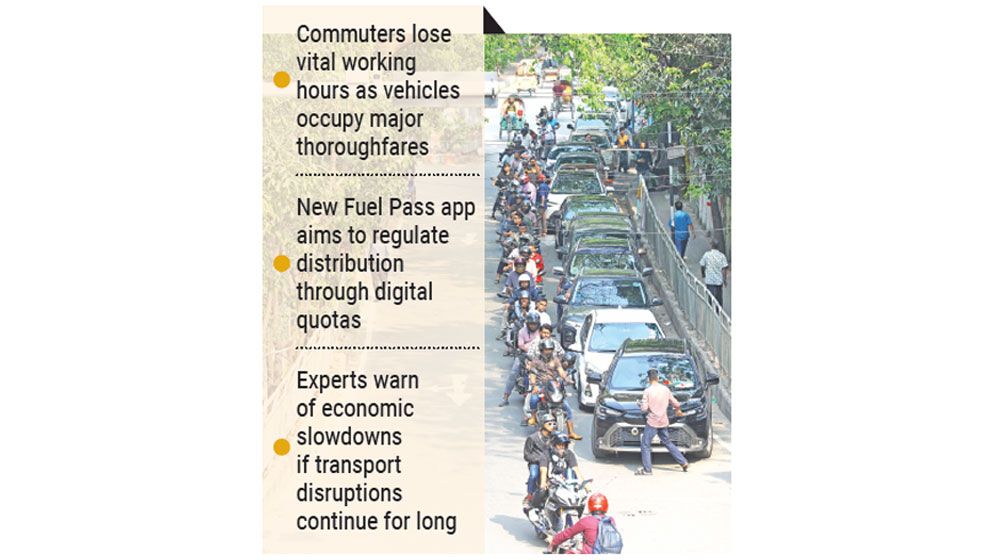
Dhaka’s notorious traffic congestion has taken a turn for the worse in recent weeks as long queues at refueling stations spill onto major thoroughfares, creating severe bottlenecks across the capital.
While the city is no stranger to gridlock, the recent surge in vehicles lining up for petrol, octane, and diesel has added a fresh layer of disruption to daily commutes and commercial activity.
The government has characterised the situation as an "artificial fuel crisis," attributing the lengthy lines to "panic buying" triggered by concerns over the ongoing Middle East conflict.
Despite official assurances that national reserves remain stable, the sight of hundreds of vehicles snaking around pumps has become a common fixture in areas such as Shahbagh, Asad Gate, Bijoy Sarani, and Khilkhet.
The crisis is resulting in the loss of thousands of working hours daily.
From private cars and motorcycles to ambulances and public buses, drivers are spending hours in stationary lines with no certainty of receiving fuel. I
n many instances, the tail-ends of these queues have occupied significant portions of main roads, effectively halving the available space for moving traffic.
The government recently introduced the “Fuel Pass” app on an experimental basis to bring transparency to the distribution process.
Under this system, registered users receive a QR code for scanning at designated pumps.
Motorcycle riders with a pass can purchase fuel worth up to Tk1,000, while others are limited to Tk500.
However, the sheer volume of demand has tested the limits of this new digital framework.
Ataur Rahman, a motorcyclist at Asad Gate, described the uncertainty facing many residents. Having left his Mohammadpur home after Fajr prayer, he found the queue already stretching beyond Dhanmondi-27.
"I set out early to ensure I could begin my day’s work, but I have no idea if I will be able to start even by the afternoon," he told the Daily Sun.
The disruption has also raised concerns regarding emergency services. Abul Kalam, an ambulance driver, noted that the fuel uncertainty is making long-distance patient transport increasingly risky. "There are also reports of CNG shortages in some areas, which is complicating matters further," he added.
Public frustration is mounting, with many commuters calling for a shift in strategy. Jahangir Alam, a passenger on an Airport Paribahan bus, reported that a journey from Shahbagh to Uttara took nearly four hours.
"The government should consider providing energy to public transport on a priority basis rather than private cars to keep the city functioning," he suggested.
Experts have warned of a broader economic slowdown if the situation is not managed effectively.
Anu Muhammad, former member secretary of the National Committee to Protect Oil, Gas, Mineral Resources, Port and Power (NCBD), told the Daily Sun that the gridlock is a direct outcome of global energy volatility. "The government must ensure that accurate information regarding stocks and purchase orders is made public so that consumers are not misled by misinformation," he said. He further emphasised the need for law enforcement to maintain discipline at stations and for the authorities to curb any potential corruption in the distribution chain.
The Dhaka Metropolitan Police (DMP) has responded by deploying additional personnel to manage the congestion. Mohammad Anwar Saeed, deputy commissioner (Uttara Traffic Division), said he has held meetings with station owners to ensure vehicles are not parked haphazardly on busy streets.
Despite the chaos on the streets, the Ministry of Power and Energy maintains that the country has sufficient refined oil reserves for at least two months. Current stocks include 101,385 tonnes of diesel, 31,821 tonnes of octane, and 18,211 tonnes of petrol.
Meanwhile, two more vessels, the “MT Torm Damini” and “MT Lucia Solis”, arrived at Chattogram Port carrying 68,000 tonnes of diesel from Malaysia on Tuesday.
These follow several other shipments of diesel and jet fuel that arrived earlier this month. Chattogram Port Authority (CPA) Secretary Syed Refayet Hamim confirmed that unloading activities would begin shortly, which officials hope will ease the immediate pressure on the capital’s fuel stations.