


 For all latest news, follow the Daily Sun's Google News channel.


THE DOLLAR TRAP
With domestic gas dwindling and the US dollar at Tk123, Dhaka faces a “two-lung failure” in the real economy. Is a regional currency pivot the inevitable next step for energy security?

In the global South, energy security is usually measured in megawatts. In Bangladesh today, it is measured in greenbacks. Caught in a structural “pincer movement”, the nation finds itself devoid of the domestic gas needed for growth, yet lacks the foreign exchange to comfortably import the alternative.
This is the “Dollar-Energy Trap.” With petroleum and LNG prices remaining volatile due to ongoing tensions in the Middle East, the cracks in Bangladesh’s import-heavy energy policy have widened into a fiscal chasm.
The crisis is no longer merely about whether we have enough power plants – the nation possesses a massive surplus of installed capacity – but whether the central bank has the hard currency to keep them breathing.
The macroeconomic suffocation
The government is walking a fiscal tightrope. Under the terms of the ongoing IMF support programme, Dhaka has committed to a “formula-based” fuel pricing mechanism and the gradual withdrawal of subsidies.
While this reduces the fiscal deficit on paper, it has triggered a “two-lung failure” in the real economy.
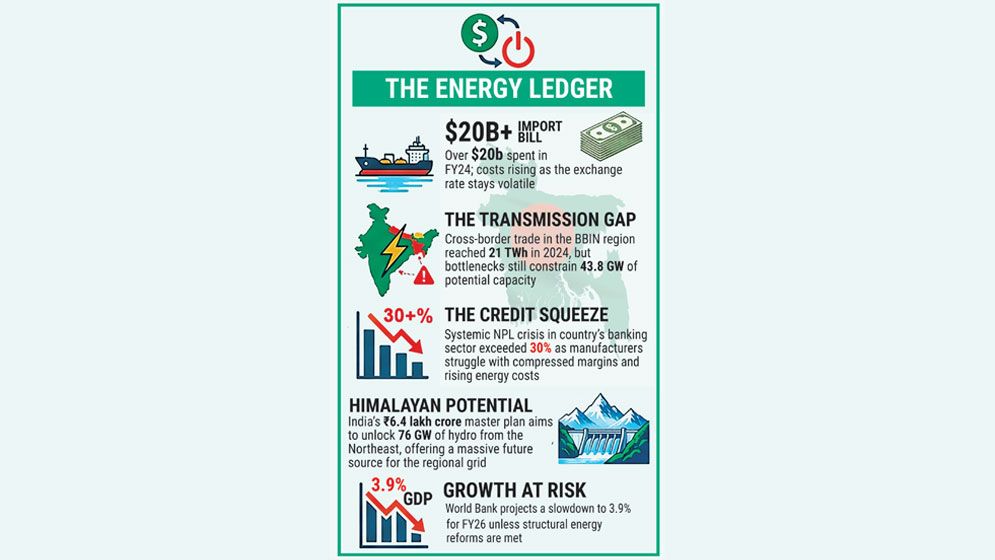
The latest Bangladesh Development Update (April 2026) by the World Bank projects Bangladesh’s growth to slow to 3.9% this fiscal year, citing persistent inflation and a banking sector where non-performing loans (NPLs) hit a staggering 35.7% in September 2025. The ratio declined to 30.6% in December; however, this improvement appears to be driven largely by loan rescheduling under relaxed regulatory policies rather than underlying balance sheet strengthening.
As energy costs soar, the industrial heartlands of Gazipur and Narayanganj are suffocating. Rising yarn and freight costs, combined with an approximately 30% increase in industrial gas tariffs, are significantly compressing operating margins across manufacturing firms.
“The rise in energy prices, coupled with a dollar-driven liquidity squeeze, has essentially cut our working capital by an estimated 35%,” says a prominent textile entrepreneur.
“If this persists, nearly half of the country’s textile manufacturers could shut down by the end of 2026.”
The RMG survival crisis
For the Ready-Made Garment (RMG) sector, energy is the new battlefield for competitiveness. Bangladesh’s merchandise exports began a contraction cycle in late 2025, dropping 5.58% year-on-year – primarily driven by a fall in RMG shipments.
Industry estimates indicate that effective capacity utilisation has declined to approximately 50%, largely due to inconsistent gas supply and pressure fluctuations.
“Textile mills are facing a major challenge in adjusting to rising costs,” says Engr Kutubuddin Ahmed.
“Once orders are confirmed at fixed prices, there is no room to revise them, even if our energy bills double overnight.” This makes the transition to a non-dollar-denominated energy source a matter of national industrial survival.
Bangladesh now faces a “troubling paradox”: while it leads the world in green RMG with 243 LEED-certified factories, its core competitiveness is being eroded by an energy framework that remains tethered to expensive, imported fossil fuels.
The Himalayan battery: A tripartite solution
The maritime disruptions in the Gulf have exposed the strategic folly of putting all of Bangladesh’s energy eggs in the “LNG basket.”
For decades, the nation looked West toward Qatar and Saudi Arabia. Now, pragmatic policy demands we look North toward the “Himalayan Battery.”
The untapped hydroelectric potential of Nepal and Bhutan offers a stable, carbon-neutral, and, crucially, a non-dollar alternative. While the initial 40MW import from Nepal, inaugurated in late 2024, was a symbolic start, the true goal is the expansion of tripartite agreements.
The South Asia Subregional Economic Cooperation (SASEC) framework has already seen cross-border electricity trade nearly triple to 21 TWh in recent years.
Energy diplomacy has reached a critical juncture. Nepal holds over 350 GW of hydropower potential, and India has unveiled a ₹6.4 trillion plan to evacuate 76 GW of hydro capacity from the Brahmaputra basin by 2047.
“Nepal’s hydropower potential and Bangladesh’s increasing energy needs provide ample opportunities,” states a recent diplomatic release.
For Bangladesh, drawing on hydropower from Bhutan and Nepal may contribute significantly to meeting its target of 30% renewable energy by 2040 while reducing pressure on foreign exchange reserves, according to sector insiders.
Breaking the greenback hegemony: Lessons from the region
Perhaps the most radical shift required is in the “currency of survival.” Bangladesh is not alone in this struggle.
Across Asia, a movement toward Local Currency Settlement (LCS) is gaining pace as nations seek to bypass the volatile dollar. Countries like Indonesia, Malaysia, and Thailand have successfully implemented LCS frameworks to settle trade in their own currencies, reducing exchange rate risks for their energy-intensive industries.
While complex, India has experimented with local currency settlements for Russian oil, a move that provided a vital buffer during global price spikes.
Experts said there is growing momentum to explore trading energy in Rupees or Taka. For Bangladesh, paying for Nepalese hydro-power through a regional clearing mechanism would provide much-needed breathing room for the country’s thinning foreign exchange buffers, they added.
However, the transition from theory to the trading floor remains fraught with administrative caution. A senior director at the Bangladesh Power Development Board (BPDB) told the Daily Sun on condition of anonymity that while the idea of bypassing the dollar is attractive, the path is not yet clear.
Speaking on the prospect of currency swaps or alternative economic arrangements for power imports, the official admitted, “There is no clear initiative on this matter yet. The issue is highly complex and depends on intricate international coordination.”
This bureaucratic hesitation highlights the depth of the trap. While 22 countries have begun exploring rupee-based settlements with India, Bangladesh’s official machinery remains in a “wait-and-see” mode even as the dollar reserves dwindle.
The lesson of 2026 is clear: energy security is national security, according to analysts. The current “pincer movement” of high import costs and low foreign reserves cannot be solved by building more fossil-fuel plants.
It requires a pivot toward regional integration and a fundamental shift in how we finance our power.
Md Shahriar Ahmed Chowdhury, founding director of the Centre for Energy Research (CER) at United International University (UIU), sums up the stakes saying, “A modern grid must handle decentralised generation and regional interconnections. For Bangladesh, the question is not whether to embrace this transition, but how quickly it can do so to safeguard its economic resilience.”
Without a stable, affordable, and diversified energy mix that looks North to the Himalayas and embraces currency innovation, the “Bangladesh Miracle” risks being remembered as a cautionary tale of a nation that outgrew its own infrastructure.
(This is the concluding part of a four-part investigative series by the Daily Sun exploring the structural fissures in Bangladesh’s power and energy sector.)
Read More