


 For all latest news, follow the Daily Sun's Google News channel.


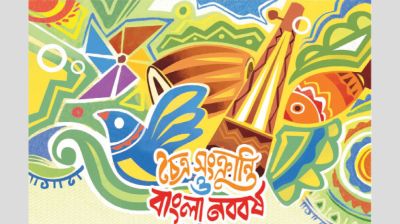
“Let the old year’s weariness fade; let a new rhythm begin.” The spirit of renewal has long shaped the cultural imagination of the Bengali New Year. Pahela Baishakh, celebrated on April 14 in Bangladesh, marks more than a change in the calendar.
It is a public cultural moment in which streets, parks, and open spaces become shared arenas of music, colour, and human connection. People wear traditional red and white, join processions, visit fairs, and take part in performances that carry both history and emotion. It stands out as one of the few occasions that brings together people across religious and social differences.
This year, however, the celebration has unfolded within visible limits. Time restrictions, tighter security, and a more measured atmosphere have reshaped the experience. The festival still carries its energy, but it moves within boundaries. That contrast between openness and control makes the moment more revealing than usual.
Festivals often give the impression that multicultural harmony is fully alive. They create scenes where diversity feels natural and unproblematic. Yet such scenes can be deceptive. Will Kymlicka reminds us that multiculturalism is not secured through visibility alone. It depends on equal access, recognition, and participation. A shared celebration does not mean a shared experience. In Bangladesh, Pahela Baishakh unfolds differently for different people. Economic position shapes mobility and choice. Some people move easily through the celebration, while others depend on public space to feel included. When that space becomes restricted, their presence narrows. Gender shapes experience as well. For many women, participation still involves caution. The festival appears unified, but the experience of that unity remains uneven.
Looking beyond Bangladesh, similar patterns appear across global festivals. In Brazil, Carnival transforms cities into sites of collective celebration where differences seem to dissolve in music and movement. Yet research shows that economic inequality continues to shape participation. In the United Kingdom, large cultural events bring diverse communities together, but they are also shaped by questions of regulation, representation, and access. In Canada, multicultural festivals are widely supported, yet scholars have argued that they can function as staged representations of diversity rather than reflections of everyday equality. These examples point to a consistent reality. Festivals create moments of connection, but those moments often sit atop deeper inequalities.
The framework offered by Bhikhu Parekh helps clarify this tension. Parekh sees multiculturalism as a living process shaped by dialogue and power. Cultural groups do not simply appear together in shared space; they negotiate their presence within it. This negotiation requires fairness, recognition, and the ability to ensure all voices are heard. Without that balance, some identities gain greater visibility, while others remain limited. A festival can create a sense of togetherness, but it cannot ensure equal participation in that space. Some people move with ease; others remain cautious. Some feel fully included; others remain at the margins. Unity, in this sense, becomes real but unstable. It depends on conditions that extend far beyond the celebration itself.
Public space and economic reality reinforce this fragility. Henri Lefebvre argued that space reflects social structures rather than standing apart from them. This year’s celebration shows that clearly. Security measures create safety, yet they also shape movement and reduce spontaneity. Economic pressure has quietly entered the festival as well. Rising costs and global disruptions have changed everyday life. These changes reshape the celebration. People continue their traditions, but in more careful and limited ways. This adaptability reflects resilience, yet it also signals normalisation. When limits become part of routine, they begin to feel natural.
This condition also raises a broader question about cultural continuity. When celebrations become more controlled and participation more uneven, the meaning of the festival begins to shift. It risks moving from a shared public experience to a managed cultural event. That shift may seem subtle, but it carries long-term implications. Cultural practices survive through repetition and openness. If access narrows, the sense of collective ownership weakens. Over time, the festival may remain visible, yet its depth of participation may decline. This is where the distinction between celebration and inclusion becomes important. A society can celebrate diversity without fully sustaining it.
As the festival fades and daily life returns, a deeper question remains. The unity created during Pahela Baishakh is vivid but temporary. It appears in full colour for a day, then recedes into the complexities of everyday life. The same pattern can be seen across cultures. Festivals offer a glimpse of shared belonging, but they cannot sustain it alone. A society that values multiculturalism must build that sense of belonging into daily structures. Public space must remain open and accessible. Participation must feel safe and equal. Pahela Baishakh continues to carry meaning because it shows what unity can look like. The challenge lies in ensuring that this vision does not remain limited to a single day.
______________________________
The writer is an Assistant Professor in the Department of Philosophy at IUBAT and is currently on study leave, residing in Oslo, Norway
Read More