


 For all latest news, follow the Daily Sun's Google News channel.


Bhabadaha waterlogging shrinks Boro farming in Jashore
7,000 hectares of land remain uncultivated this season

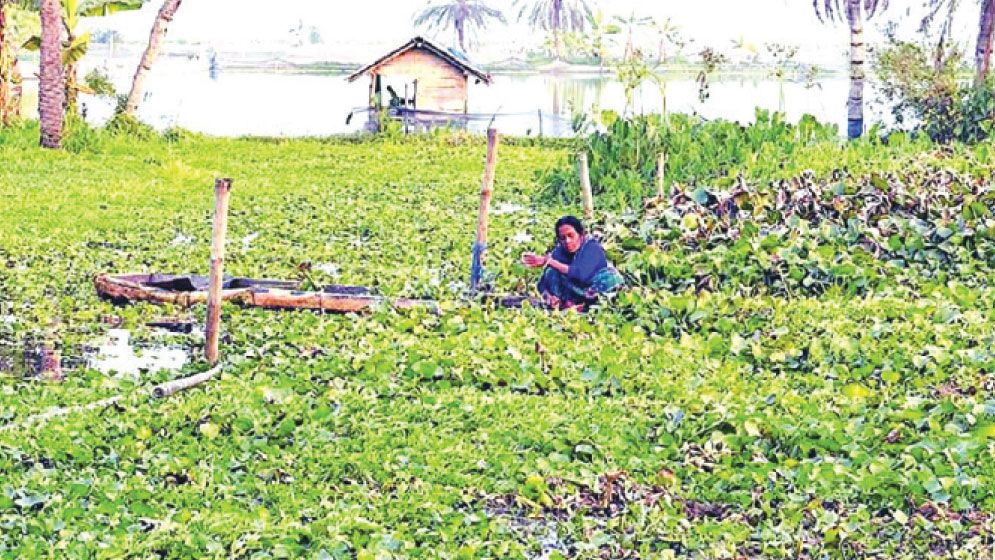
A vast stretch of wetlands (beels) in the Bhabadaha region of Jashore has remained submerged under water since the last monsoon, severely hampering Boro cultivation this season.
Water levels in many areas range from waist-deep to chest-deep, leaving approximately 7,000 hectares of land uncultivated due to prolonged waterlogging, according to officials from the Department of Agricultural Extension (DAE).
Sources at the DAE in Manirampur, Abhaynagar, and Keshabpur upazilas said around 50,000 farmers in the region depend on agriculture. Traditionally, Boro is cultivated on 24,904 hectares of land with 7,400 hectares in Abhaynagar, 5,400 in Keshabpur, and 12,104 in Manirampur.
However, this year, cultivation has been possible on only 17,661 hectares, leaving 7,243 hectares fallow. Of the affected land, 1,290 hectares are in Abhaynagar, 2,130 in Keshabpur, and 3,823 in Manirampur.
The Bhabadaha region comprises at least 52 small and large beels. Water levels in these areas are influenced by tidal flows from rivers such as the Mukteshwari, Teka, Sree, and Hari. However, heavy siltation has reduced the navigability of these rivers, severely restricting natural drainage.
As a result, excessive monsoon rainfall causes flooding in the beels, with water often spilling into adjacent villages. Last year’s heavy rains inundated large parts of Monirampur, Abhaynagar, and Keshabpur, submerging homes, educational and religious institutions, roads, and fish enclosures, and leaving over 200,000 people stranded.
In response, the Bangladesh Water Development Board (WDB) undertook a pilot initiative to excavate experimental channels in the rivers Sree and Hari using dredging equipment, which helped reduce water levels in residential areas. However, most beels remain submerged.
Agriculture officials noted that the Boro season runs from December to April, with seedbeds prepared between mid-December and early January, and transplanting typically completed by February.
Despite some improvement, a significant portion of land remains out of production.
Last year, Boro was cultivated on 16,657 hectares in the region. Although cultivation increased by 1,004 hectares this year, the overall situation remains critical.
Meanwhile, Gazi Abdul Hamid, joint convener of the Bhobadaha Water Drainage Movement Committee, rejected the official data, claiming that the actual extent of uncultivated land is significantly higher.
A recent visit to several beels revealed vast stretches of water with little visible agricultural land.
Some farmers managed limited cultivation by constructing temporary embankments and using irrigation pumps to drain water.
Farmers reported severe losses due to the prolonged waterlogging.
Bimal Roy, a farmer from Nebugati village in Monirampur, said he could cultivate only 1.5 bighas of his nine bighas of land after draining water. “A large portion of my land remains under five to seven feet of water, making cultivation impossible,” he said.
Similarly, Asim Dhar of Haridasakathi village said he managed to cultivate eight out of his 15 bighas of land, while the remaining area remains submerged.
Abhaynagar Upazila Nirbahi Officer (UNO) Sheikh Salahuddin Dipu said water has started to recede in some areas, and the situation has improved slightly compared to earlier conditions.