


 For all latest news, follow the Daily Sun's Google News channel.


REHAB voters seek dynamic leadership, policy support
REHAB election set for 18 April as members urge govt to allow use of undisclosed money in FY27 budget

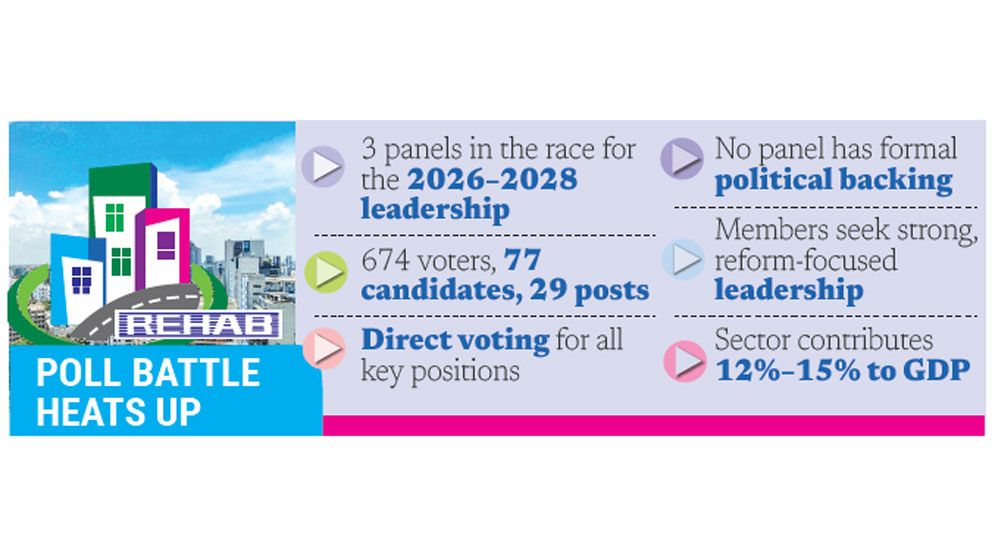
Voters of the Real Estate and Housing Association of Bangladesh (REHAB) are calling for dynamic leadership through a free and transparent election for the 2026-2028 term, scheduled for 18 April, to help revive the sector, which has remained stagnant for several years.
They have also urged the government to consider proposals submitted to the National Board of Revenue (NBR), including allowing the use of undisclosed money in the upcoming budget for fiscal year 2026-27 (FY27) to stimulate investment in the sector.
Industry representatives highlighted the economic significance of the real estate sector, which contributes 12-15% to the country’s GDP.
They noted that more than 200 related industries – such as rod, cement, tiles, and electrical equipment – are linked to the sector, with around three crore people directly and indirectly dependent on it.
Voting to elect the association’s new leadership will take place on 18 April from 10am to 4pm at the InterContinental Hotel in Dhaka. A total of 674 members are eligible to vote, including 613 from Dhaka and 61 from Chattogram.
Industry insiders said the election for the board of directors will feature a three-panel contest this year. Two groups – Progotishil Abason Baboshayee Parishad and Abason Baboshayee Oikya Parishad – have submitted full panels, while another alliance, Jagoron, has fielded a partial panel of 13 candidates.
For the first time, all positions – including president, six vice-presidents, and 19 directors – will be elected through direct voting. In total, 77 candidates are contesting for 29 posts, alongside several independent contenders.
Members seek dynamic leadership
Speaking to Daily Sun, Md Sultan Mahmud, a director candidate from Progotishil Abason Baboshayee Parishad, said members are expecting dynamic leadership through a free and fair election to overcome industry challenges.
“So far, the election environment remains positive. We expect no untoward incidents. We want to work together to develop the industry for the country’s economic growth,” he said.
Sultan, a former director of the association, also stressed the need to allow the use of undisclosed money in the housing sector.
“Undisclosed money is not necessarily illegal. Property transactions often occur above mouza rates, creating undeclared funds. If the government allows investment of this money, it will boost the sector and reduce capital flight,” he said.
Md Labib Billah, director of REHAB and also a director candidate from Progotishil Abashon Byabasayi Parishad, said the election is not driven by political affiliations, although individuals may hold personal political views.
“This year’s election will be festive. We have already broken the old culture of uncontested leadership. If elected, we will prioritise addressing key challenges, including DAP implementation and construction regulations,” he said.
REHAB elections were once held in a festive atmosphere, but this tradition declined during the tenure of the Awami League government.
In 2014, Alamgir Shamsul Alamin Kajal became president without an election, and the following three committees were formed through consensus. After a gap of 10 years, voting resumed in 2024.
Election to be free and fair
Liakat Ali Bhuiyan, senior vice-president of REHAB and also a senior vice-president candidate from Abason Baboshayee Oikya Parishad, said the sector plays a vital role in the economy, employing thousands of people.
“If the sector fails, the economy will suffer. The government should take proper initiatives to support it,” he said.
He added that the prices of raw materials need to be regulated to prevent further stagnation. “The government should strengthen market monitoring by forming a dedicated cell. Extortion and corruption must be eliminated first,” he said.
Bhuiyan also urged the government to prioritise the sector’s proposals in the upcoming budget.
“The election will be free and fair. Voters will be able to cast their ballots smoothly,” he said, adding that the current committee has tried its best despite slow activity in the sector during the interim government period.
High costs dampen real estate activity
At a pre-budget discussion held on 8 April at the NBR headquarters in Dhaka, REHAB leaders said easing restrictions on undeclared funds could help revive the sluggish real estate sector.
They also called for a reduction in land registration costs, arguing that high expenses discourage the buying and selling of land and apartments, ultimately affecting overall revenue collection.
REHAB suggested that lowering registration costs to a reasonable level would increase transactions and boost government revenue.
The association further noted that VAT is currently imposed on both building construction and land development, increasing overall costs.
To ease the burden on developers, REHAB proposed fixed VAT rates on capital gains, stamp duty, and apartment sales.