


 For all latest news, follow the Daily Sun's Google News channel.


Stocks volatile amid war fears; DSEX loses 342 points in a month
Daily Sun Report, Dhaka
Published: 12 Apr 2026, 12:00 AM
The impact of global economic uncertainty arising from escalating Iran-United States tensions has also been reflected in Bangladesh’s capital market. From the beginning of March to 9 April, the benchmark DSEX index of the Dhaka Stock Exchange (DSE) experienced notable volatility, with investor risk aversion, instability in global markets, and concerns over rising energy prices triggering several sharp declines.
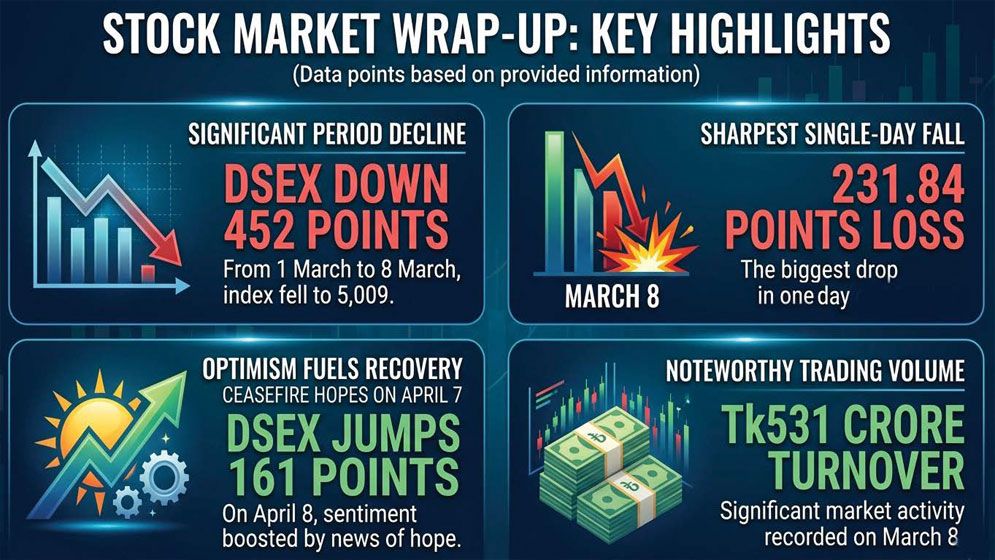
According to market data, the index stood at 5,461 points on 1 March and fell to 5,009 points by 8 March. Within just a few trading sessions, the market lost more than 452 points. The steepest fall occurred on 8 March, when the index plunged by 231.84 points in a single day. Over the period of more than a month, the DSEX recorded a net loss of 342 points.
ICB Chairman Abu Ahmed told Daily Sun that if geopolitical tensions persist, Bangladesh’s capital market may face further volatility. He noted that the impact would be more pronounced in stocks related to oil, shipping, the US dollar, and import-dependent industries.
“Now that there is talk of a ceasefire between the two countries, it is likely to have a positive impact on our economy as well,” he said.
Abu Ahmed added that Bangladesh’s stock market is highly sensitive, where news developments often trigger swift reactions among investors. He attributed this to the large presence of small retail investors with limited capital.
“Even a minor decline often causes panic selling, making it difficult to maintain market stability,” he said.
Following the onset of tensions between Iran and the US on 28 February, the first trading session in March saw the DSEX drop by 138 points compared to the previous session. Although the market briefly recovered, it soon faced another major correction. On 3 March, the index fell by 208 points, creating fresh panic among investors.
During this period, the market operated for 24 trading sessions, of which the index declined on 13 days.
More recently, reports on 7 April of a two-week ceasefire between Iran and the United States helped restore investor confidence. As a result, the index jumped by 161 points on 8 April.
Market insiders said investors rushed to offload shares amid fears that a prolonged Middle East conflict could put pressure on fuel supply, the dollar market, and import costs. Selling pressure was particularly strong in banking, energy, and import-dependent stocks.
However, the market also showed signs of recovery after the correction. Between 9 March and 12 March, the DSEX gained more than 359 points over four consecutive sessions, rising to 5,368 points, as investors engaged in bargain hunting of undervalued shares.
The market turned negative again in the final week of March. From 29 March to 31 March, the index fell by 138 points across three straight sessions, dropping to 5,178 points.
Alongside index fluctuations, trading activity also remained volatile amid war-related concerns. Heavy selling pressure from nervous investors was particularly evident on major losing days.
On 8 March, despite a 231-point drop in the index, turnover exceeded Tk531 crore, indicating both panic selling and bargain buying at lower prices, according to market analysts.
Meanwhile, the DSE’s market capitalisation declined by Tk737 crore last week. In the previous week, market capitalisation had fallen by Tk17,513 crore.