




 For all latest news, follow the Daily Sun's Google News channel.


THE SOLAR PARADOX
How fiscal architecture, policy inertia are throttling Bangladesh’s green transition

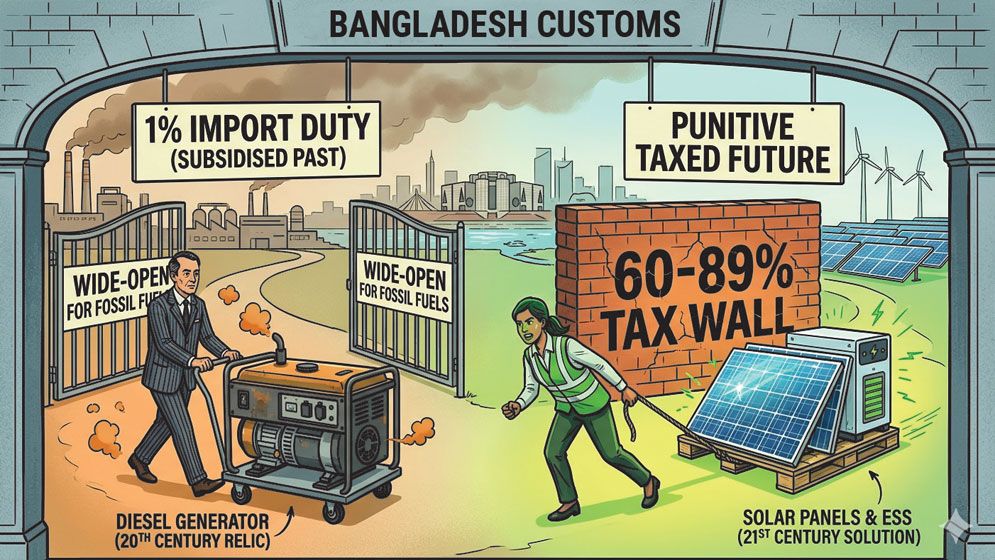
While the global energy landscape undergoes a seismic shift toward decentralised self-reliance, Bangladesh’s fiscal policy is perversely penalising the only “inflation-proof” solution available to its struggling economy: solar energy.
As industrial heartlands grapple with a terminal decline in domestic gas reserves and a volatile, dollar-denominated import market, a staggering “Duty Paradox” has emerged as the single greatest barrier to national energy sovereignty.
Currently, the nation is operating under a regulatory framework that effectively taxes the future to subsidise a failing past.
A factory owner opting for a polluting, import-dependent diesel generator – a relic of 20th-century energy thinking – is incentivised with a negligible 1% import duty. In stark contrast, an entrepreneur attempting to install a modern rooftop solar system or high-capacity Energy Storage System (ESS) is met with a punitive wall of taxes often exceeding 28% to 60%, even though the government in this year’s budget slashed the duty on solar inverters to 1% from 10%.
This structural sabotage was the focal point of a high-level energy forum organised by the American Chamber of Commerce in Bangladesh (AmCham) on Wednesday.
Syed Ershad Ahmed, president of AmCham, emphasised the need for a “consultative approach” over unilateral policymaking, warning that coordinated short- and long-term strategies are now a matter of survival for the private sector.
The ‘duty paradox’ and the NBR standoff
Engr Md Muzibur Rahman, director at the Sustainable and Renewable Energy Development Authority (SREDA), confirmed to the Daily Sun that current duties on certain solar components range from 60% to a staggering 89%.
“We have already moved a strong recommendation to the National Board of Revenue (NBR) to slash these duties to between 10% and 15%,” Muzibur revealed.
Dr Sebastian Groh, managing director of Solshare, argued at the AmCham event that these “policy distortions” go beyond just panels.
He noted that the system currently favours lead-acid batteries over cleaner alternatives and denies Energy Service Companies (ESCOs) the same duty benefits enjoyed by Independent Power Producers (IPPs).
“We must rationalise duties by removing distortions that favour diesel generators,” Groh noted, calling for a level playing field to enable scalable rooftop models.
The 5,000MW prize: Solar as the ‘quickest solution’
While land scarcity remains a common excuse for fossil fuel reliance, experts are pointing to the sky.
Prof M Tamim, an energy experts and vice chancellor of Independent University, Bangladesh (IUB), stressed that renewable energy is the fastest way out of the current crisis.
He estimated that Bangladesh could realistically add 3,000MW of solar capacity by 2030, alongside an additional 2,000MW through rooftop systems.
“This would reduce reliance on oil-based power plants during the daytime and significantly lower import costs,” Tamim noted, adding that while boosting gas output takes years, solar can be deployed almost immediately.
Meanwhile, IDCOL (Infrastructure Development Company Limited) estimates that industrial rooftops, particularly in the ready-made garment (RMG) and textile sectors, possess the untapped potential to generate 4,000 Megawatt-peak (MWp) of electricity.
This decentralised power plant requires no land acquisition and results in zero transmission loss.
Despite this “low-hanging fruit,” the uptake has been sluggish.
Shafiqul Alam, chief energy analyst at the Institute for Energy Economics and Financial Analysis (IEEFA), pointed out that while rooftop solar has crossed the 500MW mark, the pace is nowhere near its potential. “The government should limit the approval time for net-metering connections to just seven days through a one-stop service,” Alam suggested.
The RMG sector, facing an existential threat from global brands like American Eagle and Levi’s – who now mandate 10%-20% renewable energy use – is being held back by bureaucratic inertia. “Utilities need to become more flexible,” Shafiqul Alam argued.
“Rooftop solar reduces the dependence on costly furnace oil during the day, which helps contain the soaring cost of grid power.”
This sentiment was echoed by Eric Walker, president of Chevron Bangladesh, who warned that energy demand could double or triple within the next 20 years.
Walker called for a “diversified energy strategy” that includes aggressive investment in solar alongside renewed offshore exploration to meet this looming surge.
SREDA also is now moving to dismantle the “land scarcity” myth through the 2025 Renewable Energy Policy, which formally incorporates “Agrivoltaics” and “Floating Solar”.
“In Bangladesh, land is limited, so multi-functional land use is the only path forward,” Muzibur Rahman explained.
He pointed to successful pilot projects where vegetables are grown, and livestock – poultry and goats – are raised beneath elevated solar arrays.
Furthermore, the new policy opens up char lands, non-arable silted-up riverbanks, and island regions for solar investment.
Recent satellite mapping suggests that if only 1% of the country’s underutilised land were dedicated to solar, it could generate more power than the current national demand.
The failure of ‘token’ solar mandates
For years, the government mandated solar installations as a prerequisite for new grid connections. However, SREDA’s Muzibur Rahman admitted that this policy largely failed due to a lack of monitoring.
“Many installed solar just to get the connection and then never maintained it,” he said.
The new strategy is more punitive and performance-based. SREDA has proposed a system where net-metering will be used to verify if the required amount of electricity is actually being generated from solar.
“If they fail to produce the mandated energy, there will be provisions for fines,” Muzibur Rahman warned.
The $900m diesel drain: Solar irrigation
One of the most transformative opportunities lies in the fields.
Bangladesh currently operates over one million diesel-run irrigation pumps, creating a heavy dependence on imported fuel.
According to IEEFA analysis, a full-scale transformation to solar-powered irrigation could save the country between $600 million and $900 million annually.
“The real barriers are not technical; they are financial and structural,” Shafiqul Alam noted. Farmers lack the upfront equity, and the seasonal nature of irrigation means the systems sit idle for eight months of the year.
The solution, he suggests, is a business model that allows these solar pumps to feed electricity back into the grid during the off-season.
This “irrigation-to-grid” model could turn millions of farmers into small-scale power producers, provided the utilities are accommodative.
Regional lessons
Bangladesh’s 5% renewable share, against a target to reach 20% by 2030, looks particularly bleak when compared to regional peers.
India serves as the primary benchmark, having crossed the 51% non-fossil fuel capacity threshold by early 2026 – hitting its 2030 target nearly five years early. By developing centralised “Solar Parks,” India bypassed the land-acquisition hurdles currently paralysing Dhaka, proving that when the state treats solar as a strategic asset rather than a marginal alternative, the scale of transition can be unprecedented.
Vietnam provides a different lesson in the power of time-bound incentives. By offering a lucrative, fixed Feed-in-Tariff for a limited window, the government triggered a private-sector “gold rush,” adding over 9 GW of solar in a single year. This proves that private capital moves with incredible speed if the state provides a clear, profitable market signal.
Meanwhile, Pakistan offers a cautionary tale of a “consumer-led rebellion.” Facing soaring tariffs and grid instability, millions of households took matters into their own hands. By late 2025, mass adoption of cheap panels caused grid demand to shrink by 11%, while LNG imports plummeted by over 15%.
As IEEFA’s Shafiqul Alam observes, Bangladesh sits at a crossroads: it can either adopt an Indian-style strategic mandate to lead the market or wait for a Pakistani-style crisis to force a chaotic, bottom-up transition. The regional evidence is clear: the transition is possible, but Bangladesh remains the outlier.
The financing gap: A Tk5,000cr fund?
To unlock this potential, the banking sector must evolve. Currently, the refinancing schemes for green energy involve a cumbersome “double-stage” approval process that often discourages industrial applicants.
“A faster, single-stage approval process, backed by a dedicated renewable fund of around Tk5,000 crore at Bangladesh Bank, could trigger a mini-rooftop boom,” Shafiqul Alam argued.
This would provide the low-cost financing necessary for factories to bypass the “Duty Wall” until the NBR aligns its tariff policy with the nation’s energy security needs.
The biological and economic toll
The cost of continued inertia is measured in both dollars and lives.
At a recent roundtable organised by GreenWatch at the Jatiya Press Club, experts highlighted that 86% of Bangladesh’s electricity currently depends on fossil fuels, contributing to air pollution that reduces average life expectancy by 6-7 years.
Economically, the country is burning through its reserves.
M Zakir Hossain Khan, CEO of Change Initiative, warned that if subsidies are withdrawn without a renewable safety net, industrial electricity prices could hit Tk20 per kWh, leading to “deindustrialisation overnight.”
Zakir proposed a carbon tax to generate Tk10,000 crore annually, providing a sustainable revenue stream to fund the “Green Pivot.”
A choice for FY27 budget
Modernising the grid is the final hurdle.
Shahriar Ahmed Chowdhury, founding director of the Centre for Energy Research at United International University (UIU), emphasises that a renewable-heavy future demands a fundamental redesign of the power system.
“Traditional grids are designed for one-way power flow – from centralised power plants to consumers. In contrast, a modern grid must handle decentralised generation, bidirectional flows and real-time balancing.”
As the government prepares the national budget for the upcoming 2026-27 fiscal year, the choice is binary. It can continue to protect a failing, import-dependent status quo that drains foreign reserves and pollutes the air, or it can dismantle the “Duty Wall” and the “Red Tape Wall” that prevent the private sector from harnessing the sun.
“The transition is no longer a choice; it is a necessity for survival,” SREDA’s Muzibur Rahman concluded.
Recommended Stories
( This is the second of a four-part investigative series by the Daily Sun exploring the structural fissures in Bangladesh’s power and energy sector. )