


 For all latest news, follow the Daily Sun's Google News channel.


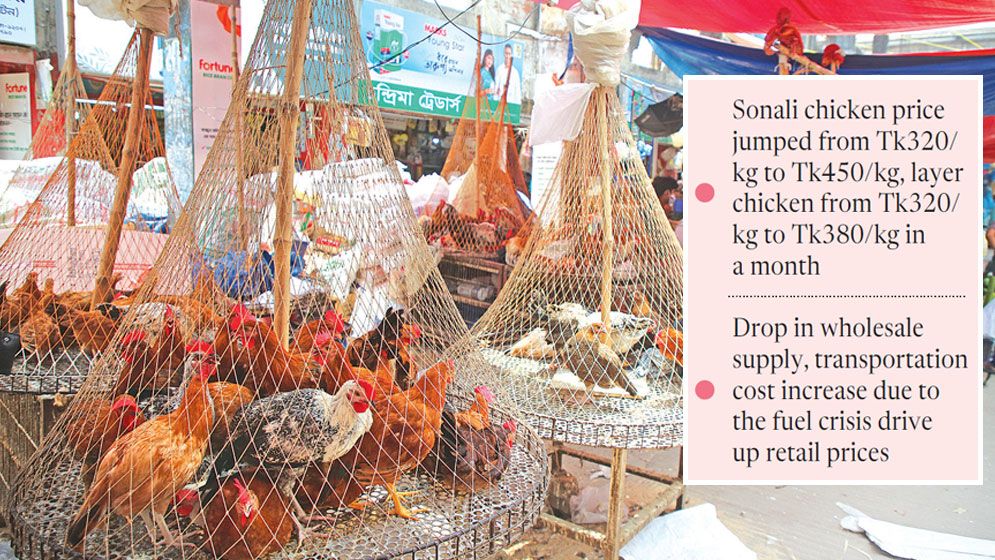
The price of Sonali chicken, a comparatively cheaper source of protein, has posted a Tk120-140 per kg hike, while the prices of other types of chicken have risen significantly, forcing lower- and middle-income people to substantially cut intake.
Traders claimed that the outbreak of bird flu and other diseases in various areas has hit Sonali chickens the hardest, which has affected the market. Besides, poultry farmers incurred losses for nearly four to five months before Eid, so they reduced the number of chicks they raised during that period, leading to lower production.
Visiting different kitchen markets in Mirpur on Friday, it was seen that Sonali chicken sold at Tk430-450 per kg, which was Tk320 per kg a month earlier.
However, according to the Department of Agriculture Marketing’s (DAM) data as of 9 April, The price of Sonali chicken increased from Tk330-360 to Tk400-440 over the last one month, a 21.74% increase. Its price increased by 58.49% in a year in the market.
Meanwhile, layer chicken sold at Tk380-400 per kg, which was Tk300-320 per kg a month earlier on Friday.
The price of broiler has increased to Tk200 per kg, while. The price of indigenous chicken, which earlier sold at Tk600 per kg, rose to Tk650 per kg on that day.
Farm eggs sold at Tk110 per dozen
Md Nasim, a poultry trader in Mirpur-10, said that the supply of chickens in the wholesale market has decreased, while transportation costs have also increased due to the fuel crisis.
Retailers are being forced to buy at higher prices and sell at higher rates. Due to the price hike, chicken sales in many shops have dropped to nearly half compared to before, he said.
Amit Mukherjee, a poultry businessman in Jashore, said, “Farmers have been incurring losses for a long time, so they reduced the number of chicks they raised recently, which led to lower production. Before Eid, farmers suffered losses for nearly four to five months at a stretch.
“Moreover, during the Eid seasons in 2024 and 2025, they marketed large numbers of chickens but did not get fair prices due to oversupply, which caused further losses. As a result, they did not raise many chickens this time, and production has not met demand resulting in abnormal price increases.”