



 For all latest news, follow the Daily Sun's Google News channel.


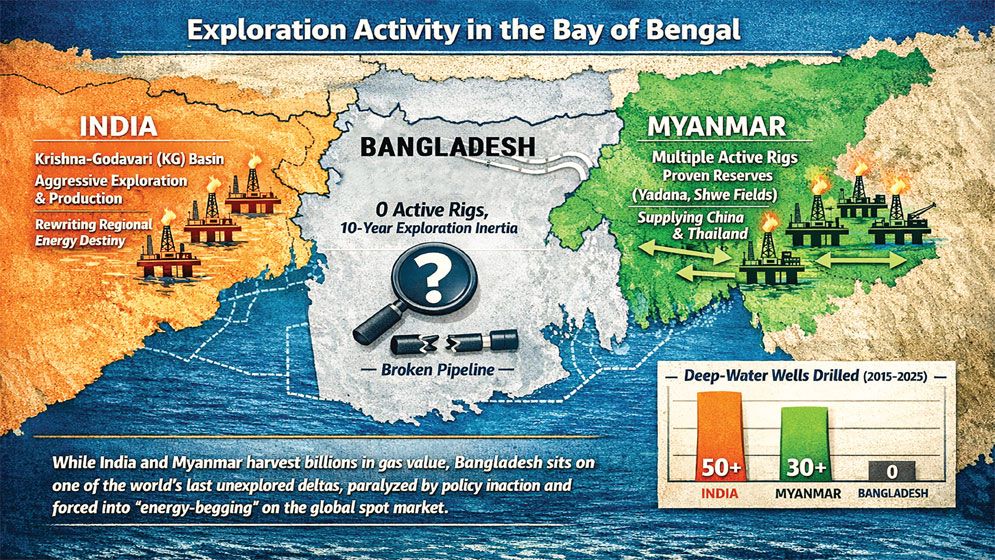
As the sun sets over the Bay of Bengal, the horizon remains a hauntingly empty expanse.
To the east, Myanmar’s offshore rigs flare with the steady rhythm of extraction, their gas flowing directly into Chinese and Thai markets. To the west, India’s Krishna-Godavari basin continues to rewrite the energy destiny of the subcontinent. Between these two hyper-active zones lies Bangladesh – a nation grappling by an energy crisis and a depleting foreign reserve, yet sitting atop what geoscientists describe as one of the world’s last great unexplored hydrocarbon deltas.
The irony is as stark as it is expensive. While the ongoing volatility in the Middle East has sent liquefied natural gas (LNG) spot prices spiraling, forcing Dhaka into a cycle of “energy-begging” on the global market, the solution to the nation’s existential threat remains buried under the seabed, untouched by a decade of policy inertia.
For a country that has historically prided itself on its “Blue Economy” potential, the silence in the Bay has become a deafening indictment of its energy strategy.
The high cost of procrastination
For over fifteen years, Bangladesh has basked in the legal glory of its maritime boundary victories against Myanmar and India.
The 2012 and 2014 ITLOS and Permanent Court of Arbitration rulings were heralded as a new dawn for the nation. Yet, legal sovereignty has not translated into energy security.
Since the settlement of those disputes, the country has seen a succession of failed bidding rounds and stalled seismic surveys, leading to a strategic tilt toward expensive imports that has drained foreign exchange reserves to critical levels.
The “LNG-first” strategy, once touted as a quick fix to satisfy the hunger of a booming industrial sector, has become a financial noose.
With the Strait of Hormuz currently a geopolitical flashpoint, the fragility of a supply chain stretching from Qatar to Maheshkhali is no longer a theoretical risk – it is a daily reality manifested in five-hour “load-shedding” cycles across the industrial belts of Gazipur and Narayanganj.
Addressing the long-standing delay in exploration, Petrobangla Chairman Md Arfanul Hoque, admits that the nation is essentially moving forward with eyes half-closed.
When asked about the ten-year delay in conducting a multi-client seismic survey, he conceded that no major new updates have been made.
“We don’t have much new information,” he told the Daily Sun, adding, “Investors will have to evaluate for themselves how effective the existing seismic data is. Those who bid will understand if this is helpful for them.”
This lack of fresh data is a significant point of contention for independent analysts. Energy specialist Prof Ijaz Hossain notes that while “failure” is a harsh word, political and policy uncertainty, particularly during past transitions, has left international oil companies (IOCs) uneasy.
“We must analyse the offers of countries like Guyana, Vietnam, or India,” Ijaz argues. “Incentives are crucial; terms must be set so that investors are not discouraged. In the past, especially during caretaker or interim periods, international companies did not feel comfortable investing in Bangladesh.”
The ‘Model PSC 2026’: A final throw of the dice?
In a belated attempt to break the deadlock, Petrobangla has recently pivoted toward the Model Production Sharing Contract (PSC) 2026.
This new framework – awaiting final approval from the ministry – seeks to address the rigid, capped pricing that drove investors away in 2019 by linking the price of extracted gas to Brent crude.
Under the final terms of the 2026 model, the gas price is set at 11% of the three-month average of Brent crude for deep-water blocks, while a rate of 10.5% has been established for shallow-water blocks.
Chairman Arfanul Hoque explains that the new model is built on lessons learned from past failures.
According to him, the 2026 model addresses specific concerns raised by IOCs in pre-bid meetings, including increasing the foreign company’s share in the production split and resolving disputes over subsea pipeline rentals.
Crucially, the mandatory 5% Workers’ Profit Participation Fund (WPPF) contribution, which had previously been a deal-breaker for American and European majors, has been slashed to 1.5% in new contract.
“We have tried to solve the concerns raised by companies that previously bought documents during pre-bid meetings,” Hoque stated.
However, a major structural hurdle remains: the mandatory involvement of the state-run explorer, Bapex.
While the Petrobangla chairman confirms that BAPEX is being strengthened – aiming for 14 wells a year with an expanded fleet of seven rigs – Prof Ijaz Hossain warns that mandatory partnership in deep-sea blocks is a deterrent.
“BAPEX’s capacity in the deep sea is extremely limited. If an international company wants to take them along voluntarily, that’s fine, but it shouldn’t be forced,” Ijaz asserts.
He believes that to lure “Big Oil,” the environment must be simplified by removing every possible barrier.
The subsidy nightmare: Tk36,000cr in four months
The fiscal desperation of the “import-first” model was laid bare in parliament on Friday.
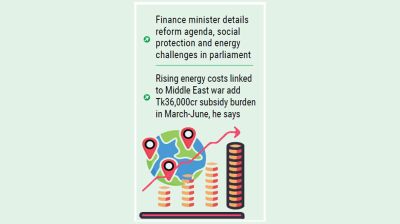
Finance Minister Amir Khosru Mahmud Chowdhury revealed that the additional import costs of fuel and LNG, exacerbated by the US-Israel-Iran conflict, would require a staggering Tk36,000 crore in subsidies between March and June alone.
He said international oil and LNG prices have more than doubled because of the war.
“This will increase budgetary pressure and require around $3 billion in additional import payments, affecting foreign exchange reserves,” he said.
Earlier, on 31 March, Power, Energy, and Mineral Resources Minister Iqbal Hassan Mahmood Tuku detailed the widening gap between retail prices and actual costs of fuel oils. While diesel is sold at Tk100 per litre, the actual cost hit Tk198 in March. Octane, sold at Tk120, actually costs the state Tk150.72.
“The government is shouldering a significant subsidy in public interest,” the minister noted, noting that Petrobangla alone may require Tk15,077 crore in LNG subsidies for the April-June quarter.
The LNG lobby vs. the drillbit
A common criticism in Dhaka’s power circles is that a powerful “LNG Lobby” has intentionally sidelined domestic exploration to protect lucrative import contracts and FSRU (Floating Storage and Regasification Unit) commissions.
Prof Ijaz Hossain, however, offers a more nuanced view.
While he acknowledges that such interest groups may exist, he argues that the current gas crisis is so severe that imports are a survival necessity rather than a choice.
“Our economy is virtually stagnant due to the gas shortage. In this situation, we must import as much LNG as possible to keep the economy moving,” Ijaz Hossain says.
However, he warns that this dependence is a “structural tax” that cannot be sustained. He points to Pakistan’s rapid solar expansion as a pragmatic lesson for Bangladesh.
Petrobangla’s Arfanul confirms this shift in infrastructure strategy. The government is now moving away from floating FSRUs toward land-based LNG terminals. “When the sea is rough, ship-to-ship transfer becomes difficult,” Hoque explained, noting that land-based solutions are more reliable. Yet, despite the staggering cost of these imports, he confirmed that “there is no specific instruction to reduce LNG imports at this moment.”
The seven-year shadow
Even if the 2026 bidding round proves a resounding success, the nation faces a sobering biological clock.
Deep-sea exploration is not a tap that can be turned on overnight. From the signing of a PSC to the first commercial flame entering the national grid, the lead time is typically seven to ten years.
“We are essentially paying the price for the decisions we didn’t make in 2016,” says one veteran geologist, adding, “By delaying the multi-client seismic survey for nearly a decade, we effectively blinded ourselves while our neighbours were striking gold.”
Despite this urgency, the state apparatus appears to be moving at a traditional pace.
When asked if the bidding process would be “fast-tracked” given the energy emergency, Petrobangla Chairman Arfanul Hoque clarified that no emergency measures have been taken. “The bidding will follow the normal process, usually open for six months or more. There are no specific instructions yet to speed it up,” he said.
( This is the first of a four-part investigative series by the Daily Sun exploring the structural fissures in Bangladesh’s power and energy sector. As the global energy crisis of 2026 hits home with unprecedented fiscal intensity, we move beyond the daily headlines of load-shedding to examine the policy inertia of the past and the existential threats to our industrial future. Over the coming days, we will deconstruct why the nation remains tethered to a high-cost import model and outline the urgent, self-reliant strategies required to break the “dollar-energy trap”. )