




 For all latest news, follow the Daily Sun's Google News channel.


From Hormuz to Dhaka: 800% acid price surge jolts battery market
Global supply shocks, soaring sulphur prices and local constraints trigger ripple effects across industries

By mid-morning, a small battery shop in Shahjadpur, Dhaka, had already seen a steady stream of frustrated customers.
Drivers arrived in search of replacement batteries. Homeowners asked for electrolyte water for their IPS units. Solar users looked for routine maintenance supplies. Most, however, left empty-handed.
What little stock remained was being sold at prices few could believe.
In some parts of the capital, the product has disappeared altogether.
Nurul Islam, proprietor of Sifat Tyre and Battery Shop in Shahjadpur, described the price surge as unprecedented.
“Just a year ago, a 30-litre jar cost Tk300 to Tk350. Before Ramadan, it rose to Tk550-600. Over the past month, it has jumped to Tk3,500,” he told Daily Sun.
He noted that car batteries typically require 2-3 litres of electrolyte water, while buses and trucks can need up to 20 litres, significantly raising maintenance costs for transport operators.
A similar picture has emerged across other parts of the capital.
Mohsin Gazi, proprietor of Gazi Trading in Merul Badda, said electrolyte water has nearly vanished from the market, while prices have increased almost sevenfold in just 15 days.
A crisis rooted far beyond borders
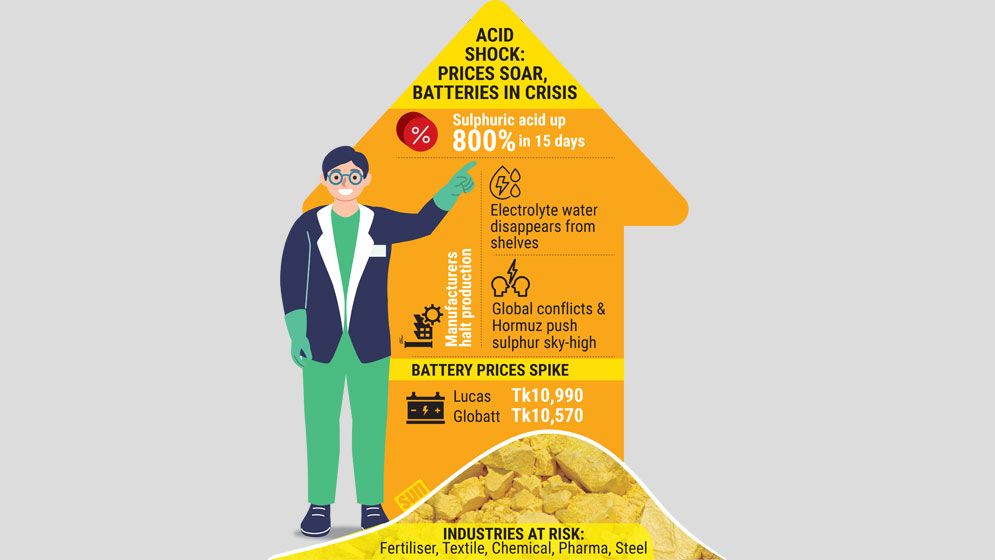
At the centre of the disruption lies sulphuric acid – a critical industrial chemical – whose retail price has surged from Tk1,500 per gallon to Tk12,000, marking an extraordinary spike within just two weeks.
The shock is now rippling through Bangladesh’s battery market, transport sector, fertiliser supply chain, and wider manufacturing industries, exposing vulnerabilities to global geopolitical tensions and fragile trade routes.
Industry insiders point to escalating conflict involving Iran, the United States and Israel, alongside the prolonged Russia-Ukraine war, as key drivers behind the disruption in global sulphur supply.
Sulphur, the primary raw material used to produce sulphuric acid, is largely sourced as a by-product of oil refining in the Middle East. With refinery operations disrupted and shipping routes increasingly uncertain, global supply chains have come under severe strain.
Particular concern surrounds the Strait of Hormuz, one of the world’s most critical maritime chokepoints. Nearly half of global seaborne sulphur trade typically passes through this route.
Now, delays, rising insurance costs and security risks have driven international prices sharply higher.
Local producers say import prices have surged from around US$550 per tonne to $1,800, an increase that has rapidly fed into Bangladesh’s domestic market.
Production halts as costs spiral
The price shock has already forced some local manufacturers to suspend operations.
At As-Salam Chemicals in Ashulia, a major producer and wholesaler of electrolyte water, production has remained halted for the past 15 days.
Managing Director Mohammad Sajerul Islam said the company can no longer absorb the soaring input costs.
“Before the crisis, sulphuric acid cost Tk20-Tk21 per kilogram. Now it has risen to Tk215,” he said.
“Earlier, we could buy 10,000 kilograms for around Tk2 lakh. Now it requires Tk20 lakh to Tk22 lakh. It is beyond our capacity.”
Previously, the company produced around 300 gallons every two days. Now, the factory floor remains silent.
Supply constraints and market tensions
Market traders allege that local supply disruptions have compounded the crisis.
They claim that TSP Complex Limited, a state-owned fertiliser producer and the country’s largest sulphuric acid manufacturer, has not been supplying the chemical to the market for the past three months.
According to traders, the company typically prioritises superphosphate fertiliser production during the Boro season, limiting availability for other uses.
Bangladesh currently has five sulphuric acid producers – Wata Chemicals, Crescent Chemicals, Salvo Chemicals Limited, AA Rashayan Shilpa Ltd, and TSP Complex Limited.
Data submitted to the National Board of Revenue (NBR) on 31 March by the Bangladesh Sulphuric Acid Manufacturers Association shows daily demand at around 500 tonnes, against a production capacity of roughly 1,050 tonnes.
Of this, TSP Complex accounts for 500 tonnes per day, followed by Crescent Chemicals (250 tonnes), Wata Chemicals (180 tonnes), and both Salvo Chemicals and AA Rashayan (60 tonnes each).
Raw material crunch deepens uncertainty
TSP Complex itself is struggling to secure sulphur from international markets amid rising global prices.
On 3 April, the company issued a tender seeking 2,500 tonnes of sulphur, an essential input for fertiliser production.
Kazi Joynal Abedin, manager (Commercial), said the company had failed in two previous attempts to procure sulphur internationally after its last purchase in 2024. “We have now floated another tender to source it locally,” he said, declining to comment on potential risks to fertiliser production if procurement efforts fail again.
Consumers and businesses feel the pressure
The impact is now being felt across households, transport operators and businesses dependent on lead-acid batteries – widely used in vehicles, generators, IPS systems, solar installations and auto-rickshaws.
Dealers across Dhaka report rising prices.
A salesperson at Sobuj Motors in Arambagh said battery prices have increased by Tk1,000 to Tk1,500 across categories.
For instance, a Lucas battery now sells for Tk10,990, up from Tk9,985, while a Globatt battery costs Tk10,570, compared to Tk9,510 earlier.
Mohsin Gazi, who deals in HAMKO batteries, said prices have risen steadily over the past two weeks.
Mahfuzur Rahman Russel, chief business officer (Battery & Fastener) at Walton, said the company has been unable to source sulphuric acid from the local market.
“It has suddenly disappeared. We suspect there may be a syndicate at work,” he said, adding that production costs have risen sharply.
Although Walton has not yet increased prices, he warned that continued cost pressure could make a price hike unavoidable.
Allegations and denials
As shortages intensify, allegations of artificial supply constraints have surfaced.
In Old Dhaka’s Armanitola, long a hub for chemical wholesalers, traders claim some producers may be restricting supply.
The Bangladesh Chemical and Perfumery Merchant Association has formally urged government intervention, sending letters to the home ministry, commerce ministry and the deputy commissioner.
Its President, Shariful Islam, alleged that a producer syndicate could be driving up prices.
Producers, however, strongly deny the claims.
AHM Abdullah, director of Wata Chemicals Limited, said the crisis is purely a result of global market disruptions.
“This is a raw material shock driven by war and shipping uncertainty. International sulphur prices have surged,” he said.
A widening industrial risk
The implications extend far beyond the battery sector.
Sulphuric acid is a critical input across industries, including fertiliser production, textile processing, chemical manufacturing, pharmaceuticals and steel treatment.
Industry leaders warn that prolonged shortages could trigger factory slowdowns or temporary shutdowns, further straining an economy already under inflationary pressure.
If disruptions persist, the effects could ripple into agriculture, manufacturing output and overall industrial costs, amplifying the challenges facing businesses and consumers alike.
Govt allows sulphuric acid imports
Meanwhile, the Ministry of Commerce has formally permitted sulphuric acid imports to mitigate supply volatility and ensure long-term equilibrium within the domestic industrial market.
The permission came following the urgent appeals from the private sector stakeholders. The policy adjustment follows extensive consultations with industrial entrepreneurs, whose formal petitions underscored a looming deficit in the local market, said a press release on Tuesday.
By facilitating the imports, the government aims to suppress inflationary pressures and provide manufacturers with the predictability required for uninterrupted operations. Recommended Stories