


 For all latest news, follow the Daily Sun's Google News channel.


LDC graduation in doubt as UN cites gaps, govt seeks postponement
Daily Sun Report, Dhaka
Published: 06 Apr 2026, 12:00 AM
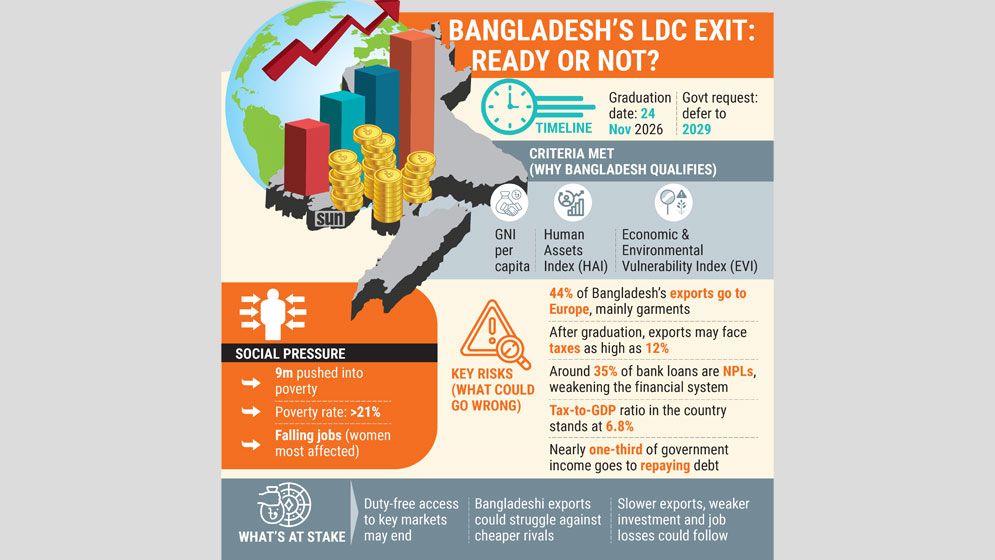
A United Nations assessment has found Bangladesh’s readiness to graduate from the Least Developed Countries (LDC) category remains weak despite meeting all formal criteria, as the government itself signals moving to defer the transition, citing mounting economic and structural pressures.
The Graduation Readiness Assessment, prepared by an expert panel under the UN Office of the High Representative for Least Developed Countries, Landlocked Developing Countries and Small Island Developing States, warns that while Bangladesh has crossed the thresholds for gross national income (GNI) per capita, the Human Assets Index (HAI), and the Economic and Environmental Vulnerability Index (EVI), significant risks persist.
Bangladesh is scheduled to graduate on 24 November 2026 following a five-year preparatory period approved by the United Nations General Assembly, though concerns are growing over its actual preparedness.
Export risks and financial fragility
The assessment identifies continued access to the European Union market as the most critical vulnerability. The EU currently accounts for around 44% of Bangladesh’s exports, largely driven by ready-made garments.
Under post-graduation arrangements, even if Bangladesh qualifies for GSP+, safeguard measures could impose tariffs averaging 12% on apparel exports, placing the country at a disadvantage compared with competitors such as Vietnam and India.
The report also highlights serious weaknesses in the banking sector. Non-performing loans reached around 35% of total credit by September 2025 – among the highest globally – limiting the sector’s ability to support investment during a crucial transition period.
Fiscal pressures are intensifying in parallel. Government revenue has dropped to just 6.8% of GDP, while debt servicing consumes about 31% of revenue.
Both the International Monetary Fund and the World Bank have raised Bangladesh’s debt distress risk to “moderate”.
Structural bottlenecks and social strain
Structural competitiveness challenges further complicate the outlook. Logistics costs remain high at around 16% of GDP, while port congestion, customs inefficiencies and energy shortages continue to drive up production costs.
The report also flags weak implementation capacity, noting that progress on the government’s transition strategy has been slow due to administrative strain and coordination gaps.
Social pressures are also mounting. Rising inflation has pushed an estimated 9 million people into poverty, with the poverty rate exceeding 21% in 2025. Employment has declined, particularly among women, reflecting a fragile labour market.
Govt seeks deferment, experts urge caution
Reflecting these concerns, the government has formally applied to the United Nations Committee for Development Policy for a three-year deferment of the graduation timeline to 2029.
Finance and Planning Minister Amir Khosru Mahmud Chowdhury said on Sunday that the country is not yet fully prepared.
“Given the current economic realities, we are not fully prepared yet,” he said, citing rising external debt, growing domestic liabilities and reliance on high-interest borrowing, alongside gaps in financial management and institutional capacity.
Commerce Minister Khandaker Abdul Muktadir stressed the need to strengthen debt management and expand the tax base, noting that internal resource mobilisation will be critical for sustaining development.
Economists, however, warn that securing a delay may not be straightforward. Zahid Hossain, a former World Bank lead economist, said Bangladesh has long acknowledged its weak readiness.
“The issue of weak readiness has existed since 2018… it is uncertain whether it will help in securing a favourable LDC deal,” he said, adding that global dynamics and the positions of other graduating countries could complicate the request.
While a deferment may offer temporary relief, he argued that the priority should be preparing for post-graduation challenges, particularly the loss of duty-free export benefits.
The UN report similarly underscores the urgency of reforms, warning that without swift policy action, Bangladesh’s transition risks undermining, rather than consolidating, its development gains.