


 For all latest news, follow the Daily Sun's Google News channel.


War-driven cargo surge squeezes vegetable exporters
Biman flight suspensions and higher freight costs erode competitiveness against regional rivals

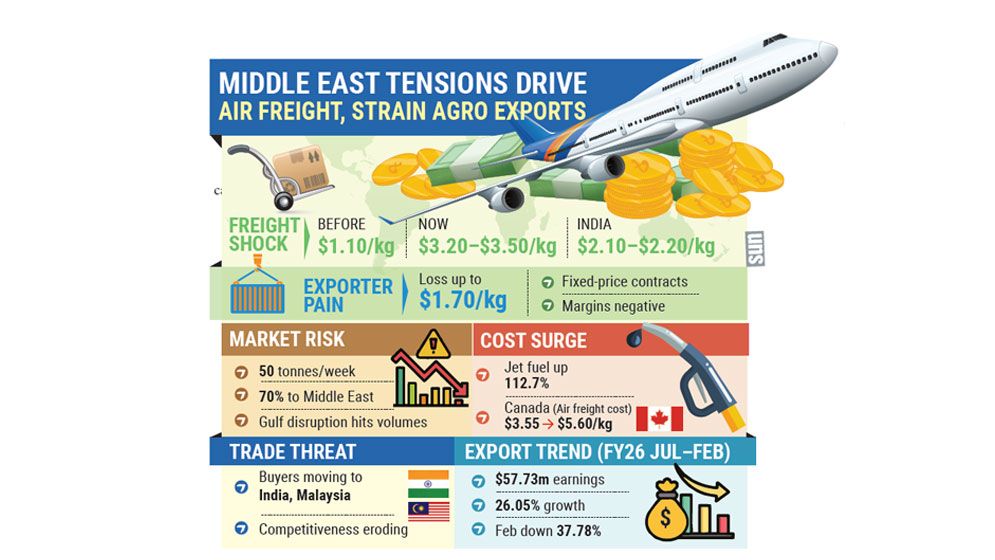
A sharp surge in air cargo fares following the outbreak of the Israel-US war on Iran has put Bangladeshi vegetable exporters under severe pressure, forcing many to incur losses and risking a shift of buyers to regional competitors such as India and Malaysia.
Industry stakeholders said Bangladeshi exporters largely rely on Biman Bangladesh Airlines to ship vegetables to key destinations including Dubai, Qatar, and Saudi Arabia. However, the national carrier has suspended flights to these routes amid the conflict.
While Biman has halted operations, other carriers – such as Air Arabia, flydubai, and Saudia – continue to operate limited flights to Middle Eastern destinations. Bangladeshi private carrier US-Bangla Airlines has also been running passenger flights on an ad hoc basis.
Saiful Hossain, proprietor of Farhin International, said that although some airlines are still operating, they have sharply increased cargo fares.
He said freight rates, which were around US$1.10 per kg before the conflict, have surged to between $3.20 and $3.50 per kg. In contrast, exporters from Kolkata, India, are still shipping at comparatively lower rates of $2.10 to $2.20 per kg.
Exporters noted that they typically sign year-long contracts, from January to December, with buyers at fixed prices. As a result, they are unable to adjust prices despite the spike in transport costs, forcing them to absorb losses.
Saiful said he had agreed to sell pointed gourd at $2.20 per kg for the year, but with export costs rising to $3.90 per kg, he is now incurring a loss of $1.70 per kg.
“Now I pray every day not to receive any work order. If I do, I have to bear the loss,” he said.
Bangladesh exports around 50 tonnes of vegetables weekly to various countries, with nearly 70% destined for the Middle East.
The situation has been further exacerbated by a steep increase in jet fuel prices.
In March, Bangladesh Petroleum Corporation raised jet fuel prices by 112.7%, prompting airlines, including Biman, to hike cargo fares on international routes.
Exporters said cargo rates on Biman flights to Canada, for instance, have increased from $3.55 to $5.60 per kg.
Kuwait has emerged as another challenging market. Exporters said airlines such as Jazeera Airways, Biman, and Kuwait Airways previously operated flights between Dhaka and Kuwait, but have suspended services due to the conflict. As a result, Kuwaiti buyers are unable to place orders with Bangladeshi exporters.
Meanwhile, Jazeera Airways continues to operate cargo flights from Kolkata to Kuwait, prompting Kuwaiti buyers to shift orders to Indian suppliers.
Mobasserur Rahman, senior vice president of the Bangladesh Fruits, Vegetables and Allied Products Exporters’ Association, said around 90% of Bangladesh’s exported vegetables are also produced by competitors like India and Malaysia.
“As a result, if we fail to deliver, buyers can easily switch to other suppliers, leading to a loss of market share,” he said.
He added that Bangladeshi exporters are already losing competitiveness, as exporters from India and Malaysia are offering products at relatively lower prices since the outbreak of the war. According to Export Promotion Bureau (EPB) data for the fiscal 2025-26, Bangladesh’s vegetable exports have recorded strong year-on-year growth. The sector earned just over $81 million in the previous fiscal year.
During the July-February period of FY26, exports reached $57.73 million, up from $45.8 million in the corresponding period a year earlier, an increase of 26.05%.
However, the momentum slowed in February, when export earnings declined by 37.78% year-on-year to $5.55 million.