





 For all latest news, follow the Daily Sun's Google News channel.


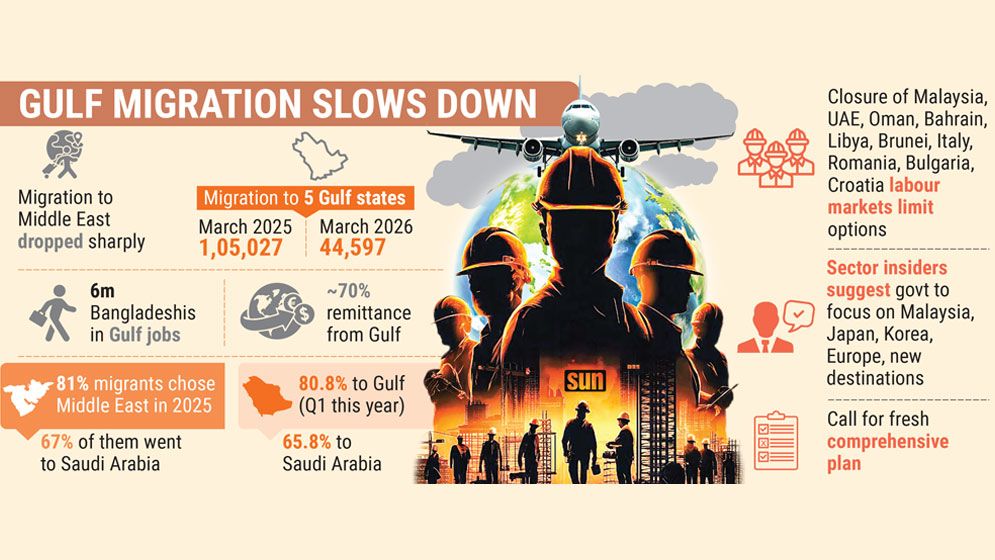
Overdependence on Middle Eastern labour markets is casting a long shadow over Bangladesh’s economic outlook as the war involving the United States, Israel and Iran continues beyond a month, raising fresh fears about job security and remittance flows for millions of migrant workers.
With around six million Bangladeshis employed across the oil-rich Gulf and nearly 70% of remittance income tied to the region, disruptions to air travel, security threats, company closures and shrinking work opportunities are already slowing recruitment and stranding workers abroad.
According to the Bureau of Manpower, Employment and Training (BMET), Bangladesh sent 105,027 workers to five Middle Eastern countries – Saudi Arabia, Qatar, Kuwait, Jordan and Lebanon – in March last year. The number dropped sharply to 44,597 in March this year.
Migration experts and sector insiders warn that if the conflict persists, the impact could hit both household incomes and the broader labour market. They say the situation exposes the risks of relying heavily on a single region, particularly a few countries, for overseas employment and foreign exchange.
Fakhrul Islam, former joint secretary general of the Bangladesh Association of International Recruiting Agencies (BAIRA), said Bangladesh’s labour market would face serious risks if the conflict continues.
“Those who are currently in those countries are living in fear and anxiety. It remains to be seen how long the war will last. If it continues, many may lose jobs and opportunities for new workers will decline. This will also deal a significant blow to remittances,” he told the Daily Sun.
Migration to Gulf countries reducing alarmingly
Uncertainty over safety and jobs is discouraging workers from migrating to the Middle East. Six Bangladeshis have reportedly been killed and around a hundred injured amid the conflict.
Employers in Gulf countries are also slowing recruitment due to disrupted air travel, security risks and business closures. As a result, migration has fallen at an alarming rate since the attacks on Iran began on 28 February.
BMET data show that the five countries – Saudi Arabia, Qatar, Kuwait, Jordan and Lebanon – received 105,027 Bangladeshi workers in March last year. The figure fell to 44,597 in March this year.
Saudi Arabia received 80,702 workers in March 2025, but the number dropped to 44,597 this year. Migration to Qatar declined to 3,973 from 9,063. Kuwait fell to 1,538 from 2,437. Jordan declined to 989 from 1,140, while Lebanon received only 30 workers compared to 662 a year earlier.
Middle East dependency continues, making future vulnerable
Despite the risks, Bangladesh’s labour market remains heavily dependent on the Gulf. BMET data show that among the top five destinations last year, three were in the region, accounting for 81% of total overseas employment.
In 2025, a total of 1,131,144 workers went abroad. Of them, 754,654 went to Saudi Arabia, or about 67% of the total. Qatar accounted for 107,600 workers, or 10%. Kuwait received 42,735 workers, or 4%.
The United Arab Emirates and Jordan ranked sixth and seventh among the top destinations, receiving 13,754 and 12,301 workers respectively.
The pattern continues this year. In the first three months, 203,610 workers went abroad. Of them, 133,869 or 65.75% went to Saudi Arabia. Qatar received 13,682 workers, Kuwait 5,966, Jordan 4,558, the UAE 3,607 and Iraq 2,869.
This means six of the top 10 destinations are in the Middle East, and 80.79% of migrant workers chose Gulf countries.
Citing BMET data, the Refugee and Migratory Movements Research Unit (RMMRU) said that although Bangladeshi workers migrated to 141 countries last year, nearly 90% went to just five destinations. Only one worker went to 13 countries, while 2 to 10 workers migrated to 34 countries. Of them, 8% went to 14 countries, and only 2% went to 123 countries.
RMMRU observed that countries receiving fewer than 100 workers should not be considered meaningful destinations.
State Minister for Expatriates’ Welfare and Overseas Employment Nurul Haque Nur, however, said the labour market may not face significant long-term impact.
He said reconstruction work after the war could create new opportunities. “There may be temporary disruptions. But once the war ends, demand for workers may increase for rebuilding infrastructure,” he said.
Experts call for diversification
Experts say Bangladesh must reduce its dependence on the Middle East and diversify labour markets to protect remittance earnings.
Fakhrul Islam said the government should explore opportunities in Malaysia, Japan, South Korea and Europe. “If one region becomes vulnerable, it should not affect the entire labour market.”
Ovibashi Karmi Unnayan Program (OKUP) Chairperson Shakirul Islam said Bangladesh failed to expand into new markets. “Many markets such as Malaysia, the UAE, Italy, Romania, Bulgaria, Oman, Croatia, Bahrain, Iraq and Egypt have shrunk, while new opportunities are limited to problematic destinations like Cambodia and Kyrgyzstan.”
He added that weak focus on skill development is a major barrier. “We are not investing enough in skills and language training. Without that, we cannot access new markets.”
Shakirul also said the government needed long-term planning and better execution. “Officials make plans and visit countries, but results are limited. They must understand the demand of different markets,” he said.
He then said, “Our research with a Dutch university shows that 74% of positions in the SME sector are vacant, and the caregiving sector needs at least 1.6 million workers.”
Analysts say without urgent action on diversification and skill development, Bangladesh’s heavy reliance on the Gulf will continue to expose its labour market and remittance earnings to external shocks.
The reporter can be reached at: [email protected]