


 For all latest news, follow the Daily Sun's Google News channel.


Shadow market strangles local shaving industry
Smuggled razors and blades flood market, eroding domestic industry and cutting government revenue

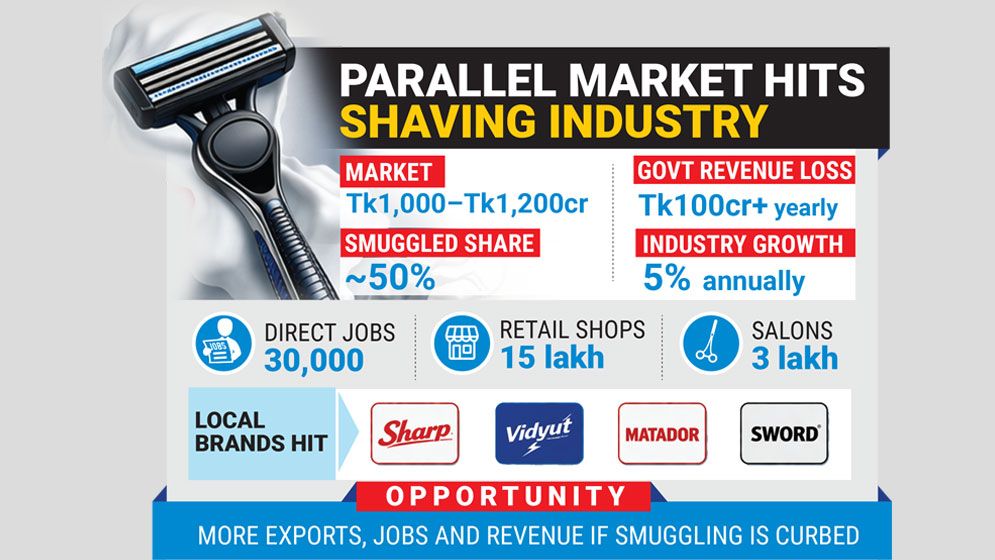
The shaving industry is emerging as a growing sector driven by strong domestic demand and manufacturing potential, but a surge in smuggled products is increasingly undermining local producers.
Industry insiders say illegal imports of low-cost razors, blades, shaving creams, foams, aftershaves, and electric grooming devices have created an uneven playing field, eroding the sector’s growth prospects.
Local manufacturers -- who legally import raw materials, pay duties and VAT, and generate thousands of jobs -- are facing mounting pressure due to the illicit trade.
Entrepreneurs estimate the domestic shaving products market at Tk1,000-1,200 crore, with nearly half reportedly dominated by smuggled goods.
The sector has recently recorded annual growth of around 5%, driven largely by population growth and rising grooming awareness.
Local brands such as Sharp, Vidyut, Matador, and state-owned Sword are currently meeting much of the domestic demand.
The industry directly employs around 30,000 people, while an estimated 15 lakh cosmetics shops and three lakh salons operate nationwide.
According to a Bangladesh Trade and Tariff Commission (BTTC) study, the country’s broader cosmetics market is valued at around Tk34,000 crore.
While a significant share of demand is driven by domestic consumers, much of it is still met by foreign brands.
Despite challenges such as price competition, limited innovation, and weak branding, industry stakeholders believe the sector holds strong potential through technological upgrades, digital transformation, and product diversification.
They say with proper policy support and investment, Bangladesh could position itself as a regional hub for affordable grooming products, including razor and blade manufacturing.
Revenue losses mount
Industry insiders claim the government is losing over Tk100 crore annually due to the smuggling of shaving and grooming products.
Cosmetics and shaving items are subject to high supplementary duties and VAT, but smuggled goods enter the market without paying taxes.
Legitimate importers, who pay duties ranging from 25% to over 100%, struggle to compete with cheaper illegal products, leading to declining formal business activity and an estimated additional Tk20 crore in lost revenue.
Jahangir Alam, managing director of Matador Shaving Industries Ltd, said the sector is under serious threat from cross-border smuggling.
“A large volume of blades is entering Bangladesh through land borders from India. Despite the absence of legal import channels for over a year, organised syndicates continue to flood the market with illegal Gillette blades,” he told Daily Sun.
He added that the situation worsened after multinational firm Procter & Gamble (P&G) terminated its Gillette India distribution agreement in Bangladesh on 31 December 2024.
Industry leaders say the resulting gap in legal supply has been exploited by smuggling networks, saturating both wholesale and retail markets and undermining compliant domestic manufacturers.
Call for stronger enforcement
Experts and industry stakeholders stress that curbing smuggling could significantly boost government revenue through proper collection of duties, VAT, and taxes.
They also note that stronger enforcement would enable authorities such as the Directorate General of Drug Administration and the Bangladesh Standards and Testing Institution to better regulate product quality in the market.In addition, a level playing field would encourage local firms to invest in new technology and expand production, creating more employment opportunities.
Prof Syed Ahsanul Alam, chairman of the National Bureau of Economic Research Bangladesh (NBER), said stronger policy support is essential to protect the sector.
“Necessary steps must be taken to stop smuggling. Otherwise, domestic entrepreneurs will be discouraged from investing, despite the sector’s strong potential,” he said.
Export potential at stake
Industry players say Bangladesh could tap into export markets for shaving and grooming products if the sector receives adequate policy support.
They warn that many smuggled items are counterfeit or substandard, posing risks such as skin diseases and other health complications. Ensuring market regulation would help protect consumers and improve product standards.
To boost exports and earn foreign currency, businesses are calling for incentives for export-oriented production and stricter measures against counterfeit goods.
Experts also recommend investing in research and development to produce skin-friendly, anti-irritation products, adopting international quality standards, strengthening branding and marketing, improving supply chains, and promoting sustainable practices such as recyclable materials and eco-friendly packaging.
They further stress the need to build a stronger local manufacturing ecosystem to support innovation and long-term industry growth.