





 For all latest news, follow the Daily Sun's Google News channel.


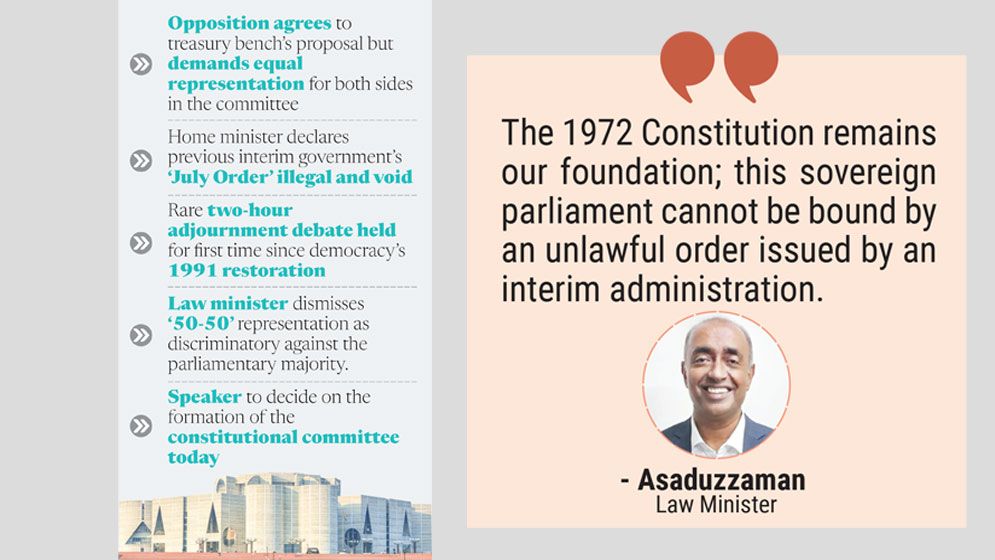
A significant shift in the implementation of the “July National Charter 2025” emerged in the Jatiya Sangsad on Tuesday, as the treasury bench proposed a new legislative mechanism to navigate the country’s post-uprising constitutional transition.
While the government has moved to form a special parliamentary committee to steer amendments, the move has immediately hit a snag over the composition of the body, with the opposition demanding representation on an “equity basis”.
The proposal was tabled by Home Minister Salahuddin Ahmed on behalf of the government and the Leader of the House Prime Minister Tarique Rahman.
The announcement came during a rare and spirited two-hour discussion on an adjournment motion, a procedural rarity that saw the House suspend its scheduled business, including the traditional discussion on the motion of thanks for the President’s address, to tackle the constitutional deadlock.
Presiding over the first session of the 13th Parliament, Speaker Major (retd) Hafiz Uddin Ahmed noted that the decision on the Home Minister’s proposal would be finalised today.
However, the debate leading up to this point laid bare the deep-seated divisions between the ruling alliance and the opposition over how to codify the reforms demanded by the 2024 mass uprising.
A rare parliamentary moment
The discussion was triggered by an adjournment motion placed by the Leader of the Opposition and Ameer of Bangladesh Jamaat-e-Islami Dr Shafiqur Rahman under Rule 62 of the Rules of Procedure.
Such motions, which seek to set aside the day’s agenda to discuss a matter of “urgent public importance,” have been seldom permitted by speakers since the restoration of parliamentary democracy in 1991.
Shafiqur Rahman’s motion focused on the “July National Charter (Constitution Reform) Implementation Order, 2025”, arguing that the government had failed to meet the statutory deadlines for convening the Constitutional Reform Council.
According to the Order, the Council’s inaugural session was required to take place within 30 calendar days of the declaration of election results – a milestone that has already passed without action.
The debate saw a flurry of contributions from both sides.
Opposition MPs, including Akhter Hossen (Rangpur-4), Hasnat Abdullah (Cumilla-4), and several high-ranking Jamaat members such as Saiful Alam Khan Milon and Barrister Nazibur Rahman Momen, pressed for the immediate activation of the Council.
Conversely, the Treasury bench, represented by Salahuddin Ahmed, Law Minister Asaduzzaman, and Barrister Andaleeve Rahman Partho (Bhola-1), argued that the process must remain within the bounds of existing constitutional law.
The legitimacy of the ‘July Order’
At the heart of the dispute is the legal status of the Implementation Order issued by the previous interim administration.
Home Minister Salahuddin Ahmed pulled no punches, describing the document as a “document of national fraud” and declaring it “void ab initio” – legally null from its inception.
“The President has had no constitutional authority to issue such an order since 1973,” the home minister asserted. He argued that while the President can issue ordinances under Article 93, he possesses no power to repeal or alter the Constitution itself.
“This order attempted to undermine the sovereign authority of this parliament, which is unprecedented anywhere in the world.”
Salahuddin also took aim at the Chief Election Commissioner (CEC) for distributing forms to MPs to take an oath as members of the Reform Council.
He contended that since MPs had already taken their oaths under Article 148 and the Third Schedule of the Constitution, a second oath to a ‘Council’ had no legal basis.
“By sending these forms to Parliament, the CEC violated the Constitution and breached his own oath,” he said.
Responding to the Opposition’s claim that the 12 February referendum gave the Charter a popular mandate, the home minister suggested the ballot was deceptive. He claimed that while the government supported the idea of a public mandate, the structure of the referendum was designed to mislead.
“A controversial order was pushed alongside three legitimate questions, akin to hiding a pill inside a quinine tablet,” he remarked.
The ‘unique situation’ of the 13th Parliament
Barrister Andaleeve Rahman Partho offered a nuanced take, describing the current legislative environment as a “unique situation.”
He argued that if the spirit of the 2024 uprising is to be upheld, the nation must look beyond partisan blocs.
“We have no problem with the July Charter; our problem is with the process,” Partho stated. He challenged the Opposition’s logic regarding the transition of power.
“Why didn’t you form a revolutionary government at that time? You could have formed a transitional revolutionary government, rewritten the constitution, even torn it up. But now, staying within the old constitution, you are trying to nullify it – this doesn’t work.”
Law Minister Asaduzzaman echoed these sentiments, labelling the July Order as “colorable legislation” – a legal term for a law that appears to be within a government’s power but is actually designed to achieve something it has no authority to do.
He pointed out that despite the Opposition’s rhetoric against the 1972 Constitution, they had all taken their seats and oaths under its very framework.
“Article 12 of the July Order itself mentions incorporating the July Charter into the Constitution. This means the 1972 Constitution remains the foundation, and all amendments must be made within its framework,” the law minister explained.
He also highlighted what he saw as the Opposition’s selective adherence to the Charter, noting that while the Charter calls for 5% women candidates, the Opposition benches did not nominate a single female candidate in the last election.
The demand for equity
When Dr Shafiqur Rahman returned to the floor, he shifted the focus to the practicalities of the proposed special committee.
While agreeing that a committee could be a viable “way-out,” he was adamant that it must not be a mere rubber stamp for the majority.
“If the government considers it appropriate, a committee can be formed. However, I urge that it include an equal number of members from both sides so that they can present their views properly,” Shafiqur Rahman said.
He warned that a committee based on simple majority representation would only lead to further deadlock. “In that case, nothing will change, and no meaningful outcome will be achieved.”
The Jamaat ameer called on the government to respect the “broader mandate” of the people, insisting that the referendum result was a clear instruction from the electorate.
He struck a philosophical note on the nature of the House: “The constitution and the parliament are permanent institutions... In independent Bangladesh, some parties used to sit on one side, now they are nowhere; sometimes they sat here, sometimes there. This is the beauty of democracy.”
He also reminded the treasury bench that many actions taken during the recent period of upheaval were technically outside the strict letter of the constitution, yet were accepted by all parties because they were deemed “necessary for the country and the people.”
A historical milestone?
The Law Minister remained firm on the issue of representation, describing the demand for a “50-50” split as inherently discriminatory.
He argued it would be unfair for the 77 MPs of the Jamaat-led alliance to have the same weight as the 219 MPs of the treasury bench.
Instead, he suggested that the special committee should conduct a “detailed analysis” to bring forward an amendment that aligns with the July Charter while remaining legally sound.
“This amendment would become a milestone in our history,” the law minister concluded.