



 For all latest news, follow the Daily Sun's Google News channel.


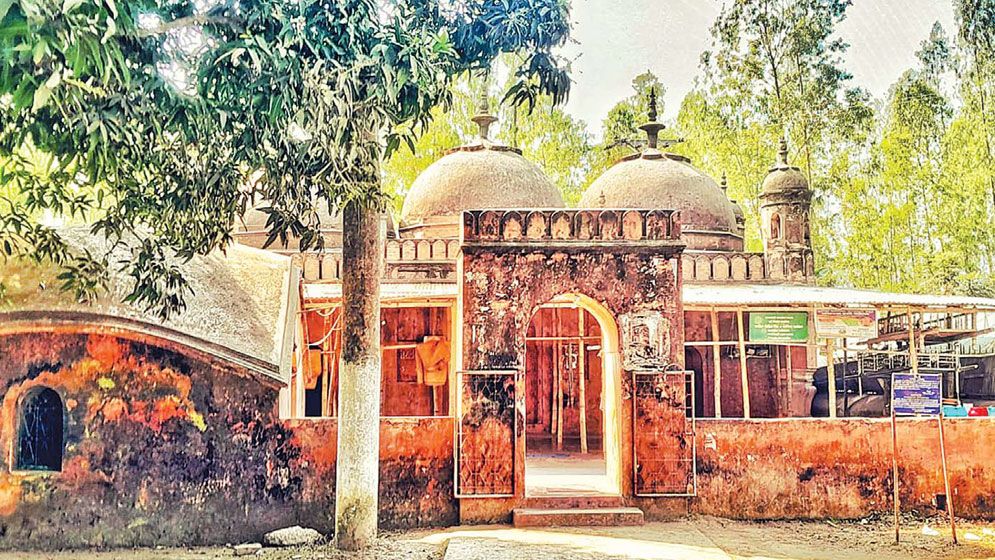
Locals have called for urgent renovation of the historic Nidaria Mosque in Lalmonirhat, an ancient structure believed to have been built in 1176 Hijri during the Mughal era.
The three-domed mosque, located in the Nayarhat area of Panchagram Union under Lalmonirhat Sadar upazila, is now in a fragile condition as its roof has developed cracks and parts of the structure have weakened over time.
According to local accounts, the mosque was established by a subedar named Manshur Khan, who lived in the area during that period. Elders say he had no beard, which caused him embarrassment in society. It is believed that he vowed to build a mosque if Allah granted his wish of growing a beard.
Local elderly resident Kafil Uddin said that after making the vow, Manshur Khan reportedly grew three strands of beard, which he believed was a blessing from Allah. In fulfilment of his vow, he built a mosque with three domes in 1176 Hijri, symbolising the three strands of beard.
The mosque later became known as Nidaria Mosque, a name derived from a Persian word referring to the absence of a beard. However, documentary historical evidence regarding the origin of the name is limited.
Ansar Ali, the mosque’s muezzin, said the story has been passed down through generations. “We have heard this story from our elders and it remains widely known in the area,” he said.
Local resident Qaiser Ali said the mosque is in urgent need of renovation. “The mosque is very old. The roof has cracks and the structure has become weak. However, renovation cannot be carried out without permission from the Department of Archaeology,” he said.
He also alleged that part of the mosque’s land has been encroached upon, which has created additional complications.
Another resident, Mokhtar Ali, said he had heard from his grandfather that the mosque existed long before his grandfather’s time.
“The mosque is gradually deteriorating due to natural calamities and the passage of time.
There have been talks about renovation many times, but no effective steps have been taken,” he said.
The mosque is a single-room structure measuring about 42 feet in length and 16 feet in width. It has three domes on top and four pillars at the corners. There is a main entrance at the front and a small adjoining room on the left side, which is believed to have been used as a storeroom or residence for the imam.
A large Eidgah field lies in front of the mosque, while a graveyard is located at the north-eastern corner of the premises. A Hafiziya madrasa was also established near the mosque in 2019.
Local sources said around 10 acres and 56 decimals of land had been donated in the name of the mosque in the past. Income from this land is used to organise annual religious gatherings, including Waz Mahfils. However, a portion of the land remains under dispute and a case related to the property is still pending in court.
Ninety-year-old local resident Manchur Ali urged the authorities to take effective steps to renovate the mosque and resolve the land-related issues.
According to another local resident, Khyber Ali, the Nidaria Mosque was declared an ancient monument by the Department of Archaeology and Museums in 1994, when a signboard was installed recognising its historical importance.
He said the mosque has not received proper development initiatives due to the ongoing land dispute and its status as a protected heritage structure.
The mosque is situated at Kishamat Nagarband Mauza in Panchagram Union, about two kilometres south of Barabari Bus Stand on the Rangpur–Kurigram highway. It is listed as an archaeological heritage site by the Directorate of Archaeology.
Devout Muslims from different parts of the country visit the mosque to offer prayers and seek blessings.
Lalmonirhat Deputy Commissioner HM Raqib Haider said the mosque is under the supervision of the Department of Archaeology.
“Necessary steps will be taken to renovate the historic Nidaria Mosque and resolve the existing problems,” he said.