




 For all latest news, follow the Daily Sun's Google News channel.


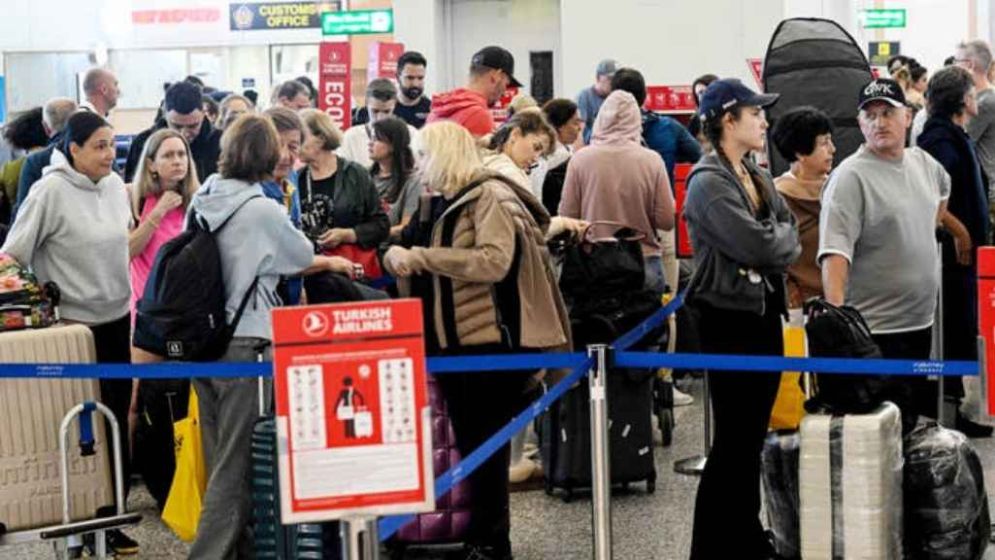
Photo: Collected
Since Zahirul Islam learned that his flight had been cancelled after reaching Hazrat Shahjalal International Airport (HSIA) on Monday, he has been making phone calls to various people, trying to find a solution. He appeared frustrated and somewhat confused.
Zahirul has barely a week left before the validity of his Qatar visa expires. Yet he remains unsure whether he will be able to return to his workplace in time.
“I have been working as a senior staff member at a hospital in Doha for the last eight years. If I cannot return in time, I will lose my job. Now I don’t know what to do,” he told the Daily Sun.
Zahirul is among many workers caught in uncertainty since the United States and Israel attacked Iran on 28 February. Many others who were scheduled to travel to Middle Eastern countries – either for the first time or after returning from leave – are now facing a similar situation.
Around 366 Middle East-bound flights have been cancelled over the past 11 days, leaving roughly 55,000 passengers stranded, including about 40,000 migrant or aspiring workers, according to statistics from the Civil Aviation Authority of Bangladesh (CAAB).
Airlines have advised passengers with expiring visas to apply for extensions. Meanwhile, the Ministry of Expatriates’ Welfare has arranged accommodation and meals for stranded workers whose homes are far from Dhaka.
Big blow to migration and remittance
According to the Bureau of Manpower, Employment and Training (BMET), 1,131,144 workers went abroad for employment in 2025.
Of them, 754,369 (67 percent) went to Saudi Arabia, followed by 107,596 to Qatar (10 percent), 70,177 to Singapore (6 percent), 42,241 to Kuwait (4 percent) and around 40,139 to the Maldives (nearly 4 percent). Smaller numbers travelled to the United Arab Emirates (13,752), Jordan (12,301), Cambodia (12,251), Italy (9,365) and Kyrgyzstan (6,650).
Data for the first two months of this year show Saudi Arabia remains the top destination with 108,919 workers, followed by Singapore, Qatar, Kuwait, Jordan, the UAE and Iraq.
Government data indicate that nearly 4.5 million Bangladeshis are currently working in the six member states of the Gulf Cooperation Council (GCC)—Saudi Arabia, the United Arab Emirates, Qatar, Kuwait, Bahrain and Oman.
Statistics from Bangladesh Bank show that expatriate Bangladeshis sent home a record $32.8 billion in remittances in 2025. Of this, about 45.40 percent of the country’s total remittances in the 2025–26 fiscal year came from these six GCC countries. Experts warn that prolonged instability and the resulting unavailability of flights to Middle Eastern cities could reduce the number of outbound migrant workers, dealing a heavy blow to the migration sector and Bangladesh’s foreign currency inflow.
Ali Haider Chowdhury, former secretary general of the Bangladesh Association of International Recruiting Agencies (BAIRA), said that if the conflict continues and the normal flow of workers abroad remains disrupted, both aspiring migrants and recruiting agency owners will face severe hardship.
“With six to seven million Bangladeshi workers, Middle Eastern countries are the prime destinations for Bangladeshis seeking overseas employment. These countries share religious and cultural similarities with Bangladesh, which makes our workers feel comfortable working there,” he told the Daily Sun.
“We are also able to send a large number of unskilled and semi-skilled workers to these destinations. Any prolonged escalation in the Middle East could severely damage the entire sector, shattering the dreams of workers and recruitment agencies alike,” he added.
Aviation sector already under strain
A significant portion of Bangladesh’s aviation sector depends on the Middle East. As a result, instability in the region is directly affecting the country’s air transport, trade and economy.
Airlines including Kuwait Airways, Air Arabia, Gulf Air, Qatar Airways, Emirates, Jazeera Airways, Flydubai, US-Bangla Airlines and Biman Bangladesh Airlines have suspended several flights to Middle Eastern destinations amid rising tensions in the oil-rich Gulf region.
Biman Bangladesh Airlines alone has suspended flights on its Doha, Sharjah, Kuwait and Dammam routes until further notice. Biman’s General Manager (Public Relations) Bosra Islam said on Monday that the decision had been taken in response to the current security situation in the region.
Flights to Dubai and Abu Dhabi will remain suspended until 10 March, while further decisions will depend on improvements in the situation and approval from the respective airport authorities.
Md Kamrul Islam, general manager (public relations) of US-Bangla Airlines, said Bangladesh’s heavy dependence on the Middle East has now exposed the country to serious risks. “The majority of passengers from Bangladesh travel to Middle Eastern destinations. Moreover, most travellers heading to Europe and the United States rely on Middle Eastern transit hubs such as Dubai, Doha and Abu Dhabi,” he told the Daily Sun.
“Therefore, when a crisis occurs in the Middle East, flight rerouting, travel delays and higher ticket prices become inevitable. Ordinary passengers face considerable inconvenience, while airlines’ operating costs also increase.”
He said airlines are currently being forced to use alternative routes to avoid the airspace of conflict-affected countries. “This makes journeys longer and increases fuel consumption. At the same time, the war could push global oil prices higher. Since fuel accounts for a major portion of airlines’ operating costs, the impact will be immediate in the aviation sector.”
“Ultimately, these additional costs will be passed on to passengers, making air travel even more expensive. Meanwhile, pressure is also mounting on air cargo transportation,” he added.
Read More