




 For all latest news, follow the Daily Sun's Google News channel.


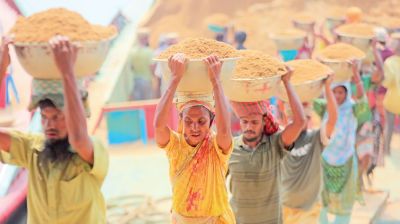
Waking up at dawn to cook, fetch water, care for livestock, work in the fields, and then return home to look after children and family—this is what a typical day looks like for countless rural women in Bangladesh.
Despite this extensive contribution, a large portion of their labour remains outside the calculation of national income or gross domestic product (GDP), raising an important question: what is the true economic value of the invisible labour performed by rural women?
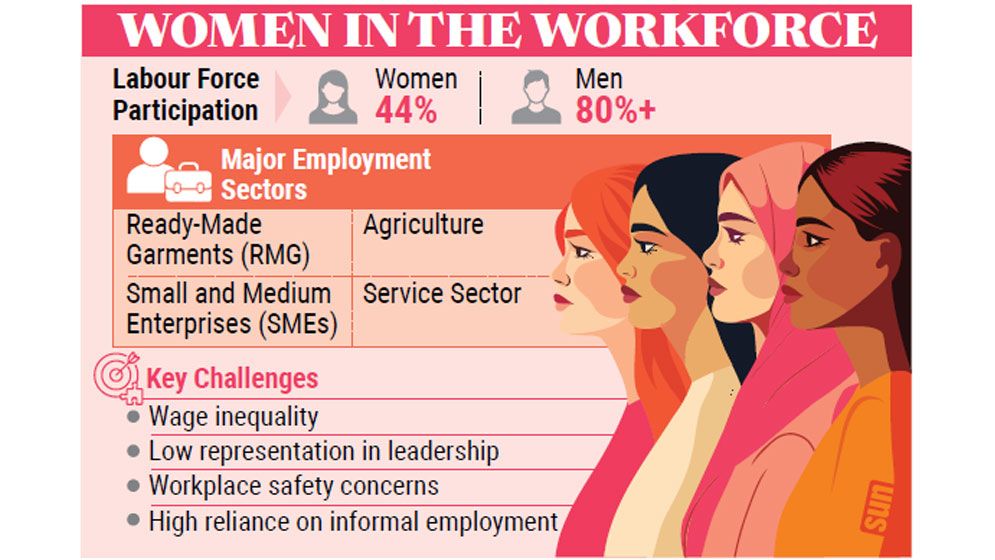
According to data from the Bangladesh Bureau of Statistics (BBS), women make up about 44.2% of the country’s total labour force. Although women’s participation in the labour market has increased over the past decade, a significant majority—around 96%—are employed in the informal sector, mainly in areas such as agriculture and domestic work.
Economists say that if the value of household work and informal production activities were properly measured, the overall picture of the country’s economy could change significantly. In rural households, women contribute substantial time and effort to productive activities, but much of this work remains unrecognised in official statistics.
Fahmida Khatun, executive director at the Centre for Policy Dialogue (CPD), said that if household work and informal production were valued at market rates, the country’s GDP could increase by several percentage points.
Incorporating women’s invisible labour into economic statistics could reshape development strategies and highlight the critical role women play in sustaining the rural economy. Recognising women’s work is essential for unlocking the country’s full economic potential, as a large portion of economic activity still remains invisible, she added.
Women entrepreneur Tahmina Ahmed Banee, founder of Banee’s Creation told the Daily Sun that although women work throughout the day, their efforts are often not considered real work because they do not generate direct income.
She suggested strengthening gender-responsive budgeting, providing easier access to credit for rural women entrepreneurs, recognising unpaid labour within social protection programmes, and improving childcare and elderly care infrastructure.
Such measures could help bring women’s economic contributions into the formal policy framework and encourage greater participation in the labour market, she added.
Shaila Abedin SEVP, head of liability and women banking at Prime Bank, told the Daily Sun, “Investing in women is investing in innovation, resilience, and the future of our organisations. Empowered women transform businesses and societies alike. Symbolic gestures are not enough. Real empowerment requires structural change, leadership development, and an environment where women can thrive without barriers. A culture of accountability, equity, and respect is not optional—it’s the foundation for unleashing the full potential of women leaders.”
Labour force participation vs actual work
Official data show that women’s participation in the formal labour market remains significantly lower than that of men. According to BBS, women’s labour force participation rate is below 50%, compared to more than 75% for men.
Bangladesh’s ready-made garment (RMG) industry has emerged as the largest source of employment for women. According to industry sources, nearly 60% of the workers in this sector are women.
More than 80% of the country’s total export earnings come from the garment industry.
However, experts say these statistics do not fully reflect the real situation. In rural areas, women are deeply involved in agricultural activities, poultry rearing, food processing, and family-based production systems. Much of this work, however, takes place within households and is therefore not counted in formal labour market data.
Mohammed Hatem, president of the Bangladesh Knitwear Manufacturers and Exporters Association (BKMEA), told the Daily Sun that the share of women workers in the RMG industry was once around 75%, but the proportion has declined somewhat in recent years. One of the main reasons behind this change is the increasing use of new technologies and automation in the sector, which many women workers have not yet had adequate opportunities to adapt to.
He noted that the situation could improve if greater emphasis is placed on skills development and technology-based training. With stronger government support for training programmes that help workers adapt to modern technologies, women’s participation in the sector could increase again, further strengthening their role in the industry.
Role in agriculture, household production
Women play a vital role in various segments of the rural economy. In agriculture, they take part in planting, weeding, and harvesting crops, while also contributing to livestock management and dairy production.
Beyond agriculture, many rural women are engaged in small-scale household production activities. Processing foods such as dried fish, pickles, puffed rice, traditional cakes, and other homemade items contributes significantly to family income and local markets.
Microfinance programmes have also helped many women emerge as small entrepreneurs. Development organisations and microcredit initiatives have played an important role in supporting women’s economic participation in rural areas.
Economic value of invisible labour
Economists often estimate the value of unpaid household labour using the “replacement cost” method, calculating how much it would cost if someone were hired to perform the same tasks.
Analysts estimate that a rural woman spends an average of six to eight hours per day on household and supportive productive activities. If the value of this work is calculated at around Tk50-60 per hour, it would amount to several thousand taka worth of labour each month—most of which goes unrecognised in formal economic accounting.
Why the labour remains uncounted
Dr Mustafa K Mujeri former director-general of the Bangladesh Institute of Development Studies (BIDS) points to several structural reasons why women’s labour remains invisible in national statistics.
First, most household work does not involve market transactions. Second, such work is often viewed as part of family responsibilities rather than economic activities. Third, many statistical surveys do not fully capture time-use data that could reflect the actual workload of women.
He believes that expanding time-use surveys could provide a clearer picture of how much time women devote to productive and household activities.