




 For all latest news, follow the Daily Sun's Google News channel.


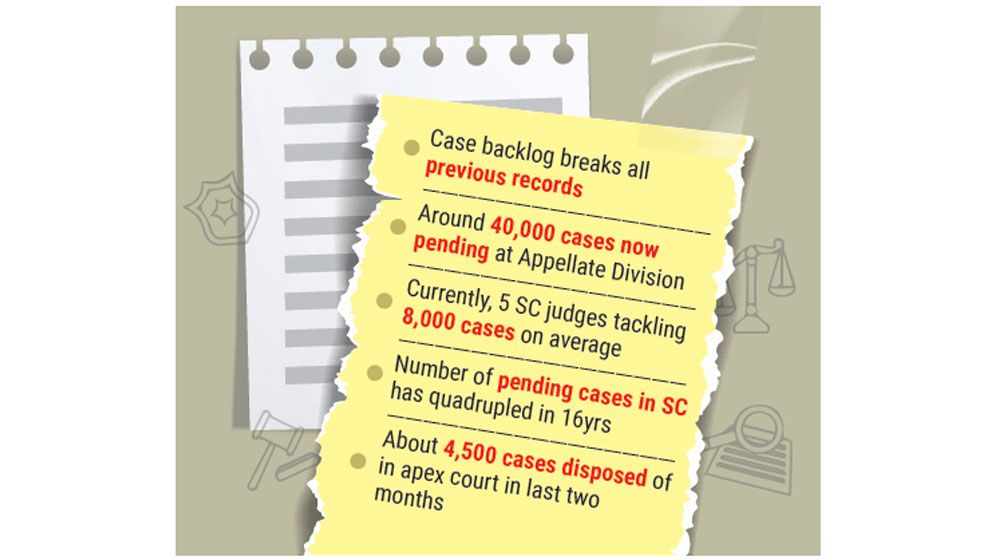
The backlog of pending cases is growing at the Appellate Division of the Supreme Court for various reasons, including shortage of judges. The apex court is now operating with only five judges, each handling an average of 8,000 of the over 40,000 pending cases.
After assuming office, Chief Justice Zubayer Rahman Chowdhury has laid special emphasis on resolving the backlog of cases. As a result, a total of 4,429 cases have been disposed of in the Appellate Division in the bench headed by him in 33 working days in the last two months.
Although the development has raised hopes, the judge crisis looms once again in the apex court, likely contributing further to the increase in case backlog.
The judge crisis intensified after Justice AKM Asaduzzaman retired on Thursday, leaving five judges remaining in the Appellate Division.
Md Shafiqul Islam, public relations officer (PRO) of Bangladesh Supreme Court, said that 4,429 cases were disposed of in 33 working days in Court No. 1 of the Appellate Division from 5 January to 26 February. Out of this, 2,270 cases were disposed of in 18 working days from 5 January to 29 January, and 2,159 cases were disposed of in 15 working days from 1 February to 26 February.
The chief justice laid special emphasis on the disposal of old cases and took several steps in this regard. As a result, significant progress has already been observed in the disposal rate of cases in the Appellate Division of the Supreme Court.
A press statement of the Supreme Court signed by Shafiqul Islam said that the initiative of the chief justice is not just a statistical success; rather, it is an important milestone in the implementation of the constitutional commitment to establish justice.
The statement further states that the dynamism created in the Appellate Division under the chief justice’s leadership will further strengthen the reform and modernisation of the judiciary. In particular, the speedy disposal of long-pending cases will increase the confidence of the litigants and send a positive message to the public about the effectiveness and transparency of the judiciary.
Crisis looms despite hopes
Although the Supreme Court’s statement on 26 February conveyed a message of hope, the judicial crisis intensified again when a judge retired on the same day. As a result, the crisis deepened further, leaving the Appellate Division with only one functional bench. Chief Justice is now unable to constitute more than one full bench, which requires at least three judges.
The case backlog had reached an all-time high in the beginning of 2025. The Supreme Court was facing the brunt of the crisis, as the number of pending cases had tripled over 15 years, with five Appellate Division judges tackling 27,000 cases at that time. Last year’s backlog of cases increased further this year, breaking all previous records, with the number of judges equaling the previous lowest record.
In the beginning of 2025, the Appellate Division had five judges, each with approximately 5,500 pending cases. Later on 24 March 2025, two High Court judges – Justice AKM Asaduzzaman and Justice Farah Mahbub – were elevated to the Appellate Division, and with their appointments, the number of judges had gone up to seven.
Former Chief Justice Dr Syed Refaat Ahmed retired in December 2025, while Justice AKM Asaduzzaman bid farewell to the Appellate Division on Thursday.
With their departure, five judges now remain in the Appellate Division – Chief Justice Zubayer Rahman Chowdhury, Justice Md Ashfaqul Islam, Justice Md Rezaul Haque, Justice SM Emdadul Hoque, and Justice Farah Mahbub. By the end of 2023, over 26,000 cases were pending with the Appellate Division, while the number reached 27,000 by the end of 2024. As of late 2025, the Appellate Division had about 40,000 cases pending. SC sources said the main reason behind the rising backlog is the shortage of judges.
In contrast, 16 years ago, there were eight judges handling 9,141 cases in total. The number of pending cases in the Appellate Division has quadrupled since then, while the number of judges has decreased.
In 1974, the Appellate Division had five judges managing just over 4,000 cases. By 2009, the number of judges had been increased to 11, but that precedent has not been maintained. Legal experts and lawyers see the acute shortage of judges as one of the primary reasons for the backlog. They said forming two or three full benches could significantly speed up case disposal.
Advocate Muzahedul Islam Shahin, a lawyer of Supreme Court, described the number of judges in the apex court as dire. He said that appointing new judges in the apex court is important to get rid of pending cases.
The reporter can be reached at: [email protected]