




 For all latest news, follow the Daily Sun's Google News channel.


Rise in seismic activity as country witnesses 12 jolts this month
Latest tremor felt nationwide on Friday with Satkhira being epicenter

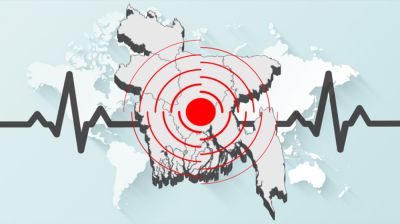
Bangladesh has experienced an unusual rise in seismic activity, with 12 earthquakes recorded in the first 27 days of February, while the epicentres of 10 of them were inside the country, raising concern among experts and general public.
According to data from the Bangladesh Meteorological Department (BMD), both 2025 and 2026 have seen a noticeable increase in earthquake occurrences, compared to previous years when annual totals typically ranged between two and 11 tremors.
Rubayet Kabir, a meteorologist, who is in charge of the BMD Earthquake Observation and Research Centre, told the Daily Sun that based on his analysis of the past 10 years, he has found that 2025 and 2026 have experienced a higher number of earthquakes.
“From last February to this February alone, around 32 earthquakes have occurred. If we consider the previous years, in many of those years, there were only 2-3 earthquakes. In some years, there were 5-7, and in others around 10 or 11. However, in 2025 and 2026, the tendency of earthquakes has increased significantly,” he said.
According to his analysis, the epicentres of 22 tremors that occurred in 2025 were inside Bangladesh and the number is 12 for the current year so far.
According to the BMD, of the total of 12 earthquakes that jolt the country in 27 days of February, one was a major jolt measuring 7.1 on the Richter scale which struck on 22 February, three were moderate, four were light, and four were minor in magnitude.
Earlier, on Wednesday night, a moderate 5.1 magnitude earthquake was felt in the country while its epicentre was in Myanmar.
Rubayet Kabir said, “The increase in the number of tremors is actually quite natural. Bangladesh lies between the Indian Plate and the Eurasian Plate, where subduction is taking place. At the same time, there is subduction occurring towards Myanmar in the east. From the current trend, it appears that a significant amount of energy may have accumulated in this region. As a result, the tendency of earthquakes here may have increased.”
In the last 27 days, the earthquakes were felt in different areas, including the capital, Dhaka. Although most of the tremors were mild to moderate in intensity, they have raised concern among the general public.
Earthquake specialist and retired Dhaka University geologist Prof Dr Syed Humayun Akhter said, “Our main sources of earthquakes are the subduction zones in Sylhet and Cox’s Bazar, which we often describe as notorious zones. Another source is the Dauki Fault, and to the north, the Himalayas. This recent earthquake, however, did not occur in those areas; it happened in the western region, where there is no major known source.”
“There have been earthquakes here before. Some people are wondering why several tremors are occurring in a short span of time. In reality, there is no significant tectonic source in this area. Moderate to slightly strong earthquakes may occur. There is no reason to panic,” he said.
Explaining the geological process, the earthquake specialist said, “The Indian Plate is subducting beneath the Burma Plate along its eastern margin. As the eastern edge of the Indian Plate is being pulled downward, gravitational forces are also causing the vast western portion of the plate to exert tension in the opposite direction. This creates stress in the middle. Due to this stress, a new fault could develop and trigger an earthquake, or an old fault could be reactivated. However, there is not enough accumulated energy here to generate a major earthquake.”