



 For all latest news, follow the Daily Sun's Google News channel.


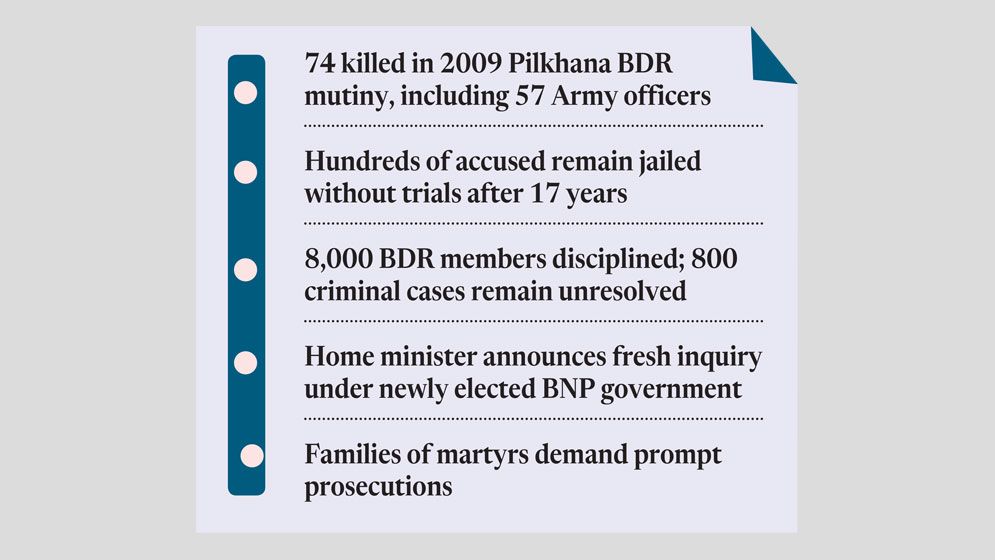
Seventeen years after the so-called “Bangladesh Rifles (BDR) mutiny” at Pilkhana left 74 people dead, including 57 Army officers, the massacre remains an unresolved chapter in Bangladesh’s history, with questions lingering over whether those who planned and directed the violence – at home and abroad – will ever be held to account.
Despite the passage of time, hundreds of accused remain in jail without their trials being completed, while a series of investigations have yet to translate into prosecutions.
An independent inquiry commission, formed after the fall of the government led by fascist Sheikh Hasina, submitted a report identifying alleged masterminds and others involved in the killings. Its findings, however, were not acted upon during the interim administration.
As the nation observes National Martyred Army Day today, expectations are now mounting on newly elected BNP-led government to take prompt and impartial action.
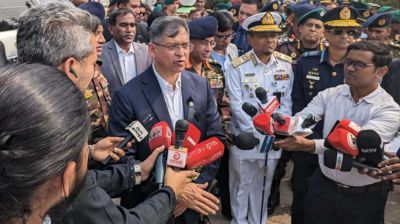
On Monday, Home Minister Salahuddin Ahmed said the government would form a new inquiry commission to look again at the BDR carnage.
“We have a promise in our manifesto. We will thoroughly re-investigate the BDR (massacre) incident or form a commission and act upon its report. We are committed to establishing justice,” he said.
Victim families, however, urge the new government to act on the findings of the independent inquiry rather than reopen a case that they say has already been exhaustively investigated.
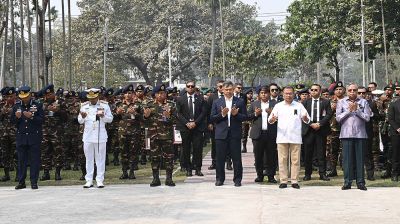
Bangladesh marks National Martyred Army Day today, paying tribute to those killed during the 25-26 February 2009 so-called “mutiny” at the BDR headquarters in Dhaka.
The previous interim government decided on 23 February 2025 to observe 25 February as the national day of remembrance.
President Mohammed Shahabuddin is scheduled to lay a wreath at the Banani Military Graveyard at 10am, according to a notification from the protocol wing of the president’s office.
On the eve of the day, Prime Minister Tarique Rahman issued a message praying for the eternal peace of the martyrs’ souls and expressing sympathy and solidarity with their bereaved families.
Families urge prosecution, not delay
Barrister Sakib Rahman, son of Colonel Kudrat-E-Elahi, one of the 57 Army officers killed, told the Daily Sun that almost all the families of the martyrs were satisfied with the findings of the National Independent Inquiry Commission.
“The past interim government should launch prosecution in accordance with the commission report but it failed to do so. Now, the home minister is talking about a new commission. I think the minister is not well aware of the commission report,” he said.
“It is our demand that the present government will begin prosecution following the commission report.”
Sakib said the commission had also pointed to the roles of former home adviser Lt Gen (retd) Jahangir Alam, who it said failed to make proper recommendations following his inquiry, and former special branch chief IGP Baharul Alam, whose conduct was described in the report as negative.
Punishments imposed, trials unfinished
According to Rahman, around 8,000 BDR members were punished under internal disciplinary laws, receiving varying jail terms – the maximum being seven years – and being dismissed from service.
“It was done following the BDR internal law,” he said.
Separate criminal cases, however, remain unresolved. About 800 BDR personnel were arrested in 2009, but their trial has yet to be completed. Some were released on bail during the interim government.
In the main murder case, 185 BDR members were sentenced to life imprisonment and 139 to death. Appeals in both cases are now pending before the Appellate Division of the Supreme Court of Bangladesh, Sakib said.
Survivors speak out
Major (retd) Zayedi Hasan, the first officer injured by gunfire during the mutiny and later held captive for more than 30 hours, said those who survived were often viewed with suspicion.
“Many were benefited by the BDR carnage, but the survivor officers were undermined, with questions raised about how they survived,” he said.
Zayedi, a witness before the inquiry commission, said its report had not been fully disclosed.
“The interim government formed a commission. The commission made a good report but the past government did not disclose the report fully. Many officers were promoted but many of them were involved in the massacre,” he said.
“I hope that the incumbent government will bring the real culprits to book through an investigation.”
What the commission said
According to a summary of its findings, the National Independent Investigation Commission concluded that the massacre was the result of a pre-planned political and external operation carried out on 25-26 February 2009.
It alleged that Sheikh Hasina, along with senior figures from the Awami League, orchestrated the events “with the collaboration of a neighbouring country”.
The commission named former MP and ex-Dhaka South mayor Sheikh Fazle Noor Taposh as the “chief coordinator” of the carnage and said the plot had been set in motion as early as 2008, exploiting growing unrest among rank-and-file BDR personnel over army officers posted on deputation.
The report cited retired army officers who said that, during the siege, the then prime minister did not allow a military operation to rescue those trapped inside the headquarters.
It further alleged that those responsible were later granted general clemency, while innocent individuals were implicated in the cases.