


 For all latest news, follow the Daily Sun's Google News channel.


Interim govt borrowed for operating costs after Ershad era
Citizen’s Platform flags deep fiscal stress as revenue shortfall, weak investment and job losses strain macroeconomic stability
Daily Sun Report, Dhaka
Published: 20 Feb 2026, 12:00 AM
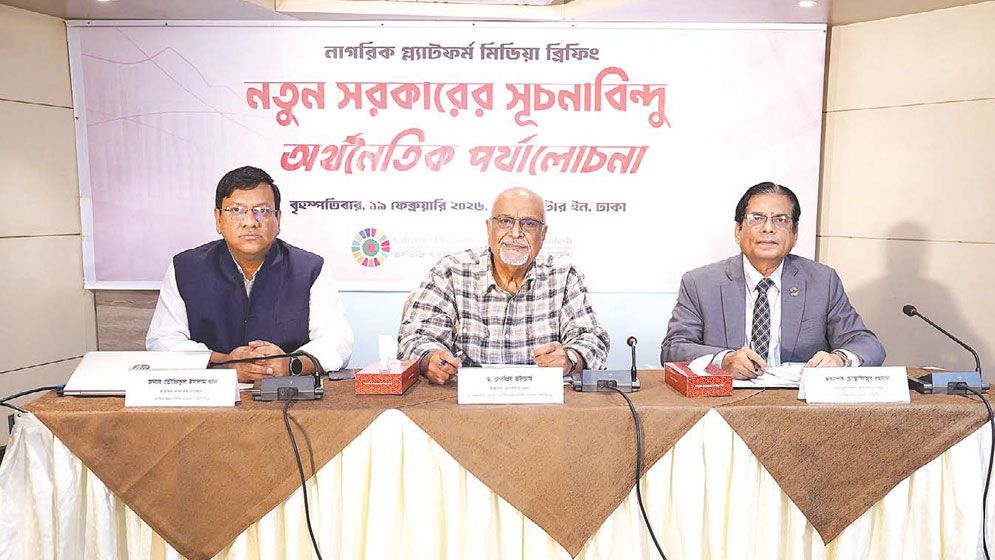
The interim government has borrowed to finance its operating expenditure for the first time since the regime of Hussain Muhammad Ershad, highlighting deep fiscal stress in the economy, according to the Citizen’s Platform for SDGs, Bangladesh.
The disclosure came at a media briefing titled “The Point of Departure of the New Government: An Economic Review,” held on Thursday.
The findings were presented by Towfiqul Islam Khan, additional director (research) at the Centre for Policy Dialogue (CPD). The event was chaired by Citizen’s Platform Convenor Dr Debapriya Bhattacharya, with CPD Distinguished Fellow Mustafizur Rahman also present.
Borrowing to cover operating expenses
Towfiqul Islam said the government’s operating expenditure stood at nearly Tk4.60 lakh crore in fiscal 2025, while revenue earnings amounted to Tk4.36 lakh crore.
As a result, the government faced a shortfall of more than Tk23,000 crore and had to borrow to bridge the gap.
He noted that no government after the Ershad administration had resorted to borrowing to finance operating expenses.
The interim government has now become only the second administration in Bangladesh’s history to do so, underscoring the severity of the fiscal imbalance.
The platform attributed the situation to lower-than-expected revenue collection and mounting expenditure pressures, warning that reliance on borrowing for recurrent costs reflects structural weaknesses in public finance management.
Broader economic strain
The briefing also painted a picture of a fragile macroeconomic environment confronting the newly sworn-in government.
The platform identified persistent inflation, weak private investment, job losses and shrinking fiscal space as major challenges.
Inflation remains elevated despite a global decline. In January, the 12-month average inflation stood at 8.77%, exceeding the central bank’s 7% target.
Although food inflation has moderated slightly, non-food inflation continues to strain households. Wage growth has lagged behind price increases, eroding real incomes.
In the external sector, exchange rate stability and modest growth in foreign exchange reserves have provided some relief.
However, heavy reliance on bank borrowing to finance the budget deficit, along with foreign currency purchases by Bangladesh Bank, has contributed to money supply growth. Rising debt repayments and potential external pressures remain concerns.
Investment slump and job losses
Private investment has declined to around 22.5% of GDP in the fiscal 2024-25 – the lowest level in a decade. Sluggish industrial growth has kept overall GDP expansion near 4%.
Approximately 21 lakh jobs were lost nationwide during the first half of FY25, according to data presented at the briefing.
The platform warned that the suspension of regular labour market data makes it difficult to fully assess the social impact, including potential increases in poverty.
Stabilisation plan urged
To restore fiscal stability, the Citizen’s Platform recommended adopting a comprehensive economic stabilisation plan with strict budget ceilings and a realistic revision of the current budget.
It advised maintaining a cautious monetary policy stance, avoiding aggressive reserve accumulation and implementing gradual exchange rate adjustments.
The platform further proposed phasing out export and remittance incentives, tightening public spending, improving tax compliance without raising rates and offloading shares of profitable state-owned enterprises.
It also stressed the importance of recovering laundered money and defaulted assets and developing a credible medium-term reform roadmap.
The platform concluded that unless structural fiscal weaknesses – such as borrowing to cover operating costs – are addressed decisively, restoring macroeconomic stability and sustainable growth will remain a formidable challenge for the new administration.