



 For all latest news, follow the Daily Sun's Google News channel.


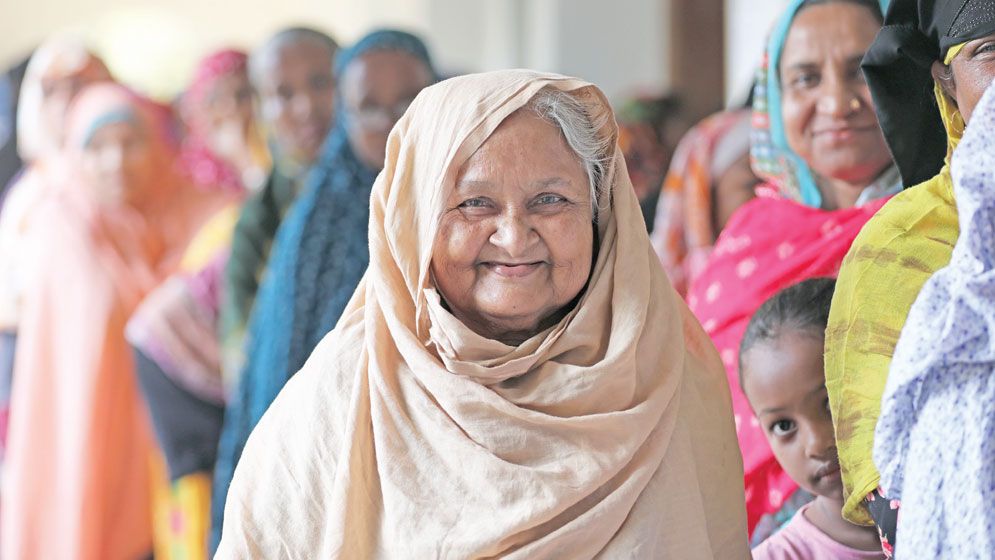
An elderly female voter smiles after casting her vote at a polling centre in the capital’s Banani on Thursday. An elderly female voter smiles after casting her vote at a polling centre in the capital’s Banani on Thursday. Kamrul Islam Ratan
Bangladesh held its 13th parliamentary election on Thursday in what election officials and observers described as the most peaceful and festive national vote in years, marking a sharp contrast with three previous controversial elections, although isolated violence, allegations of irregularities and uneven voter turnout were reported across the country.
Polling took place from 7.30am to 4.30pm under tight security, with voters returning to the ballot box after nearly 17 years amid a largely festive atmosphere. While no 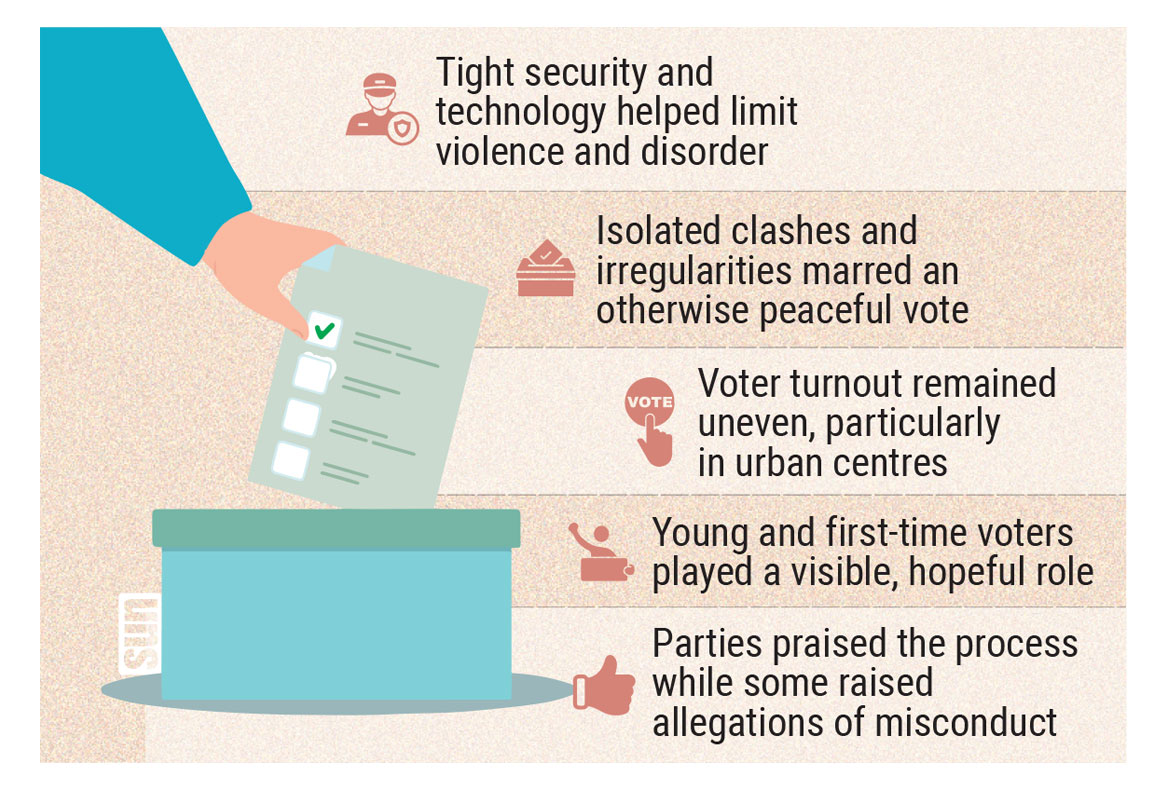 widespread unrest was recorded, the Election Commission confirmed one death, more than 130 injuries and dozens of incidents involving clashes, fake voting and ballot-related violence.
The calm nature of the vote was widely welcomed by voters, political parties and election authorities, who credited enhanced security measures, technological monitoring and what they described as a more restrained posture by political actors.
Peaceful voting day, cautious optimism
For many voters, Thursday’s election represented a rare opportunity to participate freely in the democratic process after years of disputed polls.
“I voted without fear,” said one voter in Dhaka. “After a long time, it felt encouraging to take part freely.”
Polling centres across the country saw steady queues in the morning, with turnout gradually increasing from midday to afternoon. However, voter participation remained lower than expected in several urban centres, particularly in parts of the capital.
According to the Election Commission (EC), 47.91% of registered voters had cast their ballots by 2pm based on data from 36,031 of the country’s 42,651 polling centres.
“Based on the data available till 2.00pm, the voter turnout stands at 47.91%,” EC Secretary Akter Ahmed told reporters. “This reflects voting from 7.30am to 2pm.”
He noted that results from 6,620 centres were still pending at that time.
Security deployment and technology
More than 750,000 law enforcement personnel, including police, the Rapid Action Battalion (RAB), Border Guard Bangladesh (BGB) and Ansar members, were deployed nationwide. Mobile courts operated in several districts to deal with violations of the electoral code of conduct.
In a significant departure from previous elections, the EC used technology extensively to monitor polling centres. CCTV cameras were installed at thousands of locations, while body-worn cameras attached to law enforcement personnel and presiding officers transmitted live footage to a central control room at the Election Building in Agargaon.
From there, officials monitored both visuals and audio from sensitive centres, with GPS tracking allowing real-time observation of personnel movements.
“If any untoward situation arises, we can issue immediate instructions,” an EC official said, adding that body cameras were “effectively complementing” existing CCTV surveillance.
Election officials said the technology helped ensure transparency and allowed rapid intervention when tensions emerged.
Calm in Dhaka, uneven turnout
In Dhaka, Daily Sun reporters visited polling centres across 16 parliamentary constituencies and reported that voting was largely peaceful and uninterrupted.
In constituencies such as Dhaka-11, Dhaka-12, Dhaka-13 and Dhaka-17, polling was described as free, fair and orderly, supported by law enforcement and marked by strong participation from young voters.
However, turnout was noticeably low in the early hours in Dhaka-4, Dhaka-6 and Dhaka-8. Presiding officers attributed this to local voting habits, with residents typically arriving later in the day.
BNP and Jamaat activists were seen stationed near several polling centres, while the presence of independent candidates and smaller parties was limited.
In Dhaka-16 and Dhaka-18, voter turnout was comparatively higher, with voters expressing satisfaction over the calm environment.
Md Shahidullah, a voter in Dhaka-16, said: “The process was very good as before. I did not face any difficulties in casting my vote.”
At the Rajuk Uttara Model College polling centre, presiding officer Md Anwar Hossain said voting proceeded smoothly throughout the day, with enthusiastic participation.
Young voters and the legacy of protest
Many young voters described the election as reflecting the spirit of the July 2024 uprising, which began as a protest movement against discrimination.
“The main goal of the Movement Against Discrimination has not yet been addressed,” several young voters said collectively. They warned that unless the next government upheld the spirit of the July uprising, the country could face further turmoil.
For first-time voters, the day carried particular significance.
At the BAF Shaheen Haji Ashraf Ali School polling centre in Dhaka-15, long queues formed before voting began.
Munia Rahman, a class 12 student, said, “Casting my first ballot makes me feel like a very important citizen.”
Aklima Akter, registered as a voter in 2023, described her first voting experience as joyful despite nervousness over handling the ballot paper.
Sultana Rahman and Priti Jannat also expressed happiness, noting that the process was smooth and quick.
Phone restrictions and polling discipline
At several polling centres, voters were required to deposit their mobile phones before entering the voting booths, a measure intended to preserve ballot secrecy.
At the 56th polling centre in Dhaka-15 at Taqwa International School in Shewrapara, presiding officer Nahid Hossain said: “As of 9.30am, 10.51% of the centre’s 2,207 registered voters had cast their ballots. There was a crowd of voters in the morning, but it gradually eased after 9.30am.”
At a neighbouring centre, presiding officer Abbas Ali reported that 216 out of 2,213 voters – around 9.76% -- had voted by 9.19am.
Officials at both centres said voting was orderly, with mobile phones securely held by polling staff.
Allegations and localised tensions
Despite the overall calm, allegations of mismanagement and irregularities surfaced at several locations.
At Darus Salam Government Primary School polling centre in Dhaka-14, voters complained of confusion over booth locations and discrepancies in voter information. One woman alleged that her voter number displayed another person’s photograph, while others reported duplicate voter numbers.
Presiding officer Md Kashimuddin denied receiving formal complaints, saying voting was proceeding smoothly. Brief tension erupted as frustrated voters gathered outside, but army personnel later restored order.
Elsewhere in Dhaka, 80-year-old Bilkis Begum cast her vote for the first time since 2008 at Kalyanpur Girls’ School and College.
“Today, I finally voted with my own hands. I feel very happy,” she said.
Violence and arrests outside the capital
The Election Commission’s division-wise summary recorded one death in Khulna and 135 injuries nationwide.
The EC documented two incidents of ballot snatching, three cases of arson, 29 clashes, and 53 instances of fake voting or attempted fake voting.
In Bhola Sadar upazila, voting was temporarily suspended at Alinagar School and College polling centre following a cocktail explosion and an attempted ballot snatching.
In Munshiganj Sadar, crude bombs were detonated near Makhati Gurucharan High School polling centre, triggering panic. Five people were arrested.
In Kishoreganj’s Hossainpur upazila, a mobile court sentenced a youth to two years in prison and fined him Tk10,000 for casting a fake vote. A presiding officer in Lohaboi Baradi Government Primary School was removed for failing to prevent fraudulent voting.
In Noakhali’s Hatiya upazila, clashes between BNP and National Citizen Party supporters at Char Eimbar Bangla Bazar polling station left at least 20 people injured.
Jamaat allegations and EC response
Bangladesh Jamaat-e-Islami and its 11-party alliance submitted more than 100 video clips and documents to the Election Commission, alleging irregularities, harassment of polling agents and attacks on candidates.
Jamaat lawyer Moazzem Hossain Helal said polling agents were expelled from at least 30 centres in Cumilla-8 (Barura), adding that their candidate formally requested voting suspension.
Similar allegations were raised in Tangail, Narsingdi, Noakhali, Jhalokathi, Barguna, Patuakhali and Shariatpur.
Mujibur Rahman Bhuiyan Manju, member secretary of the Amar Bangladesh Party, condemned the incidents, calling them a deliberate attempt to undermine a fair election.
The Chief Election Commissioner and other commissioners reportedly assured party representatives that urgent measures would be taken.
EC Secretary Akter Ahmed urged caution, saying complaints were under review.
“We cannot make any advance comments without verifying the information,” he said. “If the complaint is proven, the returning officer concerned will take necessary action.”
Official reaction and closing prayers
Chief Election Commissioner AMM Nasir Uddin expressed “heartfelt satisfaction” with the overall conduct of the election and thanked political parties, candidates, law enforcement agencies, election officials, observers, media professionals and voters.
The Election Commission also requested special prayers after Friday’s Jumu’ah prayers at mosques across the country, and prayers at other places of worship, seeking peace, prosperity and progress for Bangladesh.
For many Bangladeshis, the day marked a cautious step towards restoring confidence in the electoral process – peaceful, if imperfect, and watched closely at home and abroad.