


 For all latest news, follow the Daily Sun's Google News channel.


Shafiqur promises inclusive state, urges end to politics of fear
Daily Sun Report, Dhaka
Published: 10 Feb 2026, 12:00 AM
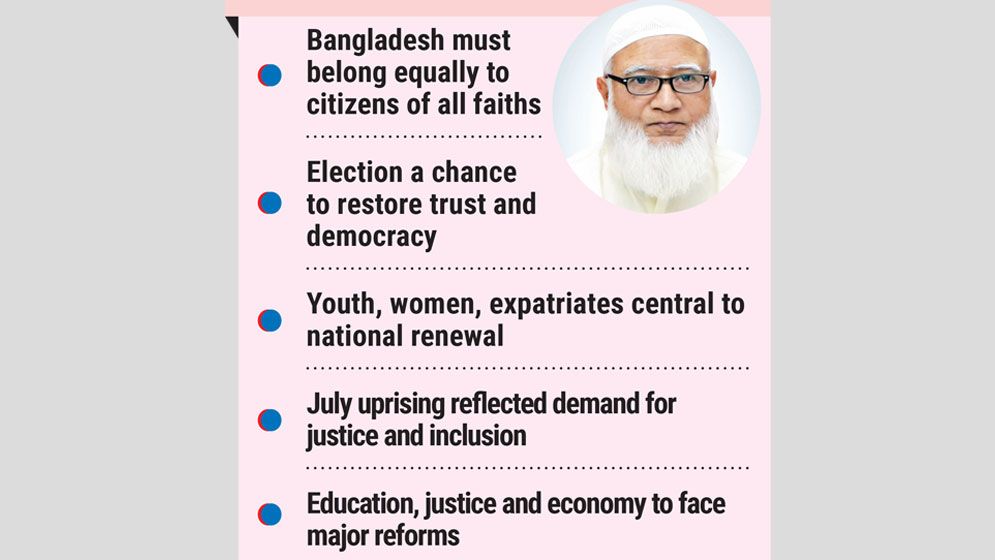
Bangladesh Jamaat-e-Islami Ameer Dr Shafiqur Rahman on Monday called on voters to back the Jamaat-led 11-party alliance in the upcoming general election, pledging to build an inclusive state, restore democratic norms and protect the dignity and rights of all citizens, regardless of faith or political affiliation.
Addressing the nation ahead of the 13th parliamentary election and a simultaneous referendum scheduled for Thursday, Dr Shafiqur said Jamaat wanted to be a “partner in nation-building” and to “change the prevailing trend” in national politics.
“This Bangladesh belongs to all – Muslims, Hindus, Buddhists and Christians – regardless of party or opinion. No one will live in a culture of fear,” he said. “If anyone tries to hurt anyone on the basis of religious identity, we will resist it as in the past.”
The address was broadcast on state-run Bangladesh Television (BTV) and Bangladesh Betar as part of Jamaat’s election campaign.
Calling the election a “critical opportunity” to restore public trust, the Jamaat chief urged national unity, moral renewal and ethical leadership to steer the country towards a just, democratic and prosperous future.
He outlined proposed reforms in education, the judiciary, the economy and governance, stressing inclusive development and accountability.
Highlighting the role of youth, women and expatriates in shaping a new Bangladesh, Dr Shafiqur said the country’s young generation was ready for change.
Describing the July uprising as a collective outcry against injustice, he said people from all walks of life had come together in unity. “We don’t want another July. We want a Bangladesh where citizens never have to take to the streets to demand their rights,” he said. He added that the uprising stemmed from demands for a discrimination-free country and an end to entrenched political practices.
“For generations, power was vested in the hands of the dynastic system, in the hands of a specific group. The 2024 mass uprising happened for liberation from that,” he said.
Calling for an end to divisive politics, Dr Shafiqur said peace and unity must return to people’s lives. “A Bangladesh where no one can sit in the driver’s seat of the country just on the basis of family identity. A Bangladesh where the state will be for everyone, the government will be for the people,” he said.
On women’s dignity and empowerment, he said no society could prosper without protecting women’s rights. If elected, he pledged to bring women into the mainstream of leadership.
“We will honour women not only in the home, but also in the mainstream leadership of society,” he said, adding that merit would be recognised across politics and the corporate world without discrimination.
He criticised what he described as the erosion of democratic practices over the past decade, referring to the elections of 2014, 2018 and 2024.
“When people lose their right to vote, they lose their voice,” he said, alleging misuse of state institutions, lack of accountability and suppression of dissent.
Stressing reform in education, he said the system must be modern, value-based and aligned with technological advancement. On the judiciary, he warned that a nation could not progress if people lost faith in justice.
He also called for economic restructuring, particularly in the banking sector, to create jobs and encourage investment. Dr Shafiqur reaffirmed his commitment to protecting the rights of religious and ethnic minorities and said Bangladesh would pursue balanced diplomacy based on mutual respect while safeguarding sovereignty.
He highlighted climate change challenges and reiterated continued humanitarian support for Rohingya refugees alongside diplomatic efforts for their safe repatriation.
Praising expatriate workers for their role in the July Uprising, he announced plans to hold volunteer representative elections to liaise with embassies and high commissions.
He also pledged initiatives to elect or nominate expatriate representatives to Parliament on a proportional basis.
Concluding, he urged voters to exercise their democratic rights responsibly. “The ballot is not just a vote; it is a trust,” he said.