


 For all latest news, follow the Daily Sun's Google News channel.


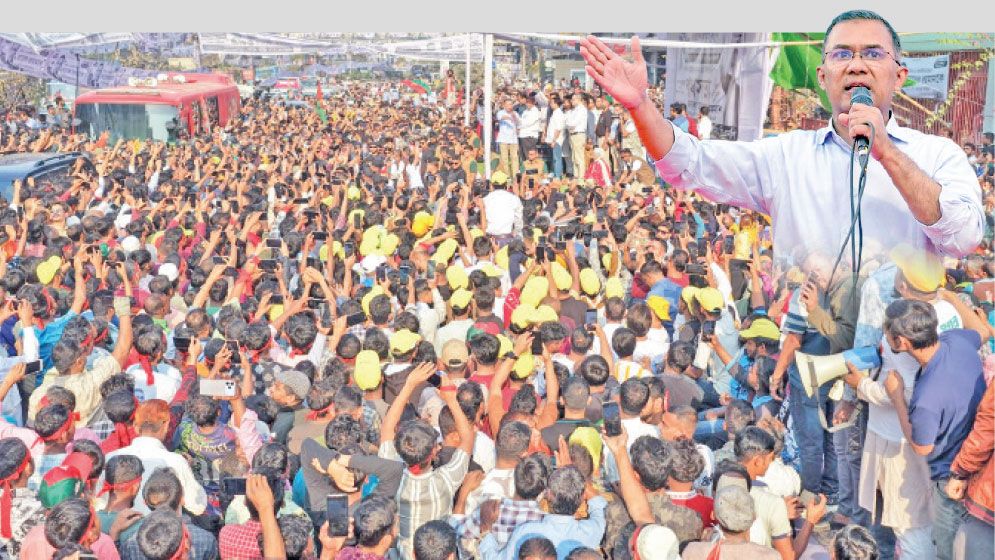
The return of Bangladesh Nationalist Party (BNP) Chairperson Tarique Rahman, and his direct involvement in election rallies, has created a new dynamic in the Dhaka-17 constituency ahead of the 13th parliamentary election.
Analysts say his presence has re-energised the party’s grassroots and sparked renewed interest among general voters, particularly the younger generation.
Despite years of political repression, BNP and other parties have maintained activity at the grassroots level.
Barrister Andaleeve Rahman Partho, chairman of the Bangladesh Jatiya Party (BJP), had been a prominent figure in Dhaka-17, known for consistent engagement with voters. Partho had planned to contest the seat in the upcoming election.
However, following Tarique’s registration as a voter in Dhaka-17, senior BNP leaders asked him to contest from the constituency. Out of respect, Partho shifted to contest from Bhola-1, creating a renewed sense of energy among local voters.
Dhaka-17 constituency consists of wards no. 15, 18, 19, and 20 of Dhaka North City Corporation and the Dhaka Cantonment Thana area, including Gulshan, Banani, Niketan, Mohakhali, Baridhara, and Shahjadpur.
Twelve candidates are contesting the seat, including SM Khaliduzzaman of Bangladesh Jamaat-e-Islami, Kamrul Hasan Nasim of Bangladesh Jatiya Party, Mohammad Ullah of Islami Andolan Bangladesh, and independent Kazi Enayet Ullah, whose “Rooster” symbol is expected to carry local influence.
The constituency has 333,777 registered voters, including roughly 45,000 in the Korail slum, a key bloc for any hopeful candidate.
Meanwhile, talking to the Daily Sun, voters in the area expressed strong support for Tarique.
Haji Rahmat Mia of Gulshan-2 said, “Tarique Rahman has a distinct legacy. His mother was a three-time prime minister, and his father was a freedom fighter and former President. No one else can be compared to him.”
Omar Majhi, a boatman from the Korail slum, said, “This will be my first time voting, and no one else will get my vote except Tarique Rahman.”
Kazi Suleman, a grocery shopkeeper in the same area, noted that Tarique’s rallies had made a tangible impact, despite relief work by Jamaat-e-Islami after a fire in the slum.
Independent candidate Kazi Enayet Ullah emphasised gradual political transformation through responsible participation and institutional integrity, cautioning that Bangladesh’s political crisis reflects deeper public mistrust, corruption, and moral decay rather than mere electoral competition.
Asked, political analyst Dr Dilara Chowdhury said the anticipated “mass wave” for Tarique had yet to fully materialise, while Jamaat-e-Islami had made significant local gains.
She warned the contest could still be affected by black money, muscle power, and potential violence, adding that the public’s desire to end extortion remains a critical issue.
The reporter can be reached at:
[email protected]