




 For all latest news, follow the Daily Sun's Google News channel.


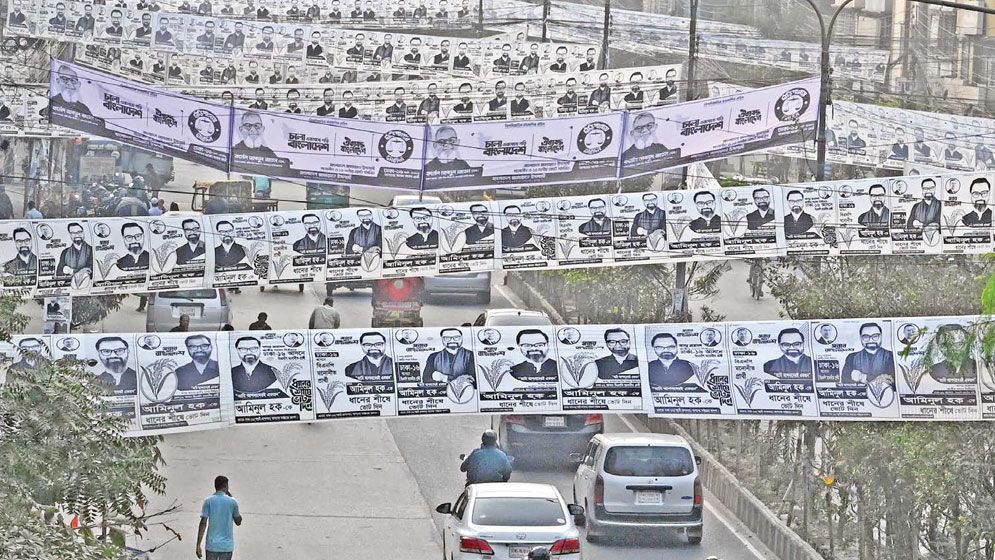
Candidates adopt eco-friendly cloth banners for electioneering ahead of the national election, adhering to the ban on non-biodegradable plastic and polythene. This shift follows strict environmental regulations aimed at reducing hazardous waste throughout the country. This photo was taken form Kalshi area in the capital's Mirpur on Wednesday. - NAZMUL ISLAM
With the 13th parliamentary election just a week away, campaign materials – posters, banners, festoons and leaflets – are filling constituencies across the country.
But this year’s campaign looks markedly different from previous elections. New restrictions imposed by the Election Commission (EC) have banned the use of polythene materials as well as paper-made posters and banners.
While the measures are aimed at reducing environmental harm, they have significantly disrupted the printing industry, which traditionally depends on election-season orders.
Industry insiders say demand for paper posters and banners has collapsed, leaving many printing houses struggling.
According to business owners, the sector is facing substantial financial losses.
Some businesses have adapted by switching to fabric banners and posters.
Halim Musa, proprietor of Munshi Supplement, told Daily Sun that production of fabric banners, festoons and posters had surged in recent days.
“I have already distributed these products among MP candidates in Narayanganj, Dhaka-17 and Dhaka-18, Chattogram, Cumilla, and Nilphamari. I expect to receive more orders in the coming days. At present, the machines at my factory are operating 24 hours a day,” he said.
Musa said that although he had been in business for several years, this was the first time he had produced fabric campaign materials.
“But at the first time I stated to make the fabric banners and posters this year. Earlier, I used to manufacture jersey, T-shirt and three-piece garments. However, after the direction from the EC, I get order to print fabric banners and posters. I use the same machine for this,” he explained.
He said fabric banners and posters cost Tk7-8 per square foot to print, compared with Tk17-18 for PVC banners of the same size.
“And the rate of fabric and paper is same. So, the printing costs of fabric and papers are very reasonable,” he added.

Rising costs amid growing demand
The Narayanganj-based businessman said he had been printing fabric banners and posters worth Tk2-3 lakh daily over the past several days, with volumes expected to rise further.
“Owing to demand hike, the price of fabric increased Tk2-2.5 each feet and chemical Tk40-45 each litre for the last several days. I purchased fabric from Narshingdi and Chemical from abroad,” he said.
Similar trends are evident elsewhere.
Kawser Alam, proprietor of Star Garments in Keraniganj, said demand for fabric posters and banners had increased significantly this election.
“Many persons from MP candidates across the country have come to us for making the posters,” he said. “As it is environment friendly, all are very interested to follow the EC direction. The prices of the fabric made banner and poster are more reasonable compared to the plastic or paper made banner and poster. We take Tk6-7.5 per square feet to make fabric banner.”
Printing industry under strain
Despite the rise in fabric printing, much of the traditional printing industry says it has been hit hard.
Md Junayedullah Al Mahfuz, senior vice-chairman of the Printing Industries Association of Bangladesh (PIAB), said election-related business had largely shifted away from paper printers.
“We just produce paper made banners and posters during election. Alongside this, we manufacture diary, calendars, text book, and others. As this year, the EC banned paper based banners and posters, we can produce leaflets. Our members are now producing leaflets ahead of the election,” he told Daily Sun.
Mahfuz estimated the industry would earn around Tk4 crore from leaflets this year – far below the Tk200 crore it could have generated if paper posters and banners were still permitted, as in previous elections.
He said around 1,000 printing businesses operate in Dhaka’s Fakirapul and Arambagh areas, though only a small number focus on banners and posters. Most are engaged in other activities, including textbooks and exercise books.
According to PIAB, the association has 2,400 members among roughly 16,000 printing businesses nationwide.
The sector employs more than 300,000 people, rising to around one million during peak seasons between November and January.
Mahfuz, who is also managing director of Zara Printers, said rising costs had made operations increasingly difficult.
“I have expenditure more than Tk3.5 lakh each month including shop fare. If there is found any mistake in book or leaflet, it has to be printed again. So, we count loss here,” he said.
He valued the paper printing market at Tk30,000 crore, with 5%-10% of products exported, including pharmaceutical packaging.
“Before 2016, there is a lack of capacity. So, new books were printed from India. Now, we are fully capable to print all books and others times.
Around 100 companies produce papers in the country,” he said, adding that bank financing constraints and high import duties pose growing challenges for small and medium-sized firms.
Payment concerns and shrinking orders
Some printers have opted out of election work altogether. Mohammad Israfil Hossain, proprietor of Colorex Bangladesh in Fakirapul, said he had stopped taking orders for posters and banners.
“But this year, I avoid posters and banners’ orders as political party leaders don’t pay bills properly,” he said.
He noted that PVC print machines can be used for both fabric and plastic banners, while paper-based items require separate equipment.
“The printing press business significantly reduced this year compared to previous year. But my business persists thanks to my exports items including boxes,” he added.
What candidates can – and cannot – do
Under the Political Parties and Candidates’ Code of Conduct, 2025, posters are no longer allowed in election campaigns. Billboards are capped at 20 per constituency, each no larger than 16 feet by 9 feet.
All printed campaign materials – except those in electronic and digital media – must be in black and white. Banners cannot exceed 10 feet by 4 feet, leaflets and handbills must be A4 size, and festoons must not exceed 18 inches by 24 inches.
To address environmental and noise concerns, the EC has also banned polythene materials, drones and artificial lighting, except on digital billboards.
Sound levels at rallies must not exceed 60 decibels, and electricity use is restricted to approved digital displays.
Candidates may distribute voter slips, but these must not include names, photographs, symbols or posts.
Violations may lead to up to six months’ imprisonment, fines of up to Tk1.5 lakh, or cancellation of candidacy under the Representation of the People Order (RPO).
The reporter can be reached at: [email protected]
13th National Parliamentary Election and Referendum 2026