


 For all latest news, follow the Daily Sun's Google News channel.


Smaller partners of the Bangladesh Nationalist Party (BNP)- and Jamaat-e-Islami-led alliances are facing mounting difficulties less than two weeks before the 13th parliamentary elections, amid the rise of rebel candidates and a lack of coordinated campaigning by major partners.
Candidates from most parties in the BNP-led alliance are in an increasingly uncomfortable position as BNP rebel contenders continue campaigning in defiance of party decisions and disciplinary action, while local Jamaat leaders and activists remain largely absent from electioneering for alliance partners’ candidates.
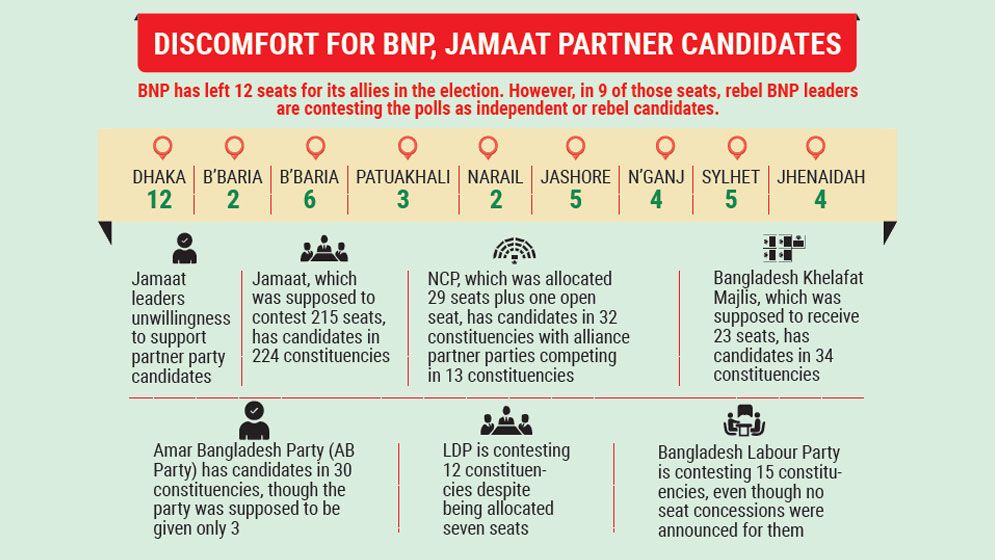
BNP has left 12 seats to its allies, but in 9 of those constituencies expelled or defiant BNP leaders are contesting as independent candidates. Despite formal expulsions, these leaders have maintained full-scale campaigns and grassroots outreach, relying on local support networks to remain electorally competitive. In many areas, a section – and in some cases a majority – of BNP’s grassroots leaders are reportedly aligned with the rebel candidates, undermining official alliance nominees.
As a result, BNP’s allies are failing to secure full backing from the party’s local units, leaving them under intense pressure from rebel candidates and jeopardising their electoral prospects.
In Dhaka-12 (Tejgaon), where BNP ceded the seat to Biplobi Workers’ Party General Secretary Saiful Haque, former BNP Dhaka Metropolitan North Convener Saiful Alam Nirab is contesting as an independent candidate, emerging as a major obstacle to Saiful’s campaign.
BNP also allocated the Brahmanbaria-6 (Bancharampur) seat to Ganosamhati Andolon Chief Coordinator Zonayed Saki, but BNP leader Saiduzzaman Kamal is contesting as a rebel candidate. A local BNP leader in Bancharampur, speaking on condition of anonymity, said a section of party leaders and activists were openly supporting Kamal, while others were quietly backing him out of fear of expulsion.
In Patuakhali-3, expelled BNP leader Hasan Mamun is running as an independent candidate, despite BNP’s decision not to field anyone in support of Gano Odhikar Parishad president Nurul Haque Nur. Most grassroots leaders are reportedly backing Mamun. Efforts by Barishal divisional organising secretary Bilkis Jahan Shirin to mobilise organisational support for Nur failed to yield results, prompting the dissolution of Galachipa and Dashmina upazila BNP committees.
BNP has left Brahmanbaria-2 (Sarail, Ashuganj and parts of Bijoynagar) to Jamiat-e-Ulamaye Islam Vice-President Maulana Junaid Al Habib, but former BNP assistant international affairs secretary Barrister Rumeen Farhana and BNP leader Tarun Dey are contesting as independents.
In Narail-2, the paddy sheaf symbol was ultimately awarded to alliance partner and unregistered NPP Chairman Dr Fariduzzaman Farhad. Earlier, BNP had given preliminary nomination to district BNP General Secretary Monirul Islam, who later entered the race as an independent. Farhad told the Daily Sun that the presence of a rebel candidate had divided BNP’s grassroots, although he claimed the situation was gradually improving following strict central directives.
In Jashore-5 (Monirampur), BNP left the seat to Rashid bin Wakkas, Joint Secretary General of its 12-party alliance partner Jamiat, but upazila BNP President Shahid Md Iqbal Hossain is contesting as a rebel candidate and has also been expelled.
Apart from these, Jamiat Secretary General Monjurul Islam Afendi in Nilphamari-1, Bobby Hajjaj in Dhaka-13 and Andaleeve Rahman Partho in Bhola-1, are not facing any competition from BNP rebels.
Meanwhile, within the Jamaat-e-Islami-led 11-Party unity, partner parties have also expressed frustration over what they describe as limited engagement by local Jamaat units in constituencies where Jamaat has not fielded candidates. Alliance sources said that in many such areas, Jamaat leaders had been preparing their own campaigns since the political changeover of 5 August 2024.
A Jamaat leader from Shahjahanpur, speaking anonymously, said sudden decisions to nominate candidates from partner parties had caused frustration among Jamaat activists, adding that ideological differences and the proportional representation equation in the upper house had further complicated cooperation.
The National Citizen Party (NCP) is contesting 30 seats under the 11-party alliance, with one additional seat declared open. However, candidates from alliance partners are competing in another 13 constituencies. A central NCP leader said the party had not received Jamaat’s support in at least five to seven constituencies. In Narsingdi-2 and Chattogram-8, Jamaat candidates initially did not withdraw their nominations. Although Jamaat candidate Md Abu Naser later announced his withdrawal from Chattogram-8, allegations persist that Jamaat has not fully supported the NCP candidate there.
Alliance candidate Zubairul Hasan Arif of Chattogram-8 wrote on Facebook that mutual non-cooperation within the alliance would only strengthen BNP’s influence nationwide, warning that defeat would be inevitable without unity.
The situation is most acute in Narsingdi-2, where alliance nominee NCP Joint Convener Md Golam Sarwar, also known as Sarwar Tushar, is facing competition from Jamaat candidate Amzad Hossain, who has neither withdrawn nor openly supported the alliance bid.
Other Jamaat partners have also voiced dissatisfaction. Bangladesh Khelafat Andolan Central Publicity Secretary Maulana Saiful Islam Sunamganji said Jamaat had yet to give clear support in specific constituencies, adding that discussions were ongoing.
Under the seat-sharing announcement of 21 January, Jamaat-e-Islami was allocated 215 seats, NCP 30, Bangladesh Khelafat Majlis 23, Khelafat Majlis 10, Liberal Democratic Party seven, Bangladesh Nezame Islam Party three, Amar Bangladesh Party three and Bangladesh Development Party two. In practice, Jamaat has fielded candidates in 224 constituencies, while NCP is contesting 32 seats, including 13 shared with alliance partners.
Several parties have exceeded their allocations. Bangladesh Khelafat Majlis is contesting 34 seats instead of 23, Khelafat Majlis 21 instead of 10, AB Party 30 instead of three, and the Liberal Democratic Party 12 instead of seven. The newly joined Bangladesh Labour Party is contesting 15 constituencies despite receiving no formal allocation. Bangladesh Development Party and Bangladesh Nezam-e-Islam Party, however, are contesting only the seats allotted to them.
The reporter can be reached at: [email protected]