



 For all latest news, follow the Daily Sun's Google News channel.


Mixed and contradictory signals from the interim government and the Election Commission (EC) have thrown the rules governing referendum campaigning by public officials into disarray, raising questions about neutrality ahead of a vote scheduled to be held alongside the next parliamentary election.
Earlier this month, senior figures in the interim government indicated there was no legal impediment to government officials campaigning in favour of a “Yes” vote in the referendum.
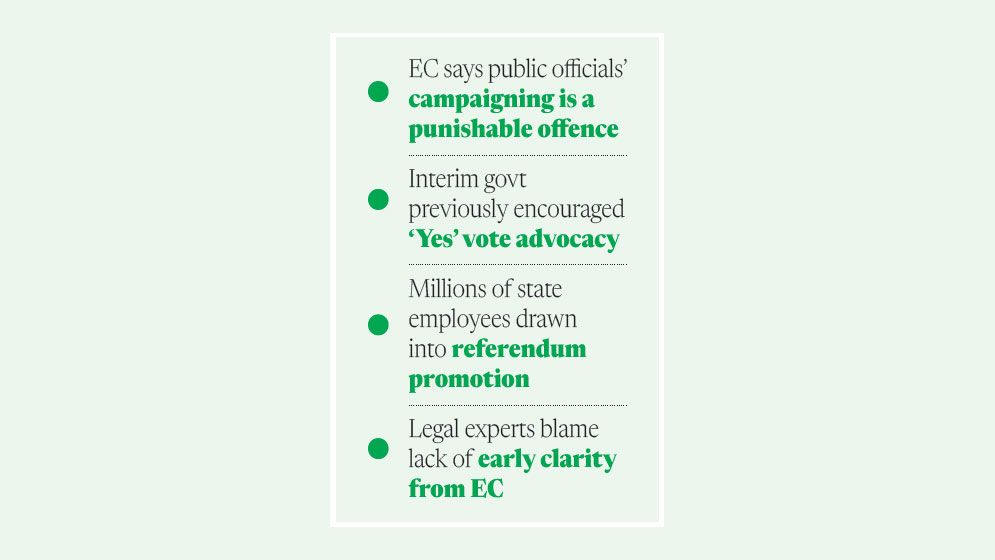
But on Thursday the Election Commission issued a firm directive declaring that any campaigning by public servants for either side would constitute a punishable offence under election law.
The conflicting positions have unsettled both administrators and election observers, fuelling concern over the integrity of the referendum process.
Speaking at an exchange of views programme in Sylhet on 24 January, Prof Ali Riaz, special assistant to the chief adviser and chief coordinator of the referendum campaign, insisted there were “no legal barriers preventing government officials from campaigning in favour of a ‘Yes’ vote”.
Riaz argued that neither the constitution, the Representation of the People Order (RPO), the July National Charter Implementation Order 2025, nor the Referendum Ordinance contains any prohibition on public employees speaking in favour of what he described as “positive change”.
“No one can provide a reference showing a legal bar to such campaigning. Those claiming there are restrictions are spreading misinformation with ulterior motives,” he said.
However, the Election Commission has now taken an opposing stance. In a letter sent on Thursday to all returning officers, the constitutional body instructed them to ensure that government officials and employees do not campaign for either a “Yes” or “No” vote, warning that doing so would be a punishable offence under the Referendum Ordinance and the RPO.
Copies of the directive were also sent to the cabinet secretary, the principal secretary to the chief adviser and other senior authorities.
According to the EC, Article 86 of the Representation of the People Order, 1972, and Section 21 of the Referendum Ordinance – which deals with offences, punishment and judicial procedure – clearly state that any attempt by public officials to influence the outcome of a vote constitutes an offence.
The announcement follows weeks of controversy over the interim government’s visible and extensive campaigning for a “Yes” vote to implement the so-called July Charter.
During this period, government departments at all levels – from headquarters to field administration – were instructed to conduct vigorous advocacy in favour of a “Yes” outcome.
Letters from the chief adviser’s office were sent to ministry secretaries, divisional commissioners and deputy commissioners, urging them to explain the necessity and objectives of the referendum at grassroots level.
Government employees were also encouraged to promote the slogan “The key to the country is in your hands; vote Yes for change” on their personal Facebook accounts. Billboards, banners and festoons supporting a “Yes” vote were displayed inside and outside government buildings.
According to official estimates, at least 2.1 million officials and employees from government departments, directorates, agencies, corporations and autonomous bodies took part in the campaign.
The campaign provoked unease within the administration itself.
Civil servants – from secretaries to office assistants – speaking on condition of anonymity said the government’s role should be limited to facilitating a free and fair referendum, not spending public money to advocate for a particular outcome.
Election expert Begum Jesmin Tuli, a member of the Election System Reform Commission, said the situation could have been avoided with clearer guidance from the outset.
“This was already in the RPO. This situation would not have happened if the Election Commission had been clear from the start,” she told the Daily Sun.
“It seems to me that with today’s announcement, the legal violations that were occurring will no longer happen. They should have done this from the beginning; nevertheless, it is good to see that they have finally taken the right step regarding this matter,” she added.
Despite the EC’s intervention, the abrupt shift in official messaging has deepened uncertainty over the permissible role of the state in the referendum campaign – at a time when public trust in the process is already under strain.