


 For all latest news, follow the Daily Sun's Google News channel.


Multinational listings still elude Bangladesh bourses
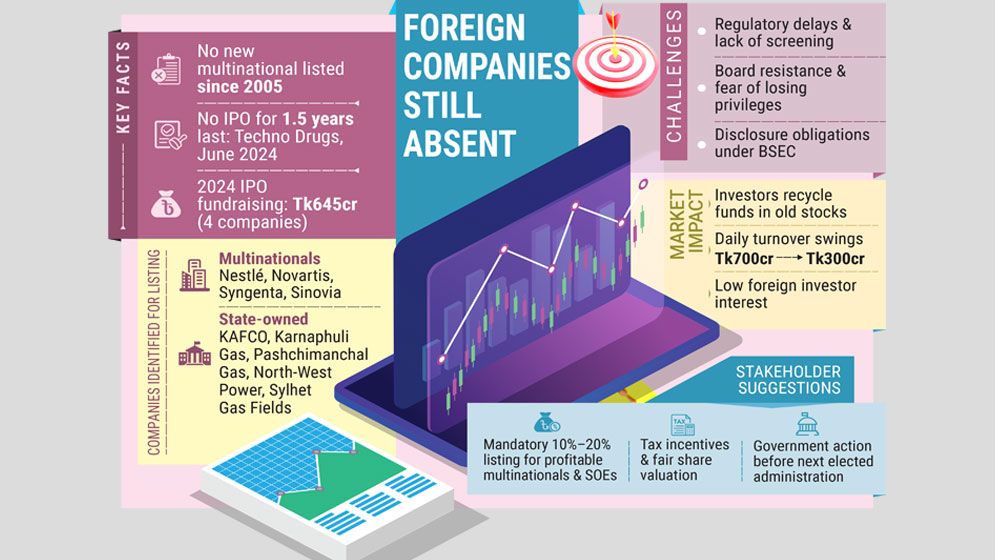
No new foreign company has listed since 2005, while an 18-month IPO drought deepens investor concern and prompts fresh policy pressure

Two decades after policymakers first urged multinational corporations operating in Bangladesh to list on the stock market, the goal remains elusive.
Not a single new multinational has entered the bourse since 2005 and, compounding investor unease, the market has seen no initial public offering (IPO) for the past one and a half years.
Market participants say the prolonged absence of new listings has deepened trading stagnation, narrowed investment options and weakened foreign portfolio interest.
Although the Bangladesh Securities and Exchange Commission (BSEC) rolled out capital market reform measures after August 2024, stakeholders argue the regulator has shown limited urgency in attracting new issuers.
As a result, companies that earlier expressed interest in listing have yet to undergo formal screening or verification.
With no fresh stocks entering the market, investors are forced to recycle funds into a small pool of securities, dampening liquidity and enthusiasm.
The lack of multinational listings has also constrained foreign investors’ appetite for exposure to Bangladesh equities.
Renewed policy push
In recent months, however, the government has revived efforts to bring multinational companies and profitable state-owned enterprises to the stock market, holding several high-level meetings to advance the process. ICB Chairman Abu Ahmed told the Daily Sun that the issue of multinational listings has lingered for years, but said renewed political intent was encouraging.
“The government’s intention is a positive step,” he said, adding that tax incentives and fair share valuation would be critical. He also pointed to recent amendments to IPO rules by BSEC, which he believes could help attract quality companies.
However, he acknowledged that transparency requirements remain a major deterrent.
“Once listed, companies come under regulatory supervision and must disclose financial reports. Many do not want to come under these obligations,” he said, explaining why both multinationals and profitable state-owned enterprises have historically resisted listing despite repeated government initiatives.
Directives from the chief adviser
Momentum increased following an 11 May 2025 meeting chaired by Chief Adviser Prof Muhammad Yunus at his Jamuna residence, where officials reviewed market conditions and outlined steps to strengthen the bourse.
The meeting was attended by the BSEC chairman, the finance adviser, the chief adviser’s special assistant and the secretary of the Financial Institutions Division.
Following the directives, BSEC convened several stakeholder consultations, including a 7 January meeting at the Secretariat chaired by Finance Adviser Dr Salehuddin Ahmed. Representatives from Karnaphuli Gas Distribution Company, Karnaphuli Fertilizer Company (KAFCO), North-West Power Generation Company, Pashchimanchal Gas Company, Syngenta Bangladesh, Sylhet Gas Fields, Unilever Bangladesh, Sinovia Bangladesh, Novartis (Bangladesh) and Nestlé Bangladesh PLC attended.
Among the multinational firms identified for possible listing are KAFCO, Sinovia (formerly Sanofi) Bangladesh, Novartis, Syngenta and Nestlé Bangladesh.
Tariqul Haque, manager of the Board and Share Section of Pashchimanchal Gas Company, said discussions have continued for years without tangible progress.
“No official letter has been received regarding when and how to enter the stock market. So it is difficult to say when the listing will happen,” he said.
At the same meeting, Dr Salehuddin said the government holds shares in several multinational companies that remain unlisted.
He said the process would begin soon and that the companies have indicated the matter would be decided at their respective board meetings, with government consent already in place. On timelines, he said companies have been urged to act swiftly, though listing remains a complex process governed by the Companies Act.
Stakeholders call for decisive action
Dhaka Stock Exchange (DSE) Director Richard D Rosario said multinational firms generating substantial profits in Bangladesh should offer partial ownership to the public.
“If necessary, laws should be enacted to mandate listing 10% to 20% of shares,” he said, dismissing concerns that such measures would deter foreign investment.
“They operate here because it is profitable. They must follow local rules.”
Rosario also blamed political interference and board-level resistance for the failure to list strong state-owned enterprises, arguing that the current non-political administration is better positioned to act before an elected government takes office.
DSE Brokers Association of Bangladesh (DBA) President Saiful Islam echoed the criticism, saying dialogue alone would not revive the market.
“It is unfortunate that not a single company has entered the market during the current government’s tenure,” he said, adding that fundamentally sound government and multinational firms could significantly deepen the capital market.
He cited reluctance among board members and officials, often driven by fears of losing privileges after listing, as a key obstacle.
“Keeping strong state-owned enterprises outside the market is discriminatory. If the government wants, these companies can be listed,” he said.
IPO drought reaches historic length
The most recent IPO was Techno Drugs in June 2024. Since then, no company has gone public for one and a half years, marking the longest IPO drought in Bangladesh’s capital market history.
IPO fundraising peaked in 2020 and 2021 but slowed sharply in 2022, collapsed in 2023 and weakened further in 2024.
Last year, only four firms – NRB Bank, Best Holdings, Asiatic Laboratories and Techno Drugs – raised a combined Tk645 crore through public offerings. NRB Bank raised Tk100 crore through a fixed-price issue, Best Holdings Tk350 crore, Asiatic Laboratories Tk95 crore and Techno Drugs Tk100 crore.
Rosario said a stock market without IPOs was unsustainable.
“Whenever quality companies such as Grameenphone, Walton, Square Pharmaceuticals, Robi and multinationals came to the market, investor participation surged,” he said, reiterating calls for mandatory partial listings by major foreign firms.
Investors voice concern
Anam Ataullah Naim, president of the Bangladesh Capital Market Investors United National Alliance, questioned how multinationals could gain confidence in a market where even local firms have stayed away for over a year. He blamed regulators for discouraging quality issuers through delays and weak follow-through, despite what he described as political goodwill.
Only a handful of listed companies now trade actively, he said, while investors remain reluctant to recycle funds into the same shares repeatedly.
Without new listings, daily turnover may briefly rise to Tk700 crore before sliding back to Tk300 crore within days, reflecting fragile sentiment and speculative churn.
“Fresh companies are essential to stabilise trading and rebuild confidence,” he said.
Read More