



 For all latest news, follow the Daily Sun's Google News channel.


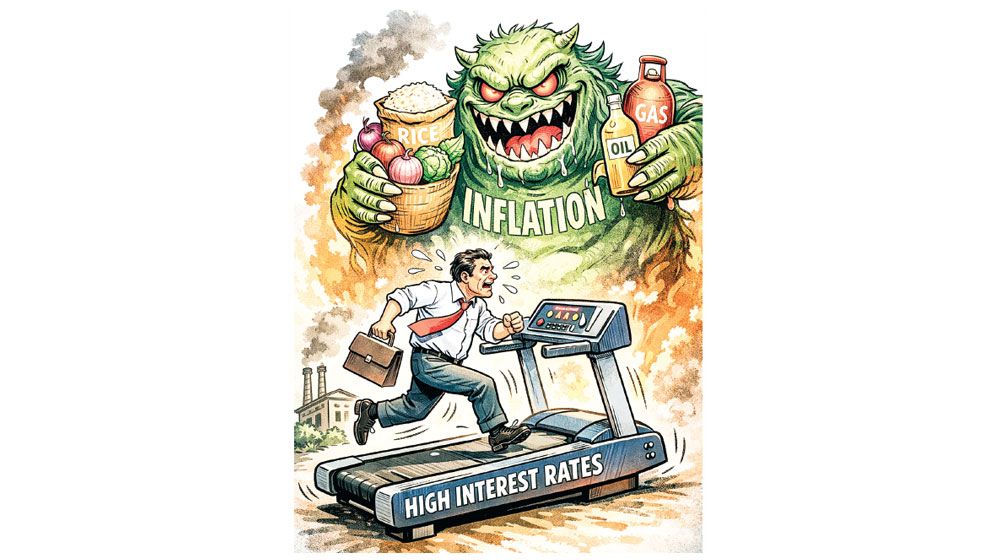
Despite repeated hikes in the policy interest rate, inflation in Bangladesh shows little sign of easing, raising questions about the effectiveness of monetary policy as the country braces for Ramadan price pressures.
Winter vegetable prices have eased somewhat, providing temporary relief for consumers, but the holy month historically drives up prices of essentials, fuelling public anxiety.
With inflation running high for nearly four years and political uncertainty looming ahead of the national election in February, the spotlight is now on Bangladesh Bank, which is set to unveil its Monetary Policy Statement (MPS) for the second half of the current fiscal year (January-June) later this month.
Since taking office as Governor, Dr Ahsan H Mansur has raised the policy interest rate three times by a total of 150 basis points, bringing it to 10%.
Yet, after more than a year at this level, inflation remains stubbornly high, casting doubt on whether further rate hikes would benefit the economy.
Economists and business leaders warn that higher interest rates are stifling economic activity without easing the cost of living.
According to Bangladesh Bureau of Statistics data, despite a slight year-on-year decline, overall inflation rose to 8.49% in December 2025.
Private sector credit growth, a key measure of economic dynamism, has fallen to historic lows, dropping to just 6.58% by November and remaining below 7% for six consecutive months. The target for the first half of fiscal year 2025-26 (FY26) is set at 7.2%, down from 9.8% the previous year.
Dr Mustafa K Mujeri, executive director of the Institute for Inclusive Finance and Development and former Chief Economist of Bangladesh Bank, told the Daily Sun, “The impact of policy interest rates on inflation has been limited due to rising import costs, higher energy prices, and weaknesses in the supply chain. In the absence of effective market oversight, syndicates are artificially inflating prices, while regulators have been slow to respond.”
He added that persistently high interest rates are raising business costs, discouraging borrowing, and undermining investment and growth. With the election approaching, investors are likely to adopt a cautious stance, meaning rate cuts at this stage might have little effect on activity, while risking further inflation.
Dr Mujeri suggested that maintaining the current rate, while strengthening market supervision and improving supply chains, would be a more pragmatic approach.
Business leaders echo these concerns. Shams Mahmud, President of the Bangladesh-Thai Chamber of Commerce and Industry (BTCCI), argued, “While higher interest rates can control inflation in advanced economies – where around 90% of loans are for consumers – this does not work in Bangladesh, where 85% of loans are for businesses. Rate hikes here raise production costs but do not curb consumption.”
Official data backs this view: inflation remains high even at record policy rates, while private sector credit has plummeted. “Loans at 15%-17% interest make doing business almost impossible,” Mahmud said, warning of a sharp slowdown in GDP growth.
Mohammad Hatem, president of the Bangladesh Knitwear Manufacturers and Exporters Association (BKMEA), painted a similar picture.
“Businesses now face new ‘tolls’ in the form of high interest rates. Borrowing at 15%-17% is simply not viable,” he said.
Hatem called for a reduction in the policy rate in the upcoming MPS and accused banks of imposing interest on previously interest-free funds, citing new instalment and loan classification rules as additional burdens.
He urged stronger oversight from Bangladesh Bank and a reversal of the new non-performing loan classification policy.