


 For all latest news, follow the Daily Sun's Google News channel.


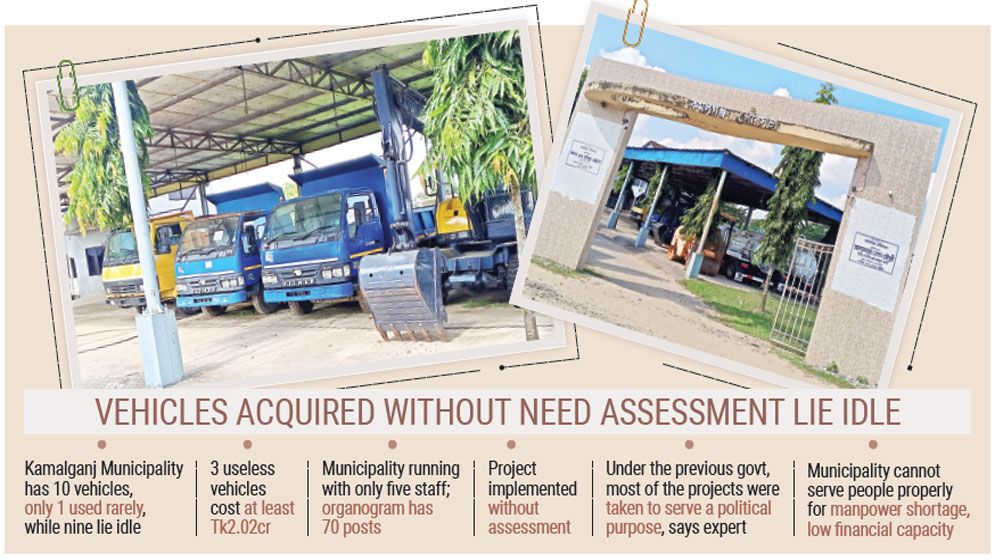
Kamalganj Municipality under Moulvibazar district has one driver but it has been given a total of nine heavy vehicles for road rolling, waste collection and transportation resulting in misuse of state funds.
Officials at the local government body said that the Local Government Division, Department of Public Health Engineering (DPHE) and others gave them the heavy vehicles without assessing their need and capacity and the vehicles have now been kept unused in its garage for years.
Among the heavy vehicles, there are three dump trucks, one Tata garbage truck, two vacuum tankers, two road rollers, and one excavator, according to the officials of the municipality.
Besides, there are two garbage vans.
Kabir Uddin who is a driver of Kamalganj Municipality, said, “I am the lone person to operate the nine heavy vehicles. Of these vehicles, only a dump truck is used sometimes. We cannot use vacuum tankers.”
Tax collector of the municipality Abdul Hannan said the municipality was founded in 2000. It has only five permanent staff and 13 no-work-no-pay staff, while there are 70 posts in its organogram. There is no staff like a conservancy inspector.
Due to the severe shortage in manpower and low financial capacity the municipality cannot serve the inhabitants under the local government body properly, said sources at the municipality.
During a visit on 26 November at the municipality, the nine heavy vehicles were seen in the garage and on the premises of the municipality.
Only acquisition, but no use
There were two brand new vacuum tankers for collecting and transporting waste from toilet pits seen at the garage of Kamalganj Municipality.
The text on the tankers said that the vehicles were given by the Bangladesh Municipal Water Supply and Sanitation for the 30 Municipalities Project.
Driver Kabir said, “The tankers were handed over in August 2024 but these could not be used for a single day as there is no human waste treatment plant for us. We use a dump truck when needed to transport waste in high volume and mostly our cleaners use waste vans as the collection is very low.”
He also said the municipality cannot use the road roller and it cannot be rented either.
Three of the idle vehicles from the project cost Tk2.02 crore.
Deputy project director for Bangladesh Municipal Water Supply for 30 municipalities Mahmudur Rashid Mazumder said that due to a land crisis the project could not construct a human waste treatment plant.
He said, “We had no chance to assess the capacity of the municipality. We have just implemented the project.”
Like the Kamalganj Municipality, similar situations were seen at Shaistaganj, Bashurhat, Kaliakoir, Sreepur, Madhupur Municipality where costly vehicles like garbage trucks and vacuum tankers and road rollers have been lying idle for years.
The vehicles were supplied to Urban Governance and Infrastructure Improvement Sector Project, Municipal Governance and Services Project and many other projects, apparently without any assessment of need.
The Daily Sun contacted the Additional Secretary of Planning and Monitoring, Inspection and Evaluation Wing of Local Government Division, Md Mahmudul Hasan, who said that they would be careful regarding the matter in future projects.
He said, “I will try to find out how many vehicles remain unused in different municipalities and what we can do to ensure the proper use of them.”
Talking to the Daily Sun, Professor at the Department of Government and Politics, Jahangirnagar University, and member of the Local Government Reform Commission Dr Mohammad Tarikul Islam, said that the discrepancies happened due to politically motivated allocation of resources.
He said, “Under the previous government, most of the projects were taken to serve a political purpose which is why it was seen that the need assessment was not done properly. Some municipalities would get excessively high allocation even when it was not necessary, while some were not allocated the needed resources.”