



 For all latest news, follow the Daily Sun's Google News channel.


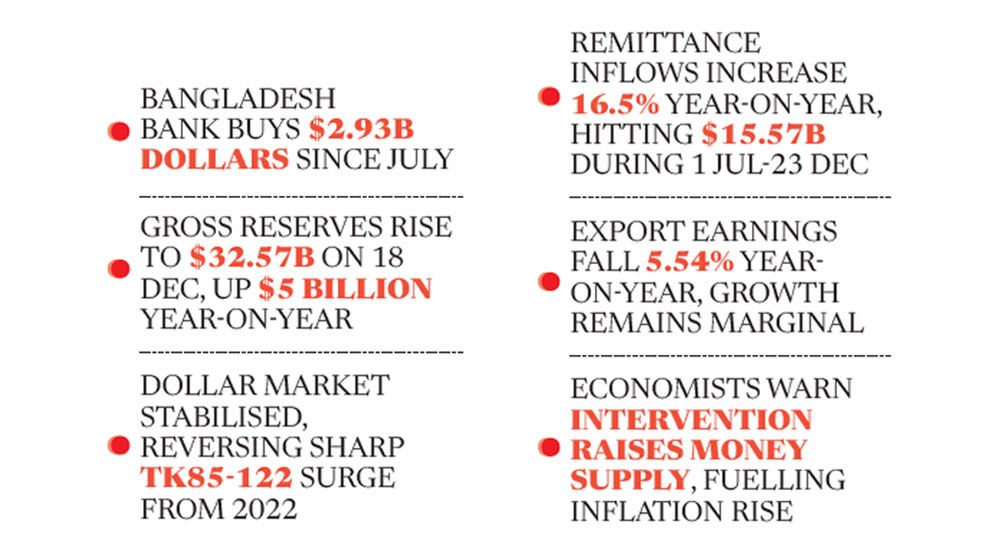
Bangladesh Bank’s sustained intervention in the foreign exchange market has helped rebuild depleted reserves and stabilise the dollar, but the strategy has intensified debate over its inflationary impact, even as remittance inflows surge while export earnings remain under pressure.
Since July, the central bank has shifted decisively from selling dollars to buying them, purchasing billions from commercial banks through auctions to prevent a sharp appreciation of the taka.
Data from Bangladesh Bank show that since the launch of the multiple-price auction system on 13 July, purchases have accelerated.
In nearly the first six months of the current fiscal year 2025-26 (July to 27 December), the central bank bought $2.93 billion from banks.
According to officials, the country’s dollar market became unstable in 2022, when the exchange rate rose from Tk85 per dollar to as high as Tk122.
Despite various measures taken by the previous government and the central bank, the market could not be stabilised.
At one stage, Bangladesh Bank was forced to sell dollars from its reserves, but even that failed to restore stability.
After the fall of the Awami League government, the current administration took strict measures to curb money laundering and control inflation.
As a result, remittance inflows have increased while exports declined, leading to a rise in dollar supply.
Although higher supply without corresponding demand would normally push the dollar rate down, the central bank has been buying dollars from the market on its own initiative to maintain stability.
These purchases have boosted reserves significantly.
As of 18 December, gross foreign exchange reserves stood at $32.57 billion, while reserves measured under the IMF’s BPM6 methodology reached $27.87 billion – up sharply from $24.96 billion (gross) and $19.95 billion (BPM6) a year earlier. Overall, reserves are now around $5 billion higher year-on-year.
Bangladesh Bank maintains that intervention is warranted because dollar supply currently exceeds demand.
“That is why Bangladesh Bank is purchasing dollars through auctions. If the dollar rate falls sharply, remittances and the export sector would be adversely affected,” Arief Hossain Khan said, adding that the practice would continue to “maintain market stability.”
The current approach marks a sharp reversal from the previous three fiscal years, when Bangladesh Bank sold around $34 billion from reserves – $7.6 billion in FY22, $13.5 billion in FY23 and $12.79 billion in FY24 – to meet import payments and counter intense pressure after the dollar surged from Tk85 to around Tk122 following global shocks triggered by the Russia–Ukraine war.
Despite those sales, market stability proved elusive at the time.
Inflation concerns intensify
Economists caution that while reserve rebuilding is positive, the inflationary risks are real. Headline inflation stood at 8.29% in November, according to the Bangladesh Bureau of Statistics (BBS), well above the central bank’s stated target of 4–6%.
Dr Zahid Hussain, former lead economist at the World Bank’s Dhaka office, told the Daily Sun, “Whenever Bangladesh Bank buys dollars from the market, it increases the money supply, which in turn fuels inflation. If Bangladesh Bank refrains from buying dollars, the exchange rate would fall slightly, creating an opportunity for inflation to ease. Yet questions remain as to why the central bank is moving in the opposite direction while claiming to prioritise reducing inflation.”
He added, “It is true that Bangladesh Bank’s current measures have stabilised the dollar market. However, given how sharply the dollar price has risen over the past three years, Bangladesh could have taken some risks and prioritised reducing inflation. Even if the dollar rate had declined slightly, it would not have had any significant impact on remittances or exports.”
In his view, greater emphasis should have been placed on lowering inflation, and the authorities could have monitored the market for a month or two before deciding on any intervention.
Mustafa K Mujeri, executive director of the Institute for Inclusive Finance and Development and a former chief economist of Bangladesh Bank, echoed the concern, saying the prolonged dollar crisis has eased and a more market-driven rate could bring relief to consumers through lower inflation.
Bangladesh Bank rejects the criticism, saying any excess liquidity is being sterilised through treasury bills and bonds, while banks’ reliance on repo borrowing has declined. Officials insist inflation risks from the operations are limited.
Remittances surge, exports struggle
The policy shift coincides with a strong rebound in remittances. Remittance inflows recorded 13.4% month-on-month growth up to 23 December 2025.
From July to 23 December 2025, remittances stood at $15.57 billion, compared with $13.37 billion in the corresponding period of the previous year (July 2024 to 23 December 2024).
This represents a 16.5% year-on-year increase in the current FY26 (up to 23 December 2025).
Industry insiders attribute the rise to a narrower gap between official and informal rates, tougher action against hundi networks, tighter monitoring of money laundering, and a more market-driven exchange rate that has encouraged the use of formal channels.
Exports, however, tell a weaker story. Earnings fell for the fourth consecutive month in November to $3.89 billion, down 5.54% year-on-year, according to the Export Promotion Bureau. While exports grew 1.77% from October, overall growth in the first five months of the fiscal year was marginal at 0.62%.