



 For all latest news, follow the Daily Sun's Google News channel.


Following the mass uprising in 2024, public expectations rose that the interim government would launch wide-ranging reforms, particularly in education, the sector from which the anti-discrimination movement originated last year.
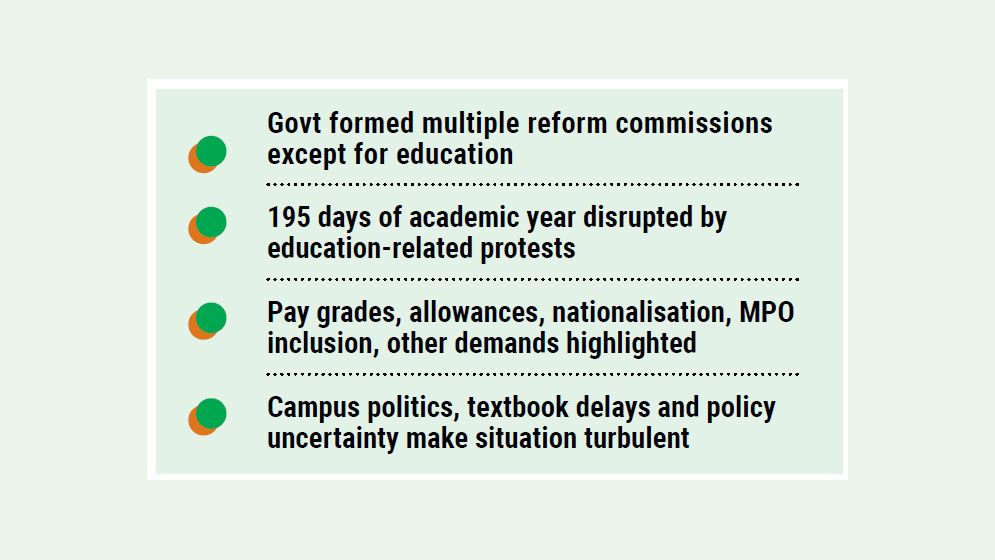
However, no concrete steps toward education reform have been taken so far.
Despite forming multiple reform bodies, including commissions on constitutional, public administration, electoral, police, judiciary, anti-corruption, local government, labour, women’s affairs and media reforms, the interim government did not establish an education reform commission.
Prof Mohammad Mojibur Rahman, of the Institute of Education and Research (IER) at Dhaka University, told the Daily Sun that the government failed to meet public expectations by sidelining education reform.
“Education should always be the top priority in any reform agenda. Ignoring it raises serious questions about whether the government truly seeks sustainable reform,” he said.
Meanwhile, the Daily Sun found that education-related movements disrupted at least 195 days of the year due to protests by nine categories of teachers and education stakeholders.
Primary-level assistant teachers demanding higher grades staged protests in three phases, including nationwide work stoppages in May and November, causing 28 days of academic disruption and forcing the postponement of annual examinations.
MPO-enlisted teachers demanding increased house rent and medical allowances protested for about 35 days across February-March and again in October, before the government eventually accepted their demands.
Ibtedayi madrasa teachers held sit-ins at the National Press Club for around 43 days demanding nationalisation, while assistant teachers whose appointments were cancelled protested for 11 days.
Non-MPO teachers demonstrated for nearly 64 days in total across February-March and November-December, demanding MPO inclusion for recognised institutions.
Later in the year, government secondary school teachers launched protests seeking ninth-grade status and BCS cadre equivalence, disrupting examinations through sit-ins and work stoppages.
Teachers of private primary schools, special-needs institutions and education cadre officials also carried out demonstrations lasting a combined 33 days.
Prof Mojibur Rahman said the growing culture of pressure-based movements reflected government short-sightedness.
“Teachers felt they could not remain passive. Ultimately, students suffered and the public paid the price,” he said, adding that an expert-led education reform commission could have prevented many of the disruptions.
The year also saw instability in higher education, with unrest over student council elections, clashes linked to student politics at several public universities, and blockades in the capital. The long-standing crisis involving the seven colleges affiliated with Dhaka University worsened as students and teachers engaged in counter-protests.
Textbook revisions, delays in textbook distribution, and debates over HSC pass rates further added to uncertainty in the education sector, making 2025 one of the most turbulent years for education in recent memory.
The reporter can be reached at [email protected]