


 For all latest news, follow the Daily Sun's Google News channel.


Smartphone prices may rise as global memory costs surge
Brands face a choice between absorbing the cost spike or passing it on to consumers
Suman Saha, Dhaka
Published: 30 Nov 2025, 12:00 AM
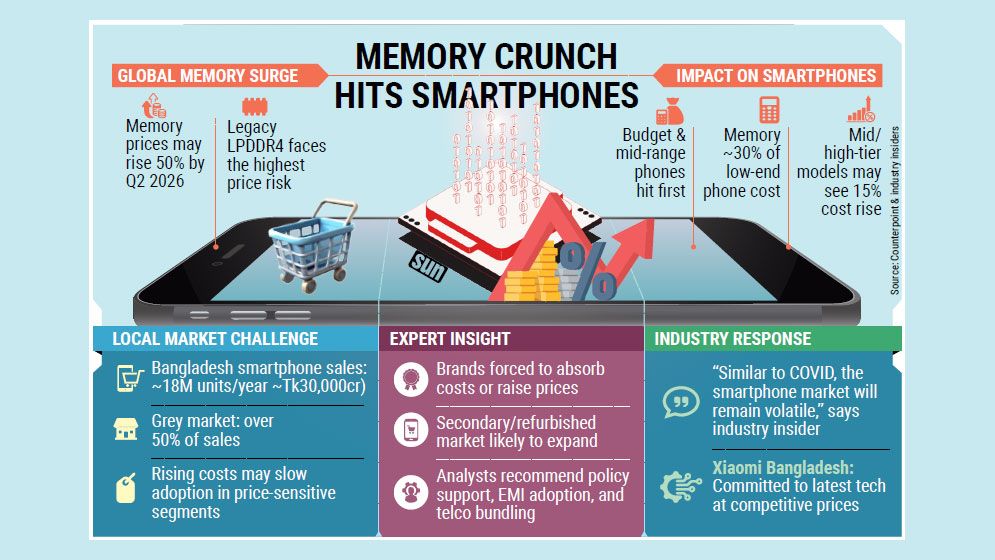
Global memory prices are set for a steep rise as AI-driven demand accelerates, with analysts warning that lower- to mid-range smartphones will feel the squeeze first, adding pressure on price-sensitive markets like Bangladesh.
Counterpoint reports that memory prices could climb nearly 50% through Q2 2026 due to a worsening chip shortage, with legacy LPDDR4 facing the highest risk of further hikes.
Distortions in the spot market are already visible, with DDR5 for servers and PCs trading at around US$1.50 per gigabit, while older DDR4 used in consumer electronics is selling for $2.10, higher than advanced HBM3e at $1.70.
Rising DRAM and NAND flash costs are being driven by global suppliers shifting production toward high-bandwidth memory for AI hardware, tightening supplies for mobile-grade memory used in budget and mid-tier smartphones.
Brands now face a choice between absorbing the cost spike or passing it on to consumers.
Industry analysts say this comes at a delicate moment for Bangladesh. After a recovery in 2024 and stability in 2025, rising memory prices threaten to push smartphone prices upward again in 2026, even as the government stresses affordability and prepares to relaunch the NEIR system on 16 December.
The pressure could reshape pricing strategies, delay launches, and alter consumer behaviour.
The budget segment is most at risk. Counterpoint Senior Analyst Ivan Lam said material costs could rise by up to 15% for some mid- and high-tier models, squeezing margins and slowing market growth.
Dhaka-based tech analyst MN Nahid said Bangladesh will not be able to escape the global shock. “The rising cost of memory is triggering a global chain reaction, and Bangladesh, where affordability drives most purchase decisions, will feel the impact.”
He said, “The segment under Tk20,000 will be affected the most because memory accounts for nearly 30% of component cost in this category.”
MN Nahid said the burden will fall hardest on price-sensitive consumers who drive digital access nationwide.
Brands in this segment already operate on thin margins, making it difficult to absorb higher costs without raising prices. As a result, smartphone adoption, particularly in underserved communities, may slow.
“We’re already seeing similar trends in larger markets. In India, smartphone prices have risen by about INR 2,000, and brands are reportedly set to hike prices by up to INR 7,000 (≈Tk10,000).
In China, Xiaomi has already increased pricing on one model by 300 RMB (≈Tk5,000). These shifts show the global pressure is real,” Nahid added.
Speaking to the Daily Sun, Xiaomi Bangladesh Marketing Director Md Asaduzzaman said technology is evolving rapidly and becoming increasingly unpredictable in the AI era.
While the company has no definitive outlook yet on the impact of rising memory costs, he said Xiaomi remains committed to offering the best technology at competitive prices.
An official at a leading smartphone brand with a factory in Bangladesh, requesting anonymity, said, “Similar to the COVID period, the smartphone market is expected to remain volatile in the coming months. We anticipate the global memory shortage to persist until Q3 2026, which will clearly impact the local market.”
Industry insiders say Bangladesh sells around 18 million handsets annually, worth over Tk30,000 crore, with more than half entering through the grey market.
Since local manufacturing began in 2017, about 18 companies, including Xiaomi, Samsung, Oppo, Vivo, and Transsion Holdings, have set up
factories, generating
jobs and technical know-how.
To support digital inclusion, Nahid recommends policy support for essential components, wider adoption of EMI options, and stronger telco-backed device bundling. Without intervention, rising memory costs could widen the digital divide.
He also noted that as new devices become more expensive, the secondary market is likely to expand, with more consumers turning to refurbished phones, creating opportunities for a more formalised pre-owned device ecosystem.
The writer can be reached at: [email protected]
Edited by: Anayet Rahaman