


 For all latest news, follow the Daily Sun's Google News channel.


‘Economy bleeding, but govt paying no heed to business community warnings’
Daily Sun Report, Dhaka
Published: 28 Nov 2025, 12:00 AM
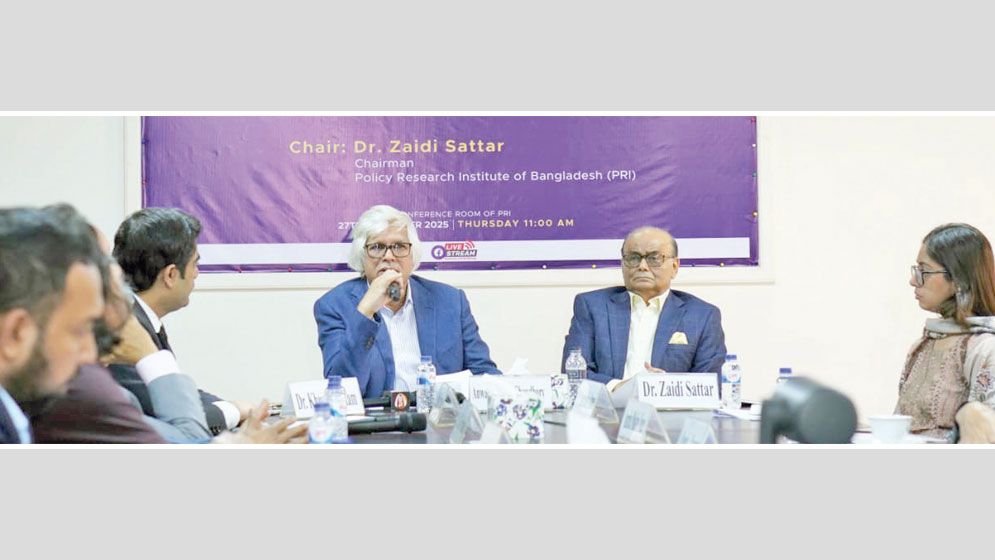
Bangladesh Chamber of Industries (BCI) President Anwar Ul Alam Chowdhury Parvez on Thursday said Bangladesh’s economy is “bleeding” amid fuel shortages, rising defaulted loans, and a fragile recovery, yet, the government is paying no heed to repeated warnings.
He made the remarks at a Policy Research Institute (PRI) economic review seminar in Dhaka.
Speaking as chief guest at PRI’s monthly economic review for September-October, Parvez accused the government of ignoring repeated appeals from the business community.
“Even though we are shouting, the government is not listening. They are not taking care of the business community,” he said.
Parvez said the government has failed to ensure adequate fuel supply despite increasing fuel prices, noting that production disruptions since 2022 have forced nearly 50% of small enterprises to shut down.
He also expressed alarm over surging defaulted loans. “When defaulted loans were at 17%, the IMF called Bangladesh a medium-risk country. Now it has exceeded 35%. What will the IMF call us now?” he questioned, warning that borrowing costs are set to rise further.
He added that Dhaka’s population has swelled to 35 million, while streets are now dominated by battery-run three-wheelers, which he referred to as “Tesla autorickshaws.”
Fragile recovery, persistent inflation, structural threats
The seminar coincided with the release of PRI’s August-September Monthly Macroeconomic Insights (MMI), prepared by the Centre for Macroeconomic Analysis (CMEA) in partnership with Australia’s Department of Foreign Affairs and Trade (DFAT).
The report highlights that although imports have begun to rise—indicating early signs of recovery—the rebound remains weak. Inflation continues to hover above 8%, eroding household purchasing power as wage growth lags.
PRI noted that Bangladesh’s tax-to-GDP ratio remains one of the lowest globally, describing it as a “pyramid of shame.”
Encouragingly, deposit growth has returned to double digits for the first time in 17 months, which economists described as a potential policy dividend—one that will need to be sustained for years to offset losses from growing non-performing loans (NPLs).
Central bank independence key to stability
PRI Chairman Dr Zaidi Sattar, who presided over the seminar, said the economy, though slowed, has regained a degree of stability. To boost employment, he urged more liberal economic policies.
He also said Bangladesh remains in a better export position than India and Pakistan despite countervailing tariffs.
Dr Monzur Hossain, member (secretary) of the General Economics Division of Planning Commission, attended as chief guest.
He stressed the need for coordinated policy between the central bank and the fiscal authorities.
“Investment depends on the overall economic ecosystem and cannot be revived overnight. The tight monetary policy should be relaxed moderately,” he said.
He also questioned the sustainability of Bangladesh Bank’s prolonged high policy rate stance.
‘Economic oligarchs’ and the danger of influence
Presenting the keynote paper, PRI Principal Economist Dr Ashikur Rahman issued a sharp warning on the rising influence of “economic oligarchs” who, he said, infiltrate political and state institutions and destabilise economies.
“If left unchecked, they destroy the very host that nourishes them,” he said, adding that recent history in the subcontinent shows how dominant parties have suffered from such capture.
He underscored that central bank independence is vital to protect public financial assets from future mismanagement or “plundering.”
Panelists echoed concerns about deep structural weaknesses.
Dr Bazlul Haque Khondker, PRI research director, said growth alone cannot reduce poverty and inequality. Only 1% of social safety allocations reach the poor, he noted.
Dr M Masrur Reaz, chairman of Policy Exchange, warned that without fresh investments, job creation will stagnate.