


 For all latest news, follow the Daily Sun's Google News channel.


Newspaper editors urge Jamaat to pursue constructive criticisms, avoid violent demos
Daily Sun Report, Dhaka
Published: 24 Aug 2026, 10:32 PM
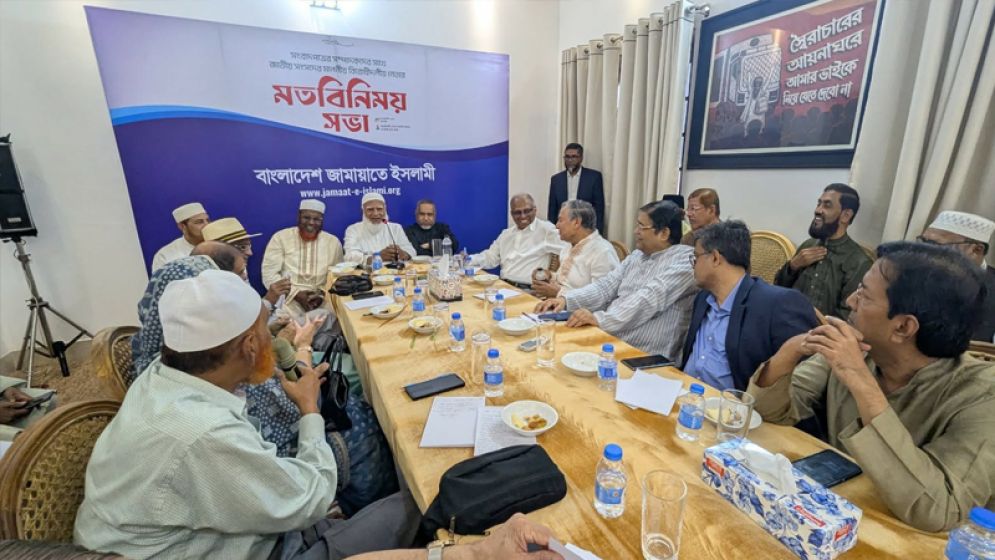
Photo: Courtesy
Newspaper editors on Monday advised
Bangladesh Jamaat-e-Islami, the main opposition party in parliament, to avoid violent
street demonstrations and instead hold the government accountable through
constructive criticism and peaceful, democratic means.
The editors also asked the Islamic party take
to the streets peacefully to raise the people’s demands when necessary.
In response, Jamaat Ameer and Leader
of the Opposition Shafiqur Rahman sought media cooperation to strengthen
democratic practices and make parliament the centre of political activity.
The exchange came during a
view-exchange meeting with editors at the opposition leader’s official
residence on Mintoo Road in Dhaka.
Speaking after the meeting, Jamaat
Secretary General Mia Golam Porwar said editors had advised the party to
criticise the government constructively and press its demands on the streets
while shunning violence.
“They advised us not to destabilise
the country by resorting to the intolerant, volatile or violent paths taken by previous
opposition parties. Some editors sought the cooperation of our Ameer-e-Jamaat
in this regard,” he said.
Porwar said Jamaat had presented the
country’s overall situation and the opposition’s role in parliament to the
editors, and had clarified its position on the government’s alleged denial of
the referendum verdict’s implementation.
Jamaat remained committed to playing
a responsible parliamentary role and to avoiding traditional opposition
politics that go against the public interest, he added, saying editors had
praised the party’s stance for the sake of national stability.
Amar Desh Editor Mahmudur Rahman
said the opposition leader had urged editors to point out the party’s mistakes
and offer advice, and had expressed interest in holding regular meetings with
senior editors.
The Jamaat chief also called for
professional, objective journalism, noting that media freedom had returned
after the July uprising.
According to Mahmudur, the
opposition leader informed editors that a shadow cabinet had already been
formed and was undergoing training.
On relations with India, the
opposition leader said Bangladesh expected “neighbourly behaviour” from New
Delhi and did not want to give away everything or take everything, Mahmudur
said.
He added that the opposition leader
urged that political issues be raised through designated platforms, and called
for resistance against any future fascist behaviour by the government towards
the media.
Pritidiner Bangladesh Editor Maruf
Kamal Khan said editors had urged the opposition leader to ensure that neither
fascism nor political anarchy in the name of opposition politics returns,
stressing that both must be prevented to make the country’s democracy
sustainable.
Porwar said Shafiqur Rahman had also
told editors that the opposition would continue to protest against all acts of
injustice and measures contrary to the public interest, and that such
resistance would remain constitutional and constructive.
Shafiqur Rahman held a
question-and-answer session with editors on the country’s current situation,
the international and geopolitical scenario, and relations with neighbouring
countries, Porwar said.
During the discussion, the Jamaat
chief also raised concerns over government allocations for development projects
and the limited time given to opposition lawmakers during parliamentary
proceedings.
“Our party chief urged the editors
to present the truth through their writings,” Porwar said, adding that Jamaat
did not see any distance between itself and the mass media.
Asked about the referendum verdict, the
Jamaat ameer said the 11-party alliance would not make the slightest concession
on its implementation.
“It would be best if the matter is
addressed in parliament. Otherwise, we will take to the streets,” he said.
Apart from the Ameer and Secretary
General, members of Jamaat’s Central Executive Council were also present.
Editors in attendance included Mahfuz Anam (Daily Star), Mahmudur Rahman (Amar
Desh), Sajjad Sharif (Prothom Alo), Shafik Rehman (Jaijaidin), Mustafiz Shafi
(Desh Rupantor), Mostofa Kamal (Khabarer Kagoj), Dewan Hanif Mahmud (Banik
Barta), Shafiqul Alam (Daily Waadaa), Kamrul Hasan (Ajker Patrika), Tasmima
Hossain (Ittefaq), Maruf Kamal Khan (Pritidiner Bangladesh), and Daily Sun
Deputy Editor Al Amin.