


 For all latest news, follow the Daily Sun's Google News channel.


Son back to 'build' nation: Tarique Rahman returns after 17 years in exile
Party leaders andactivists from across the country had gathered in Dhaka, enduring severe cold through the night to catch a glimpse of Tarique
The Telegraph, India
Published: 26 Dec 2025, 03:48 PM
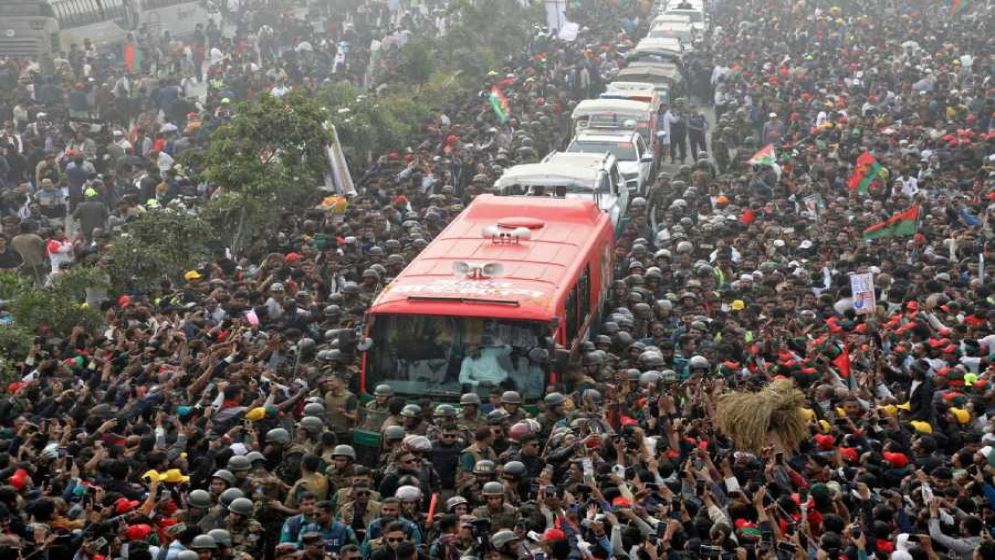
Tarique Rahman waves from a bus as his convoy negotiates a sea of people in Dhaka on Thursday. Photo: Reuters
Tarique Rahman waved at the gathering. He removed the luxurious chair reserved for him at the centre of the stage in favour of an ordinary plastic chair.
“We want to build a country where a mother can be sure of the safety of her child. Hindus, Muslims, Buddhists, Christians, people from the mountains and the plains, will all live with equal rights,” he said.
Tarique, Bangladesh Nationalist Party (BNP) acting chairman and son of Khaleda Zia and the late Ziaur Rahman, was delivering his first public address on returning to his homeland after 17 years of self-imposed exile in the UK.
He had left Bangladesh in 2008, charged in multiple cases of bribery and money laundering. Since then, Bangladesh had gone through the accumulated crises of weakening public institutions, a corrupt centralised authority, rigged elections and shrinking dissent before its patience gave way in the form of the July Uprising last year. Awami League leader and then prime minister Sheikh Hasina was ousted.
Bangladesh did not stop looking forward to welcoming the BNP’s prince-in-exile. Party leaders and activists from across the country had gathered in Dhaka, enduring severe cold through the night to catch a glimpse of Tarique.
Many slept on streets using mats, blankets or polythene, while others lit small fires with straw to keep warm. More supporters arrived in the morning. A 300-foot stage had been prepared at Purbachal, Dhaka.
Tarique returned to Bangladesh to a hero’s welcome at 11.40am. In the afternoon, he addressed a huge crowd at a grand public reception.
He began his speech with “Dear Bangladesh”, and remembered the country’s great freedom struggle of 1971 immediately after conveying his gratitude to the Almighty for allowing him to return to his motherland.
He reminded the crowd how Bangladesh had been rescued again and again from various non-democratic, autocratic and fascist regimes — in November 1975, in 1990, and again in 2024.
His speech was not long but was filled with calls to ensure communal harmony and security for women, children, the disabled and ordinary people, irrespective of class, religion, gender or occupation.
Remembering Hadi — shot a week ago on the day Tarique’s return was announced — the BNP leader said Bangladesh must pay its debts to all the martyrs of 1971, and those martyred during the subsequent fascist regimes, by making itself safe and worthy of those brave sacrifices.
He sought patience from everyone, but especially from BNP leaders and workers, whom he asked to stay calm and united, and vigilantas well.
Warning against possible conspiracies and sabotage, Tarique said, “The spies of the hegemonic forces are still involved in conspiracies. We have to remain extremely calm and steady.”
He urged the youth to take up the responsibility of building the nation, and repeatedly emphasised the need to maintain peace and order.
On his arrival, Tarique touched the earth with his bare feet and stood for a while before getting on with his schedule of addressing the crowd and visiting his ailing mother and the house where he was born.
He had flown in on a low-carbon Airbus accompanied by his wife Zubaida Rahman, daughter Zaima Rahman, and their pet cat. The furry Zeebu has already caught a good share of the media spotlight around Tarique’s return.
Despite his long exile, Tarique has remained embedded in the political process of Bangladesh. The efforts to marginalise him turned him, in absentia, into a symbol of sustained resistance.
From abroad, he exercised continuous leadership over the BNP, guiding it strategically, carrying out organisational restructuring, and helping with decision-making through digital coordination.
It exposed him to ridicule as “Zoom leader” from ministers and other Awami League heavyweights as well as a segment of the mainstream media. But this “digital bridge” allowed the BNP to survive prolonged authoritarian pressure and gradually regain public credibility.
Tarique’s long-awaited return to Bangladesh at a most fragile moment of its political history carries deep significance for the country’s future.
His return ends prolonged speculation and places him at the centre of the country’s political future as the de facto leader of the BNP ahead of national elections.
Although the BNP’s dominance may raise concerns for democratic balance, it remains the only viable moderate force against the rising Right-wing alliances.
In this period of transition, Bangladesh faces a leadership vacuum — the interim government is administratively functional but politically uninspiring, while the “new politics” lacks institutional grounding.
A return of the Awami League is almost out of the question, while the Jamaat-e-Islami’s strength remains limited despite the contrary impression created by online narratives.
Against this backdrop, leadership is likely to be measured increasingly by continuity, capacity and recognition — areas where Tarique has elevated himself beyond partisan identity into national relevance.
His 31-point reform framework signals a shift from resistance to governance, emphasising institutional independence, rule of law, accountability and socio-economic recovery.
His rhetoric prioritises inclusion over retribution, positioning his return as a catalyst for restoring political contestation and re-centring democratic power in public hands.
The country’s democracy, governance and public welfare depend heavily, in the short to medium term, on how Tarique leads the party and, when it does happen, the government.