


 For all latest news, follow the Daily Sun's Google News channel.


October 1971: When Bangladesh Refused to Surrender
"Sustained guerrilla campaigns, brutal civilian repression, and high-stakes diplomacy turned October 1971 into a crucible for Bangladesh's freedom—leaving lessons that still command the attention of a new generation."
Special Correspondent
Published: 16 Oct 2026, 12:43 PM
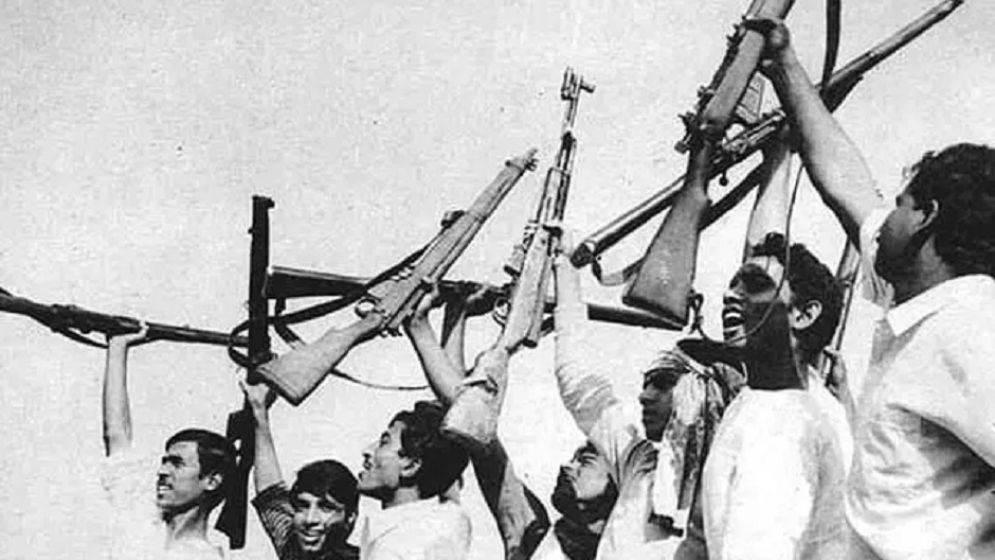
Bangladesh's freedom was not the automatic conclusion of history. Photo: Collected
Imagine a country where voters have chosen their representatives through a democratic election, only to see the military refuse to honour the result. Soldiers patrol the streets and highways. Bridges and railway lines become targets. Villages face reprisals, families flee their homes, and young men and women join a growing resistance movement. Across the border, millions seek refuge, while foreign governments weigh the crisis against their own strategic interests.
This was the reality in Bangladesh in October 1971.
Independence would be secured on December 16, when Pakistani forces surrendered in Dhaka. But the outcome was far from certain in October. The Mukti Bahini was intensifying its guerrilla campaign, Pakistani forces continued their military repression, the provisional government of Bangladesh pursued international support, and India prepared for the possibility of a wider war.
October was therefore more than an interval between the military crackdown of March and the victory of December. It was a critical phase in which armed resistance, civilian suffering, political mobilisation and international diplomacy converged. For a generation born long after 1971, the month offers an opportunity to understand how democratic denial can lead to conflict, how ordinary people sustain a national liberation struggle, and why history must be examined through evidence rather than slogans.
A Nation That Refused to Be Subdued
By October, the central question was whether Pakistan’s military could maintain control over a population increasingly determined to establish an independent Bangladesh.
The Mukti Bahini expanded its guerrilla operations against Pakistani positions, ambushing patrols and disrupting the transport, power and communications networks that sustained the military occupation. Reports from different regions indicated that the resistance was becoming more organised and geographically widespread.
A Bangladesh Forces bulletin dated October 16 reported that guerrilla operations had destroyed four electricity substations in Chattogram, disrupting power across extensive areas during the first week of the month. Another bulletin, dated October 25, recorded further ambushes, attacks on Pakistani positions and disruptions to railway communications in several sectors.
These accounts, produced by the liberation forces during wartime, are valuable contemporary records. Their operational claims, particularly reported casualty figures, must nevertheless be assessed in light of their origin and the limitations of wartime reporting. Read critically alongside independent historical research, they offer insight into the scale of the resistance campaign and the efforts of its leadership to document military activities.
The strategy was straightforward: restrict the movement of Pakistani troops, disrupt supply lines, stretch the resources of the occupation army and demonstrate that its authority remained contested. Each operation carried risks not only for the fighters but also for civilians living near military targets and transport routes.
October was a month of sustained attrition. The Mukti Bahini had not yet delivered the decisive military blow, but its continuing operations placed pressure on Pakistani forces and contributed to the conditions that would shape the final phase of the war.
When Villages Became Battlefields
The history of October 1971 cannot be measured solely through military operations, damaged infrastructure or territorial gains. It must also be understood through the lives lost, homes destroyed and communities left traumatised by violence.
According to accounts of the incident, Pakistani troops, assisted by members of a local Peace Committee, attacked Najirpur in Pabna on October 14. The reported toll was 57 civilians killed and approximately 500 houses burned. The accounts describe villagers being rounded up and killed by gunfire or bayonets.
The incident illustrates the devastating consequences of military repression and the role played by local collaborators in violence against civilians. The precise details and casualty figures should be assessed against available documentary and historical evidence, but the reported destruction reflects the wider experience of communities caught in the conflict.
The violence had begun months earlier. On March 25, the Pakistani military launched its crackdown in East Pakistan, targeting Bengali political opposition and resistance. In the months that followed, Pakistani forces carried out widespread killings, sexual violence and the destruction of settlements. Bengali nationalists, political activists, intellectuals and Hindu communities were among those targeted.
The human consequences extended far beyond the battlefield and across international borders. Approximately 10 million people fled to India during 1971, creating one of the largest refugee emergencies of the period. Families abandoned homes, land and livelihoods. Children faced hunger and disease, while Indian communities and authorities struggled to accommodate the enormous influx.
Behind every refugee statistic was an individual or family forced to make an agonising decision: remain amid the threat of violence or leave behind everything familiar in the hope of finding safety elsewhere.
The refugee crisis was not a peripheral consequence of the war. It became a defining humanitarian and diplomatic issue, shaping India's response and increasing international pressure for a political resolution.
The Democratic Crisis Behind the War
To understand the significance of October, it is necessary to return to the political crisis that preceded the fighting.
In Pakistan's general election of December 1970, Sheikh Mujibur Rahman's Awami League won an absolute majority in the National Assembly, giving it the parliamentary mandate to lead the formation of a national government. The transfer of power did not take place. The National Assembly session was postponed amid a deepening political confrontation, and the military crackdown followed in March 1971.
For many Bengalis, the refusal to honour the electoral outcome confirmed that political representation within a united Pakistan had become increasingly untenable. The demand for autonomy developed into a struggle for independence as repression intensified and the conflict spread.
By October, Sheikh Mujibur Rahman remained imprisoned in West Pakistan. Bangladesh's provisional government, formally established at Mujibnagar in April, continued to organise the independence movement from exile in India, with its principal administrative operations centred in Calcutta, now Kolkata.
The government faced two closely connected challenges. It had to sustain the armed struggle while establishing Bangladesh's political legitimacy before the international community. Its leaders sought to demonstrate that the independence movement was rooted in an electoral mandate and the aspirations of the Bengali population, rather than being merely an armed separatist campaign.
The shooting of Abdul Monem Khan, the former governor of East Pakistan and a prominent supporter of Pakistani rule, at his Dhaka residence on October 13, followed by his death later that night, underscored the continuing political violence within the occupied territory. The incident also reflected the extent to which the conflict had reached beyond conventional military engagements.
Yet battlefield operations alone could not secure diplomatic recognition or guarantee independence. Bangladesh's leaders needed international political support, material assistance and a wider understanding of the circumstances that had produced the war.
October exposed the gap between the Bengali people's determination to establish an independent state and the reluctance of several influential governments to translate their concerns into meaningful diplomatic action.
India, Washington and the International Struggle
India occupied a central position in Bangladesh's liberation struggle. It provided refuge to millions fleeing the violence, hosted the provisional government and assisted the Mukti Bahini through training, equipment and logistical support. These contributions strengthened the resistance, while the refugee emergency placed immense economic, administrative and security pressures on India.
Prime Minister Indira Gandhi sought to draw international attention to the crisis, arguing that any lasting settlement had to take account of the wishes of the Bengali people and create conditions for the safe return of refugees. At the same time, India had to prepare for the possibility that its increasingly tense confrontation with Pakistan would develop into full-scale war.
Washington's approach was shaped by a different set of strategic calculations.
President Richard Nixon and his national security adviser, Henry Kissinger, regarded Pakistan as an important partner, particularly because the Pakistani government was facilitating the United States' diplomatic opening to China. Declassified American records show that US officials received disturbing reports of atrocities in East Pakistan while the Nixon administration continued to prioritise its strategic relationship with Islamabad.
The American response was not without internal opposition. Archer Blood, the US consul general in Dhaka, and other American diplomats objected to Washington's handling of the crisis. Their concerns were expressed in the April 1971 dissent cable, which criticised the US response to the military crackdown. The episode remains a significant example of diplomats challenging their own government's policy on moral and professional grounds.
India's strategic position had also been strengthened by its treaty of peace, friendship and cooperation with the Soviet Union, signed in August 1971. As tensions increased, the treaty provided an important diplomatic backdrop to India's calculations.
On October 30, Nixon wrote to Pakistani President Yahya Khan urging measures to reduce the danger of war, including reciprocal withdrawals of forces from border areas. His letter also emphasised the need to involve the elected representatives of East Pakistan in achieving a viable political settlement.
The correspondence reflected Washington's concern about the prospect of a broader regional conflict, even as its policy continued to be influenced by the geopolitical value it attached to Pakistan.
Meanwhile, fighting around the Dhalai border outpost began on October 28 and continued into early November. The engagement involved Indian and Pakistani forces and illustrated the increasingly direct military dimension of the crisis. What had begun as a struggle for Bengali self-determination was becoming more closely intertwined with the prospect of an interstate war.
October ended without a political settlement. Nevertheless, the military and diplomatic circumstances surrounding the conflict were changing, setting the stage for the decisive developments of November and December.
Why October 1971 Still Matters
Historical memory often gravitates towards defining dates. March 25 marks the beginning of the military crackdown, while December 16 commemorates Pakistan's surrender and Bangladesh's victory. Between these milestones lies a period of struggle that deserves equal attention.
October 1971 reveals how independence was pursued through sustained resistance, political organisation, international advocacy and extraordinary civilian endurance. The Mukti Bahini maintained pressure on Pakistani forces. The provisional government worked to establish international legitimacy. India managed an immense humanitarian emergency while preparing for the possibility of war. Meanwhile, the responses of major powers demonstrated how strategic interests could limit the international community's willingness to act decisively in the face of human suffering.
For young Bangladeshis, the lesson is not simply to celebrate the courage of those who fought for independence. It is to understand why that courage became necessary and how the political choices of individuals, institutions and governments shaped the course of history.
That understanding requires more than commemorative speeches. It calls for engagement with original documents, wartime records, diplomatic correspondence, eyewitness testimony and independent historical scholarship. Contemporary military bulletins must be examined critically, individual atrocity accounts should be assessed against available evidence, and the experiences of civilians must remain central to any serious account of the war.
It also requires recognition of the many forces that contributed to Bangladesh's independence: the sacrifices of the Mukti Bahini, the suffering and resilience of civilians, the political leadership of the independence movement, India's humanitarian and military assistance, and the decisions of international powers whose policies influenced the conflict.
Above all, independence should not be treated as an inevitable outcome. In October 1971, victory was not assured. The struggle continued amid military repression, enormous human suffering and diplomatic uncertainty. Its outcome depended on the determination, organisation and sacrifices of people who persisted despite formidable obstacles.
Bangladesh's freedom was not the automatic conclusion of history. It was achieved through human choices, collective resistance and immense sacrifice.
That is why October matters. And that is why a generation born long after 1971 must understand not only how Bangladesh won its independence, but also what its people endured to achieve it.