


 For all latest news, follow the Daily Sun's Google News channel.


Jobs Take Centre Stage on Day One of World Bank-IMF Annual Meetings
Md Shumon Zihady and Saroar Ahmed Saleheen
Published: 13 Oct 2026, 02:47 PM
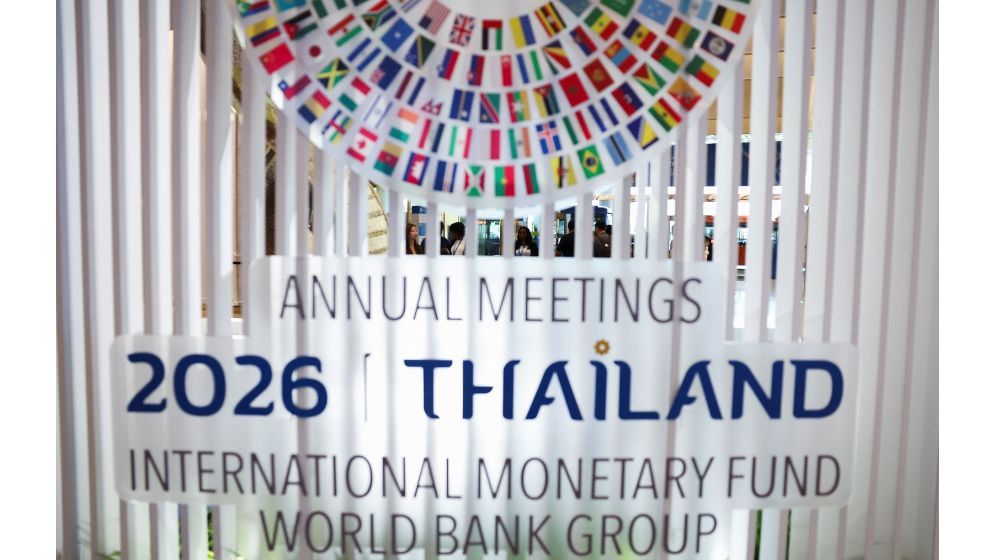
People attend the IMF/World Bank 2026 Annual Meetings at Queen Sirikit National Convention Center (QSNCC) in Bangkok, Thailand, 13 October, 2026. Photo: REUTERS
The 2026 Annual Meetings of the World Bank Group and International Monetary Fund (IMF) opened in Bangkok, Thailand, bringing together nearly 15,000 participants from governments, businesses, civil society and international institutions. Amid a wide range of deliberations, one concern dominated the opening day: the future of employment and the urgency of creating more and better jobs. Traditionally, these meetings have focused on economic growth, infrastructure and entrepreneurship. While these priorities remain relevant, this year's discussions signal a discernible shift towards employment generation, job security and the evolving nature of work. The morning's first open session, "Small AI: More and Better Jobs," reflected this changing emphasis. As artificial intelligence (AI) reshapes labour markets, international financial institutions are exploring ways to mitigate disruption while harnessing technological opportunities. IMF Managing Director Kristalina Georgieva described the current transformation as an "investment shock," to be followed by an "adaptation shock." These developments are influencing economies worldwide, particularly decisions concerning investment priorities.
A compelling dimension of the discussion was the potential of small-scale AI applications in developing economies, offering valuable lessons for Bangladesh. The World Bank-supported AgriConnect initiative in Uttar Pradesh, India, illustrates this potential. By incorporating AI into everyday agricultural activities, the initiative helps farmers overcome practical challenges while improving production, marketing and access to agricultural services. Preliminary evidence suggests that such innovations can broaden economic opportunities for smallholders, traders and agricultural workers rather than displace them. Pierre Laporte, Seychelles' Minister of Trade and Investment, similarly highlighted AI's potential to strengthen the country's blue economy, tourism and agriculture. His examples demonstrated how smaller economies could deploy AI as a transformative instrument for employment generation rather than job displacement.
The underlying message was unmistakable: technological advancement need not undermine employment. With appropriate policies and investment, it can expand economic opportunities, even in resource-constrained economies. Employment resurfaced prominently during the Civil Society Townhall, where World Bank Group President Ajay Banga presented a sobering projection. Over the next decade, approximately 1.2 billion young people in developing countries are expected to reach working age, against an estimated 400 million new jobs. This staggering disparity could unleash profound economic and social consequences. The implications extend beyond conventional measures of prosperity. GDP growth alone cannot adequately capture development success; productive employment, sustainable livelihoods and economic inclusion must become equally important benchmarks.
This raises a fundamental question, while governments and development organisations invest heavily in education and skills development, are existing economic structures capable of absorbing an increasingly skilled workforce? Addressing this imbalance requires substantial investment, accompanied by transparency, accountability and safeguards against corruption. A recurring proposition was the need for an integrated financing framework involving governments, private enterprises and philanthropic institutions. Governments would foster an enabling environment, businesses would stimulate investment and employment, and philanthropic actors would mobilise complementary financial and institutional resources. The World Bank's Philanthropy Hub and Philanthropy Forum could facilitate such collaboration, potentially reshaping development financing priorities. Historically, development assistance has prioritised infrastructure and conventional skills-training programmes. However, future interventions may face greater scrutiny over their capacity to generate tangible employment. A project that successfully trains disadvantaged communities but fails to translate those skills into livelihoods may struggle to justify continued funding.
Philanthropic investment could also become increasingly embedded in infrastructure, healthcare, education and other sectors where measurable outcomes can be delivered more rapidly. Nevertheless, this emerging financing architecture presents a dilemma for local non-governmental organisations (NGOs). Could greater philanthropic participation inadvertently deepen their dependence on external financing? If so, the employment security of development professionals may become increasingly precarious. For Bangladesh, approaching graduation from least developed country (LDC) status, these shifts carry particular significance. Whether transitioning economies can effectively access emerging financing opportunities remains uncertain. Bangladesh must therefore articulate its priorities more assertively in international development negotiations rather than remain a passive observer. Meanwhile, technological disruption, geopolitical tensions and conflicts in the Middle East are intensifying global economic uncertainty. Their cumulative consequences could prove particularly damaging if they accelerate unemployment. Bangladesh must consequently place employment generation at the heart of development planning. Projects should no longer be assessed merely by infrastructure completed, resources disbursed or beneficiaries trained. Their contribution to meaningful employment, especially for young people, deserves comparable scrutiny.
Equally important is preparing workers for emerging occupations before technological disruption renders existing skills obsolete. Investment constraints are longstanding challenges for Bangladesh. Yet evolving lending and grant-making priorities at institutions such as the World Bank and IMF could introduce additional complexities. Development financing channelled through civil society organisations may increasingly favour shorter, targeted and results-oriented interventions over conventional long-term programmes. Ajay Banga's observation that "development delayed is development denied" carries particular resonance here. It underscores the imperative of timely implementation, measurable outcomes and employment-focused development. The opening day's deliberations thus offer five overarching lessons for Bangladesh: employment-centred development, human-centred AI, integrated investment mechanisms, meaningful civil society participation and results-driven interventions.
Yet beneath the optimism surrounding technological transformation lies a deeper contradiction. Economic progress, historically associated with expanding employment and rising incomes, may increasingly coincide with job displacement, livelihood insecurity and widening inequalities. Even newly created jobs may not adequately compensate for those lost. Whether emerging occupations can guarantee comparable dignity, security and social inclusion remains an unresolved concern.
This is perhaps the defining development paradox of our time. Progress can no longer be measured exclusively through economic expansion or technological sophistication. Its ultimate test must be whether ordinary people can secure dignified employment, sustain their livelihoods and share in the prosperity it promises. For Bangladesh and other developing economies, the challenge is not merely to embrace the next wave of global transformation, but to ensure that its benefits reach those most vulnerable to being left behind.
Md Shumon Zihady, PhD Fellow at the Asian Institute of Technology, Thailand and Saroar Ahmed Saleheen, Economic Counsellor at the Embassy of Bangladesh, Thailand