


 For all latest news, follow the Daily Sun's Google News channel.


How the opposition’s long march could endanger democracy
Audite Karim
Published: 19 Sep 2026, 05:06 PM
Following the February 12 election, a democratic system of
governance was established in Bangladesh. In a democracy, both the government
and the opposition have clear and specific roles. The government’s
responsibility is to rule the country according to its electoral promises and
ensure the welfare of the nation based on its commitments to the people. On the
other hand, the opposition’s role is to hold the government accountable,
scrutinize all its actions, highlight its errors, praise its good deeds, and
criticize its shortcomings. In advanced democracies across the world, the
opposition forms a shadow government that continuously keeps the government
under surveillance. This is how the activities of both the government and the
opposition are conducted over a given period. The public observes their actions
and, in the subsequent election, votes into power those they deem worthy. This
is the timeless method of democracy.
In a democratic state, the only way to change the
government is through elections. Parliamentary democracy currently exists in
Bangladesh, and its fundamental condition is that the parliament must be the
center of all political activity. Whatever discussion takes place must happen
within parliament. Street movements outside parliament are not part of the
culture of a parliamentary democracy.
We have observed that a balanced parliament was formed
through the February 12 election. Here, the opposition is organized and vocal,
making parliament vibrant from day one. The opposition has been criticizing the
government while also praising its good work. A positive trend of healthy
political practice has been visible in parliament. The parliamentary session
that concluded just a few days ago was both heated and lively.
Our constitution mandates a parliamentary session every two
months, making parliament the epicenter of all political activities. The Leader
of the Opposition also stated during the first session that parliament would be
the main center of politics. However, that promise was not kept. We saw that
right after the session concluded, the opposition launched a long march program
on Saturday, focusing on the very issues that had just been debated in
parliament.
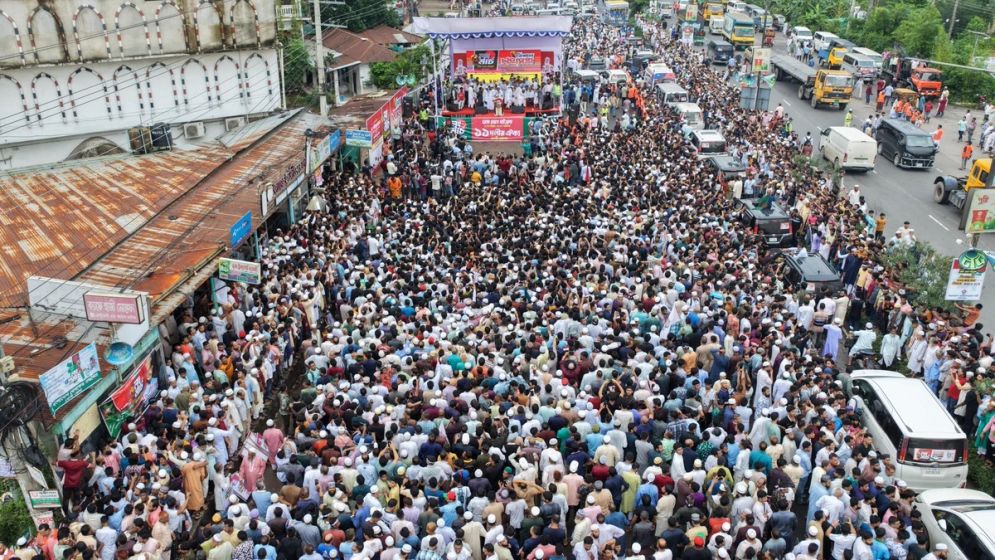
On Saturday morning, the 11-party alliance's Dhaka-Rangpur
long march commenced from Manik Mia Avenue in the capital. At the inaugural
rally, Shafiqur Rahman urged the government to accept the public's demands. The
declared demands of the long march include implementing the outcome of the
referendum, establishing a Constitutional Reform Council, bringing those
responsible for the July genocide to justice, resolving the oil, gas,
electricity, and fertilizer crises, controlling commodity prices, stopping corruption,
extortion, and land grabbing, improving the law and order situation, and
implementing the Teesta Mega Project. Surprisingly, all these demands were
discussed in parliament and could be discussed again in the future. What, then,
is the purpose of taking to the streets over issues meant for parliament? Does
this not belittle parliament? Is this a strategy to render parliamentary
democracy ineffective?
The opposition parties previously conducted a
Dhaka-Chittagong long march on September 5. What are they trying to achieve by
staging a similar program again now?
Such programs outside parliament will not only weaken
democracy but also put it at risk. Does the opposition wish to derail the
democracy earned through long struggles?
The demands presented by the opposition consist of two
parts: one political and the other socio-economic. Regarding the political
demands, the government’s position is clear. The government has explicitly
stated its stance on the referendum and the Constitutional Council, with both
the Law Minister and the Home Minister offering legal and constitutional
explanations. The core objective is the full implementation of the
constitutional matters agreed upon by all political parties within the National
Consensus Commission. Whether this is achieved through a constitutional
amendment or a constitutional council is not the main issue; what matters is
whether the articles of the constitution are amended. The government maintains
that it will implement every letter of the July Charter and has formed a
committee to amend the constitution accordingly. However, the opposition did
not join that committee. Why? Does the opposition not want the constitution
amended in light of the July Charter?
Mao Zedong once said that it does not matter whether a cat
is black or white, as long as it catches mice. Similarly, whether it is a
Constitutional Reform Council or a committee is secondary; the real issue is
whether the constitution is amended in line with the July Charter. Why is the
opposition trying to heat up the streets over such a minor procedural issue? Is
there another motive behind this? Does the opposition want to derail democracy?
The opposition itself must answer this question.
The other part of the opposition’s demands is
socio-economic, ranging from gas and electricity shortages to rising commodity
prices. Is the government denying these problems? Has the government claimed
there is no load shedding or gas crisis? Is the government not trying to bring
the law and order situation under control?
None of these problems were created by the current
government; they are the result of corruption and irregularities over the past
17 years. The opposition knows this as well. Solving these problems overnight
is impossible. The government is sincerely attempting to improve the situation,
and the Prime Minister has personally expressed regret to the public for these
hardships, asking the opposition to offer suggestions if they have a way to
resolve these crises. Yet, the opposition has chosen the streets to seek
solutions.
Questions naturally arise: does the opposition want
solutions to these problems, or do they want to create an unstable environment
in the country? Resolving the gas and electricity crises requires political
unity. Improving the law and order situation demands political tolerance.
However, by heating up the streets, the opposition is destroying the flow of
political unity and tolerance. Does the opposition not want democracy then? Do
they wish to create instability in the country? The opposition must answer
these questions.
Audite Karim is a Writer and Playwright. Email:
[email protected]