


 For all latest news, follow the Daily Sun's Google News channel.


They Cannot Rewrite the Road to Bangladesh
Special Correspondent
Published: 17 Sep 2026, 05:00 PM
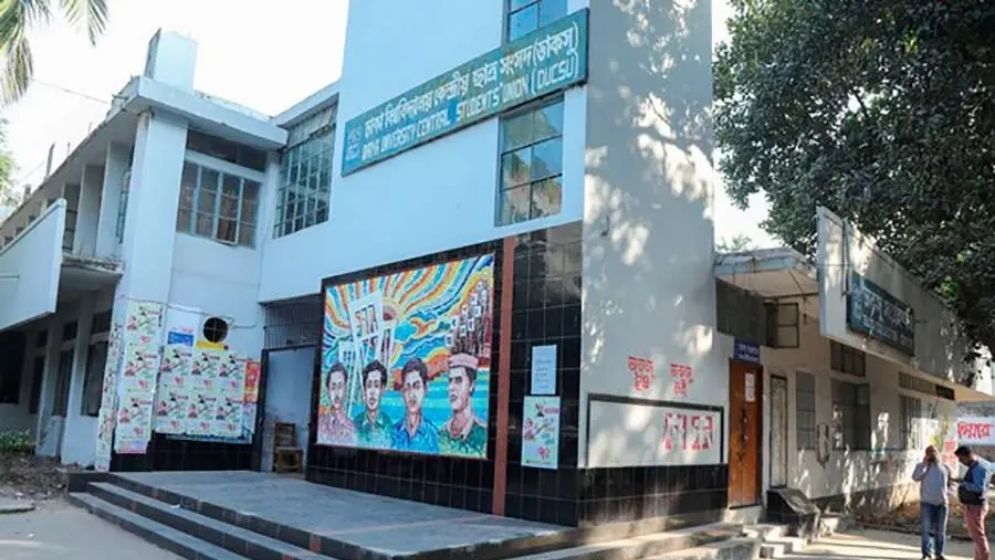
DUCSU Building. File Photo
History is being contested again in Bangladesh—not in a seminar room, but on the walls and floors of Dhaka University.
The recent controversy over the Dhaka
University Central Students’ Union (DUCSU) historical archive is more than a
quarrel over photographs. After the renovated archive reopened on 13 September,
photographs and newspaper material concerning Muhammad Ali Jinnah and Abdul Malek,
a prominent leader of Islami Chhatra Sangha, the student organisation
associated with Jamaat-e-Islami in East Pakistan, were displayed. The display
prompted protests. On 14 September, a former DU student tore down two
photographs of Jinnah; the following day, another group placed photographs of
Jinnah and Jamaat-e-Islami leader Ghulam Azam on the floor and trampled them in
protest. Dhaka University subsequently formed investigation committees and said
that displaying photographs of individuals whose roles conflicted with the
history of the 1952 Language Movement and the 1971 Liberation War was
unacceptable.
History should not be protected by vandalism.
It should be protected by facts.
And the facts about Jinnah and Pakistan’s
relationship with Bengali aspirations are uncomfortable enough without
embellishment.
Jinnah did not, obviously, oppose
Bangladesh’s independence in 1971. He died in 1948. But that chronological fact
should not prevent a serious examination of what kind of Pakistan he sought to
build and how compatible that conception was with the linguistic, cultural and
political aspirations of the Bengali majority.
The answer became apparent almost immediately
after Pakistan was created.
On 23 February 1948, Dhirendranath Datta, a
Bengali member of Pakistan’s Constituent Assembly, moved an amendment seeking
recognition of Bangla among the languages that could be used in the Assembly.
His argument rested on a basic democratic reality: Bengali was spoken by more
than half of Pakistan’s population. The proposal was rejected.
Jinnah then came to Dhaka. On 21 March 1948,
at the Race Course, he declared that Urdu would be Pakistan’s state language.
Three days later, at Dhaka University’s Curzon Hall, he reiterated that the
state language could only be Urdu. Students immediately protested. The
confrontation was not a later political invention; it occurred publicly in
Jinnah’s presence.
The significance of the episode lies partly
in what the Bengali protesters were not demanding. In 1948, the demand was not
for the dissolution of Pakistan. Datta was seeking recognition of Bangla within
Pakistan’s constitutional framework. The students were demanding linguistic
equality, not announcing an independent Bangladesh.
The transformation from that demand to the
demand for sovereignty came over the next two decades, as disputes over
language, provincial autonomy, economic inequality, political representation
and democratic rights accumulated. Pakistan had been founded on the political
argument that Muslims constituted a distinct nation, but the creation of
Pakistan did not erase the powerful identities of language, region and culture.
Bengali Muslims were Muslims—and Bengalis.
The Language Movement began well before 1952.
Tamaddun Majlish and student organisations played important roles in the
initial mobilisation of 1947–48, followed by strikes, protests, arrests and
political agitation. By 1952, the language question had become a mass movement.
On 21 February, police opened fire on demonstrators in Dhaka, killing several protesters,
including students and activists.
Ekushey was therefore not simply a cultural
commemoration. It was the culmination of a political struggle over recognition,
equality and identity. It became one of the foundations of Bengali political
consciousness and, ultimately, part of the longer road to Bangladesh.
That history also provides the necessary
context for understanding Jamaat-e-Islami’s role in 1971.
Jamaat opposed Bangladesh’s independence and
supported the preservation of Pakistan. Its student organisation, Islami
Chhatra Sangha, was closely associated with the formation and operation of
Al-Badr, while Jamaat leaders and publications campaigned in support of
Pakistan during the war. These activities subsequently became subjects of
proceedings before Bangladesh’s International Crimes Tribunal.
The roles of organisations and individuals
should nevertheless be distinguished. Motiur Rahman Nizami, then a leading
figure of Islami Chhatra Sangha, was subsequently convicted by the
International Crimes Tribunal in connection with crimes committed during the
Liberation War. The tribunal proceedings also examined the role of Jamaat and
its leadership in opposing Bangladesh’s independence.
Ghulam Azam’s postwar activities form another
part of the record. Reporting on the tribunal proceedings states that after
Bangladesh’s independence he became associated with efforts to restore
Pakistan’s former eastern wing, including the formation of the Purbo Pakistan
Punoruddhar Committee.
These facts should neither be exaggerated nor
obscured.
Indeed, one of the most revealing recent
developments in the debate has come from within Jamaat itself. According to The
Daily Star, former Jamaat assistant secretary general Abdur Razzaq recorded in
his posthumously published memoir, Bangladesh Jamaat-e-Islami: Its History and
Politics, repeated internal efforts to confront the party’s 1971 record and
formulate a formal apology. According to his account, such efforts began in
1994 and continued at various points for more than two decades.
The most striking proposal came in 2016. The
draft explicitly acknowledged that Jamaat-e-Islami had opposed Bangladesh’s
independence in 1971, expressed regret and apologised to the people of
Bangladesh. It also expressed regret that the party had failed to oppose the
Pakistani military action. The proposed statement, however, was never formally
adopted.
For a political organisation seeking
legitimacy in Bangladesh, how it confronts that history therefore remains an
unavoidable question.
The question has acquired renewed relevance
following the September 2025 DUCSU election, when candidates backed by Islami
Chhatra Shibir won 23 of the 28 central positions, including vice-president and
general secretary. The result demonstrated Shibir’s substantial presence in
contemporary student politics, but it did not settle the historical debate over
1971.
The answer should not be to tell young
Bangladeshis whom they should support or what conclusions they should reach. It
should be to place the documentary record before them. They should be able to
read Jinnah’s 1948 speeches, examine Dhirendranath Datta’s proposal, study the
records of the Language Movement, and review Jamaat’s newspapers and statements
from 1971. They should also be able to examine the International Crimes
Tribunal judgments and Abdur Razzaq’s account of the internal attempts to
confront Jamaat’s wartime record. A confident nation does not fear historical
evidence; it trusts its citizens, especially its young people, to engage with
it critically.
The same principle must apply to Bangladesh’s
relationship with Pakistan.
There is nothing inherently wrong with
maintaining normal diplomatic relations, strengthening economic ties or allowing
Pakistani diplomats to engage with Bangladesh’s political leaders. Nor should
younger Bangladeshis be discouraged from developing an interest in Pakistan or
seeking greater cultural and economic contact. But improved relations between
two sovereign states do not require either country to suppress, sanitise or
rewrite the painful history that separated them. Genuine reconciliation
requires mutual respect and honesty about the past.
Pakistan’s renewed diplomatic engagement with
Bangladesh has included high-level contacts with Bangladeshi political
organisations, including Jamaat-e-Islami. Such engagement is a normal part of
international diplomacy. But it should not become an occasion for obscuring the
history of 1971 or avoiding the unresolved historical questions between the two
countries.
The DUCSU controversy should therefore
provoke something more constructive than another round of partisan
confrontation.
Jinnah’s photograph can certainly have a
place in a museum—but only if the museum tells the whole story. His photograph
should be accompanied by the words he actually spoke about Urdu and by the
contemporary debate over Bangla. The historical narrative should include
Dhirendranath Datta’s demand, the Language Movement, the arrests and the bloodshed
of 21 February 1952; the Six-Point Movement; the 1970 general election and the
denial of its mandate; the military crackdown of March 1971; and the wartime
positions and activities of Jamaat-e-Islami and other organisations that
opposed Bangladesh’s independence, alongside the documented roles of the
Al-Badr, Razakar and Al-Shams formations. And the story must ultimately lead to
the emergence of Bangladesh and its victory in 1971.
That is what a museum should do: preserve
history with context, evidence and uncomfortable truths intact. Anything less
risks turning an institution of historical memory into an exercise in political
editing.
Bangladesh should not fear history—not
Jinnah’s history, not Pakistan’s history, not Jamaat’s history and not the
uncomfortable chapters of its own history. But historical complexity must not
become a pretext for treating every competing narrative as equally supported by
evidence.
The Language Movement happened. The struggle
for Bengali political and democratic rights happened. The 1970 election and the
subsequent refusal to honour its mandate happened. The Pakistani military
crackdown happened. The Liberation War happened. Jamaat-e-Islami and other
political organisations opposed Bangladesh’s independence and supported the preservation
of Pakistan. And the immense suffering and sacrifice of the people of this land
happened. Out of that history emerged an independent Bangladesh.
These are not merely competing
interpretations. They are events supported by a substantial documentary record.
They can be debated, studied and interpreted, but they cannot responsibly be
erased or rearranged to serve the politics of the present.
No photograph can change that history. No
diplomatic initiative can erase it. No political slogan can undo it.
And no generation of Bangladeshis should be
asked to forget the road by which their country came into being.