


 For all latest news, follow the Daily Sun's Google News channel.


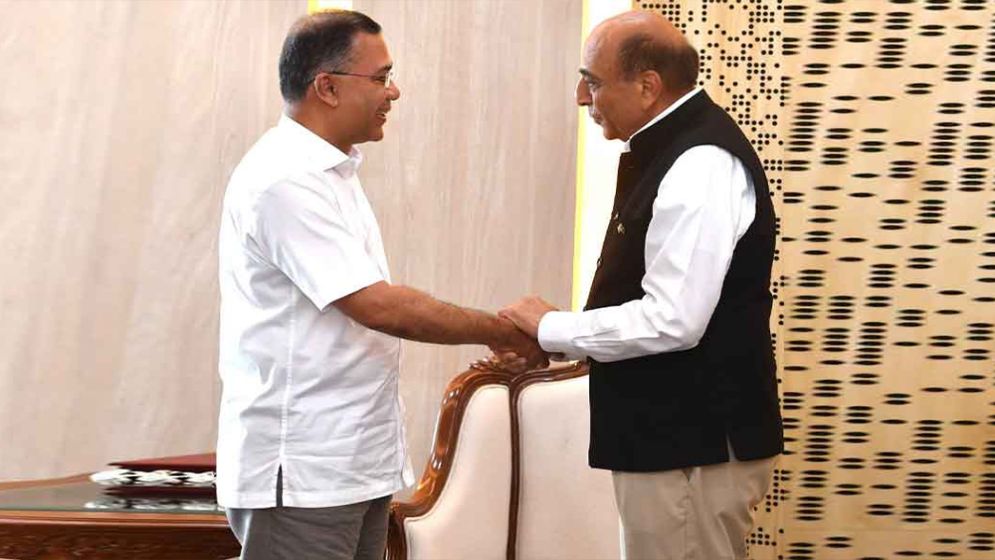
Indian High Commissioner to Bangladesh Dinesh Trivedi holds meeting with Prime Minister Tarique Rahman on Monday. Photo : PMO
There is no final word in diplomacy. There is no alternative to patience and tolerance in diplomacy. The best way to resolve any problem is discussion among ourselves. In the context of Bangladesh-India relations, fundamental diplomatic principles have come to the fore once again. On Monday morning, Prime Minister Tarique Rahman held a courtesy meeting with Indian High Commissioner to Bangladesh Dinesh Trivedi. This was the Bangladesh Prime Minister's first meeting with the Indian envoy. The Prime Minister held this meeting at a time when fresh tensions have emerged regarding relations between the two countries.
Distrust and discomfort have arisen between the two neighbors over recent issues. But hostility with a neighbor brings positive results for no one. There is no room for stubbornness in diplomacy; all problems can be resolved through mutual dialogue. The Prime Minister of Bangladesh conveyed that very message through this courtesy meeting. Therefore, this meeting serves as a message for two neighbors to move forward, leaving behind past bitterness. Although this was a courtesy call, its significance is far-reaching.
Bangladesh-India relations have been passing through their most complex and critical period over the last two years. Tensions in bilateral relations surfaced after 5 August, 2024. In particular, when a segment of the July movement began anti-India rhetoric, India scaled back its diplomatic ties with Bangladesh. Visa operations were suspended. The Yunus government summoned the Indian ambassador multiple times, and India likewise summoned the Bangladeshi High Commissioner. Both countries restricted diplomatic activities. Relations deteriorated to such a bitter point that Bangladesh did not participate in the T20 World Cup held in India.
Public anger and tension are not the same thing as diplomatic relations. Among the populace of many neighbors around the world, anger and dissatisfaction exist, yet diplomatic relations between those countries are maintained normally. That is the responsibility of governments and foreign ministries. Recently, relations between Spain and Italy strained over migrant issues, yet both nations continue working to resolve problems through mutual cooperation and dialogue. The resentment felt by a segment of the public in Sri Lanka or Nepal toward India is unknown to no one, yet maintaining normal diplomatic relations between those countries has remained possible. Tension between the United States and Mexico is long-standing, but both nations maintain diplomatic ties and ongoing dialogue.
However, after 5 August, 2024, the Yunus government led Bangladesh’s diplomacy down the wrong path. The decline in Bangladesh-India diplomatic relations occurred during the interim government led by Dr. Muhammad Yunus. During this period, under the guise of an extreme anti-India posture, the interim government compromised Bangladesh’s national interests. The irresponsible and anti-Indian remarks of Yunus and his advisers yielded no benefit, bringing only harm to Bangladesh. The comments Yunus made regarding India’s Seven Sisters clearly constituted interference in another country’s internal affairs.
Former Legal Adviser Asif Nazrul strained ties further by spreading false information that 2.6 million (26 lakh) Indian citizens were working in Bangladesh. While adopting anti-India rhetoric externally, the Yunus government internally made the nation even more dependent on Indian goods; product imports from India actually increased under Yunus's interim administration. Yet Indian visas were shut down, and Bangladeshi products were deprived of access to Indian ports. Today's push-in issue is the outcome of the Yunus government's flawed diplomatic maneuvering. Flawed policies under Dr. Yunus left Bangladesh increasingly isolated not just from India, but from the entire world.
Upon assuming office, the BNP government immediately took initiatives to restore Bangladesh's foreign policy to normal, along with everything else. The BNP government has already brought some good news for Bangladesh. The strength of the Bangladeshi passport has improved. Foreign Minister Khalilur Rahman has been elected President of the 81st Session of the UN General Assembly—undoubtedly a major achievement.
The Prime Minister's first foreign trip was to Malaysia, resulting in efforts to reopen the Malaysian labor market. During this period, Bangladesh initiated steps to normalize relations with India, and India likewise expressed interest in normalizing ties with its neighbor. Last June, a high-profile Indian politician arrived in Bangladesh as India's ambassador. Former Indian Union Railway Minister and BJP leader Dinesh Trivedi is not a career diplomat.
Last April, the Indian government appointed Dinesh Trivedi as High Commissioner to Bangladesh. In the 55-year history of bilateral relations, this is the first time India has sent a politician as its High Commissioner to Bangladesh. Upon arriving in Bangladesh, Dinesh Trivedi stated: "The sky is the same, the air is the same. Together we will solve the visa issue. We share not just a border, but common dreams. Our sky is one, our air is one, and in many cases, our challenges are common. Therefore, there is no scope to lose our way."
On June 25, Dinesh Trivedi officially began his duties as India's 16th High Commissioner in Dhaka after presenting his credentials to the President. Subsequently, on July 29, he met Foreign Minister Khalilur Rahman for the first time, followed by a second meeting last Sunday. After Trivedi assumed office, India resumed normal visa operations after nearly two years. During this time, fresh discomforts emerged in bilateral relations due to several issues. Push-ins at the border, border killings, and the former prime minister’s political activities while residing in India generated new strains. Tensions escalated sharply last Wednesday following former Prime Minister Sheikh Hasina’s exchange with journalists in Delhi. Moving past this period of tension, the two neighboring countries are now focusing on putting relations back on a positive track through dialogue, demonstrating diplomatic prudence and foresight.
A normal relationship with India is important and necessary for various reasons. For instance, when raw chili prices in Bangladesh suddenly crossed 400 taka, the government swiftly controlled prices by importing raw chilies from India. This simple example illustrates why good neighborly relations matter. Distinguished Fellow at the Centre for Policy Dialogue (CPD), Professor Mustafizur Rahman, noted that Bangladesh benefits whether importing from or exporting to India; hence, bilateral trade should be kept normal. Beyond trade, the 30-year Ganga Water Sharing Treaty between Bangladesh and India expires this year. Reaching a consensus on an issue as critical and contentious as the Ganga treaty requires extensive preparation and mutual cooperation. Dialogue between Bangladesh and India is equally essential for implementing the Teesta Water Sharing Agreement. There is simply no alternative to mutual cooperation.
The day before meeting the Prime Minister on Monday, India’s envoy to Bangladesh made some notable remarks, stating: "Problems get solved when we talk." That dialogue commenced on Monday.
While criticizing Indian actions that harm Bangladesh's interests, the government of Tarique Rahman has simultaneously kept open the path to resolving crises through dialogue. On Monday, Prime Minister Tarique Rahman conveyed through his meeting with the Indian ambassador that Bangladesh desires a friendly relationship with its neighbor, but one built on Bangladesh's national interests, mutual respect, and dignity. For a normal relationship with Bangladesh, India must transition from a "big brother" to a friend.
Under the leadership of Tarique Rahman, the cornerstone of Bangladesh’s foreign policy is "Bangladesh First." National interest must be the primary foundation of any relationship. A "Bangladesh First" foreign policy requires good relations with neighbors. However, it must be remembered that no relationship can be one-sided. It is hoped that, following his meeting with the Prime Minister, the seasoned politician and diplomat will be sincere in normalizing bilateral relations and will convey the Prime Minister's stance to Delhi. Just as anti-Indian activities on Bangladeshi soil are unacceptable, India too should ensure its territory is not used against Bangladesh. Bangladesh-India relations are vital. Normalizing this relationship serves mutual interests, but it must be grounded in respect, dignity, mutual trust, and confidence. A friendly relationship cannot be built by sacrificing national interests. That is the core essence of "Bangladesh First" diplomacy.
Audite Karim Writer and Playwright Email: [email protected]