


 For all latest news, follow the Daily Sun's Google News channel.


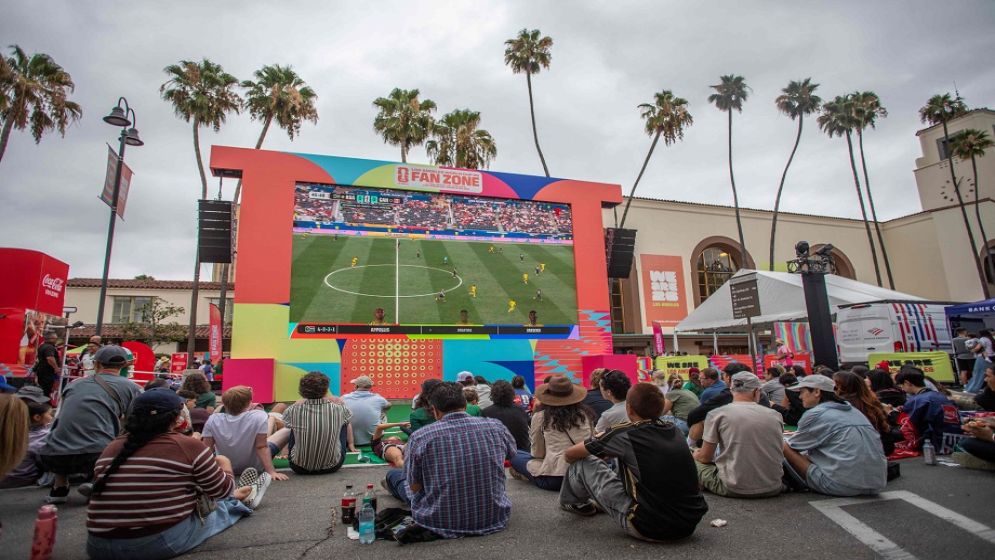
Fans watch the 2026 World Cup football tournament Round of 32 match between South Africa and Canada at the FIFA Fan Festival at Union Station in Downtown Los Angeles on 28 June 2026. Photo: AFP
Every World Cup produces champions, but not every World Cup produces winners. Champions are those who lift trophies and progress through the tournament; winners are those who capture imaginations, inspire millions, and leave behind stories that endure long after the final whistle. As the first round of the 2026 FIFA World Cup comes to an end, supporters across the globe are busy calculating points, goal differences, and knockout permutations. Yet football's greatest tournament has always possessed another, unofficial table—one that measures courage, dignity, hospitality, resilience, and even hypocrisy. The first phase of this World Cup has once again demonstrated that football's greatest triumphs are not always reflected in the standings.
Some nations have exited the tournament with their reputations significantly enhanced, while others have advanced despite leaving lingering doubts about their performances or conduct. A few countries, meanwhile, have managed to combine sporting success with admirable values both on and off the field. Taken together, these stories reveal a simple truth: the World Cup is about far more than results. It is also about the human qualities that football brings to the surface.
Iran: Victorious in Spirit
If there is one nation that epitomizes victory beyond football, it is Iran. Whatever follows in the knockout rounds, Team Melli has already secured something no elimination can erase: its place among the tournament's moral victors. Few teams arrived at the World Cup carrying a heavier burden. Iranian players competed amid extraordinary geopolitical tensions, uncertainty over travel arrangements, visa-related complications, disrupted preparations, and relentless international scrutiny. The tournament's co-hosting arrangements often appeared to place obstacles in Iran's path rather than remove them, while several contentious on-field decisions only deepened the sense that Team Melli was required to overcome more than its opponents. Yet football, not grievance, remained their answer.
Throughout the tournament, the Iranian players displayed remarkable composure and professionalism. They competed fearlessly against stronger opponents, conducted themselves with dignity, and consistently projected messages of peace, respect, and sportsmanship. At a time when international politics increasingly intrudes into sporting arenas, Iran demonstrated that football can still serve as a language of humanity. Its campaign reminded the world that sporting greatness is not measured solely by progression, and that the most meaningful victories often occur beyond the scoreboard.
History remembers teams that represented something larger than football. Cameroon in 1990, Senegal in 2002, Costa Rica in 2014, and Morocco in 2022 all transcended results to become enduring symbols of courage and possibility. Iran now deserves a place in that tradition. Long after the tournament bracket is forgotten, many will remember Team Melli not simply for its football, but for the dignity, resilience, and grace with which it confronted adversity. That may ultimately prove a greater achievement than any single result.
Cape Verde, Haiti, and Jordan: Defeat Without Dishonor
Cape Verde's achievements have also undermined one of the principal criticisms leveled against FIFA's decision to expand the World Cup to 48 teams. Critics had argued that the inclusion of smaller nations would dilute the tournament's quality and produce uncompetitive matches. Instead, the opposite has occurred. New entrants such as Cape Verde have enriched the competition, expanded football's emotional geography, and reminded millions that traditional powers do not monopolize talent and ambition.
Haiti offers another compelling example. Returning to the World Cup after more than five decades, Haiti entered the tournament amid profound domestic difficulties. Nevertheless, the team's spirit never wavered. Against Morocco, Haiti twice took the lead and pushed the Atlas Lions to the brink before eventually succumbing. Even in defeat, Haiti refused to surrender. Veteran goalkeeper JohnyPlacide's emotional performances became one of the tournament's most memorable stories, illustrating that courage often leaves a deeper imprint than victory itself.
Jordan similarly represented the continuing rise of West Asian football. Qualification alone marked a historic milestone for the country, but Jordan's significance extended beyond symbolism. Jordan carried not only the hopes of a nation but also the aspirations of an entire region seeking greater recognition on football's biggest stage. These countries may not progress further, but millions who knew little about them only weeks ago now know their stories. In football, stories often outlast results.
The Biggest Loser: Football Elitism
The performances of Haiti, Cape Verde, and Morocco have ironically underscored that the greatest loser of the first round may not be any particular country. It may instead be football elitism itself.
Long before the tournament began, many commentators, particularly in Europe, warned that FIFA's decision to expand the World Cup to 48 teams would dilute the quality of the competition. Critics predicted a series of embarrassing mismatches, arguing that smaller footballing nations lacked the quality to compete on the world's biggest stage. According to this view, the expansion represented a triumph of commercial considerations over sporting merit.
The first round has emphatically challenged those assumptions.
These performances have exposed the limitations of the traditional football hierarchy. For decades, international football has operated on the implicit assumption that a handful of established powers possess an almost natural superiority over the rest of the world. The first round of the 2026 World Cup suggests otherwise. The globalization of football, improved coaching, increased player mobility, the growth of diaspora communities, and greater investment in emerging football nations have dramatically narrowed historical gaps. Talent is now genuinely worldwide.
This development is profoundly good for the sport. Football thrives on uncertainty. It thrives on the possibility that an underdog can challenge a giant, that a small nation can capture the imagination of millions, and that established powers can no longer take victory for granted. Without underdogs, there can be no fairy tales. And without fairy tales, there can be no World Cup.
Mexico and Morocco: Winning Twice
Mexico has arguably emerged as the tournament's greatest overall beneficiary. For decades, Mexican supporters have supplied the World Cup with some of its most vibrant atmospheres, and the 2026 edition has been no exception. Mexican fans have once again transformed stadiums into celebrations of football itself.
Mexico's success, however, extends far beyond the stands. As controversies increasingly surrounded aspects of the United States' hosting arrangements, Mexico frequently projected precisely the openness, warmth, and inclusivity that many expected from the entire North American partnership. On the field, El Tri has matched diplomacy with performance, advancing confidently while combining experienced leadership with emerging talent.
Morocco, meanwhile, has continued one of modern football's most inspiring stories. Many observers wondered whether Morocco's historic semi-final run in Qatar in 2022 represented a unique moment unlikely to be repeated. The first round of 2026 has provided a clear answer. The Atlas Lions have once again demonstrated technical excellence, tactical sophistication, and emotional intensity. Morocco no longer participates merely to surprise; it now competes with the expectation of belonging among football's elite.
Advancing Yet Losing
Qualification, however, does not necessarily translate into success. Some nations have progressed while simultaneously raising uncomfortable questions about themselves. The United States presents perhaps the clearest example. While the American team deserves considerable credit for its performances on the pitch, hosting a World Cup requires far more than sporting competence. It demands openness, inclusivity, neutrality, and respect for football's universal character.
The tournament has been accompanied by controversies surrounding travel restrictions, visa complications, and broader concerns regarding whether political considerations have compromised the spirit of global sport. Coaches and officials have also questioned aspects of tournament organization, including scheduling, weather-related issues, and commercial priorities. Although such challenges are perhaps inevitable in the event of an event of this scale, perceptions matter enormously. Hosts are ultimately judged not only by their infrastructure but also by whether they embrace the inclusive ethos that the World Cup claims to embody.
Perhaps even more striking has been Europe's relative silence. During the World Cups hosted by Russia and Qatar, several European governments, media institutions, and football associations positioned themselves as vocal defenders of universal values. Germany, in particular, emerged as one of the most outspoken critics, emphasizing human rights and ethical responsibility. Many of those concerns were legitimate. However, principles derive credibility only when they are applied consistently. The comparatively muted criticism directed toward the current tournament inevitably raises questions about whether international sporting ethics are sometimes applied selectively.
Beyond the Scorecard
Ultimately, the first round of the 2026 FIFA World Cup has reaffirmed a timeless truth: football's most meaningful victories are not always reflected on the scoreboard. While some traditional powers advanced routinely, it was often the smaller nations, the underdogs, and those competing under extraordinary adversity that captured the world's imagination. Iran's dignity in the face of political and logistical challenges, Cape Verde's fearless defiance of football's established hierarchy, Haiti's refusal to surrender, and the warmth and inclusivity displayed by Mexico have enriched this tournament far beyond goals and points. At the same time, controversies surrounding hosting arrangements and the selective application of moral principles have raised uncomfortable but necessary questions about the future of global sport. Long after the trophy is lifted, the true legacy of this World Cup may not lie in who became champion, but in who upheld the spirit of football—its universality, humanity, and enduring capacity to give even the smallest nations the right to dream.