


 For all latest news, follow the Daily Sun's Google News channel.


Cashless Bangladesh dream gains ground
Bangla QR payments surging as banks, MFS providers bring millions of merchants into digital economy

At Md Toriqul Islam’s small grocery shop in Shewrapara, Mirpur, the days of lining up different QR codes at the counter are over.
Not long ago, a customer paying through a bank app had to scan one code, while someone using a mobile financial service needed another.
Toriqul had to keep track of them as customers increasingly asked to pay without cash.
Now, there is just one code.
A Bangla QR code allows customers to scan the same code and pay through participating banks, mobile financial services and other authorised digital payment platforms.
For Toriqul, it is a small change at the counter, but one that reflects a much bigger transformation taking place across Bangladesh’s retail economy.
Yet the shift is not as simple as putting a QR code on a shop counter.
Toriqul still worries that every digital payment leaves a record that could eventually increase his tax burden.
And when money received through an MFS account needs to be converted into cash, the withdrawal comes with a charge.
So, while the technology has arrived at his shop, the habit of going cashless has not fully taken hold.
His experience captures both the promise and the complications of Bangladesh’s accelerating push towards a cashless economy.
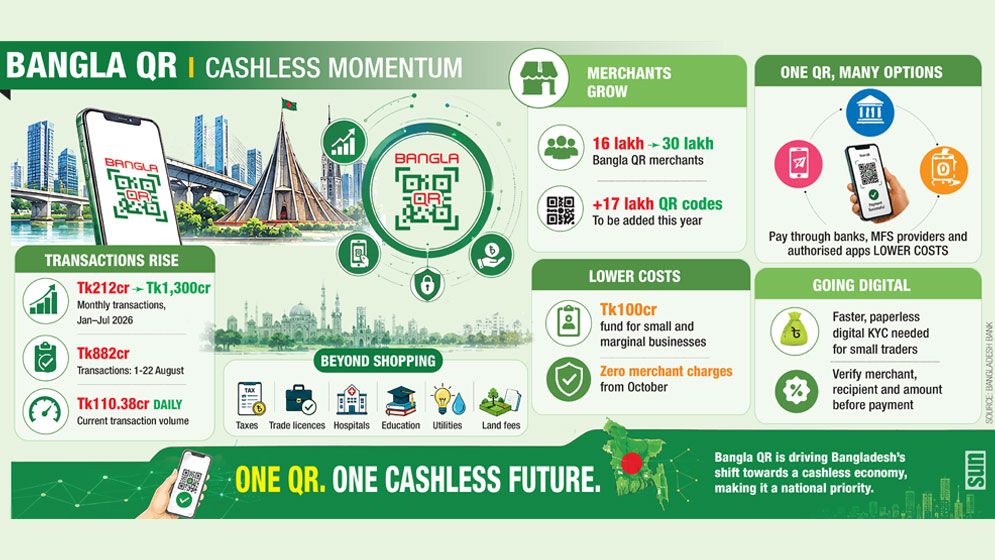
Bangla QR transactions have surged from just over Tk200 crore a month at the beginning of the year to around Tk1,300 crore by July, while the number of merchants using the system has climbed sharply.
But behind those numbers are millions of small traders like Toriqul, for whom the success of digital payments will depend not only on technology, but also on cost, taxation, convenience and trust.
One QR for multiple payment services
The concept is simple: one merchant, one QR code.
Bangla QR was introduced to eliminate the fragmentation created by multiple provider-specific codes.
Customers can use the same code through participating banks, MFS providers and other authorised payment platforms.
According to Bangladesh Bank’s Payment Systems Report 2025, nearly 963,000 merchants were using Bangla QR by the end of 2025, supported by 46 banks, seven MFS providers and four payment service providers.
The network has expanded rapidly this year, with around 1.7 million Bangla QR codes in use and more than 300,000 additional codes added in the first 15 days of August.
Bangladesh Bank data show monthly transactions rising from Tk212 crore in January to Tk218 crore in February, Tk229 crore in March, Tk199 crore in April, Tk479 crore in May, Tk844 crore in June and around Tk1,300 crore in July.
As of 22 August, transactions had reached Tk882 crore, with daily transactions currently averaging Tk110.38 crore.
The merchant base has also expanded sharply, from around 1.6 million to three million. But adoption cannot be measured by QR codes alone. The bigger question is how many merchants and customers are actually using them regularly.
A strong push from Bangladesh Bank
Bangladesh Bank has stepped up promotional campaigns and merchant onboarding efforts as it seeks to make Bangla QR the backbone of the country’s move towards digital payments.
Governor Mostaqur Rahman has participated in more than 10 promotional programmes over the past three months, while the central bank has set targets for banks and MFS providers to bring more merchants into the system.
Bangladesh Bank Executive Director Arief Hossain Khan described the transition towards a cashless economy and nationwide Bangla QR rollout as a “national agenda”.
He said MFS providers have been more successful than banks in bringing small merchants into the digital payment ecosystem.
Arfan Ali, former president and managing director of Bank Asia, said the expansion of digital payments could be particularly beneficial in rural areas, where access to financial services remains limited.
“This will be particularly beneficial for rural areas, where access to financial services remains limited,” he told the Daily Sun. “It can stimulate local economic activity, create additional business opportunities for agents and reduce the inconvenience faced by customers.”
Muhammad Zahidul Islam, head of Media and Communications at Nagad, said the MFS industry remains committed to the cashless transition, with Bangla QR and the National Payment Switch Bangladesh (NPSB) among its priorities.
“We, as part of the mobile financial services (MFS) industry, particularly Nagad, are deeply committed to transforming Bangladesh from a cash-dependent economy into a cashless one,” he told the Daily Sun.
He said the company remained committed to complying with regulatory requirements and supporting the country’s vision of a cashless Bangladesh.
Making digital payments cheaper
Bangladesh Bank has created a Tk100 crore fund to encourage digital transactions among registered small and marginal sellers and service providers, including incentives for transactions of up to Tk2,000.
The move addresses one of the biggest concerns surrounding digital payments: cost.
Merchant charges are also set to be eliminated from October, according to the central bank’s initiative.
But bankers and industry stakeholders say reducing the cost of receiving money is only part of the problem. Merchants also need affordable ways to use or withdraw the money they receive.
Bank accounts generally offer relatively low-cost access through ATMs and other channels, while MFS cash withdrawals can cost as much as 1.85%.
For small traders operating on thin margins, even a modest charge can make cash more attractive than digital payments.
The tax anxiety
Cost is not the only concern.
For many small businesses, cash remains deeply embedded in everyday transactions.
Some merchants fear that moving into the digital system will make their earnings more visible to tax authorities and increase their tax burden.
Toriqul shares that concern.
Former Bangladesh Bank chief economist Mustafa K Mujeri believes expanding Bangla QR is important for preventing corruption and promoting digital transactions.
But, he said, Bangladesh should also learn from successful international models and ensure that small businesses are not harassed simply because they have digital transaction records.
“To bring small businesses into the digital economy, the tax system needs to be made simpler and more incentive-based,” he said.
Making it easier for small businesses
The process of opening merchant accounts also remains a hurdle.
Although banks and MFS providers are bringing services closer to merchants, account opening is not yet fully digital and paperless in all cases.
Officials may still need to visit businesses to collect documents, adding time and cost.
Industry stakeholders suggest wider use of risk-based digital KYC through mobile phones could make onboarding faster and help bring millions of small businesses into the formal digital ecosystem.
Interoperability, and the risks
For Bangla QR to work at scale, participating platforms also need to be technologically ready.
Industry sources say some apps are not yet fully compatible, while transactions can sometimes become complicated or slow.
Such problems can discourage both merchants and customers from using QR payments regularly.
Security is another concern
Fake or replaced QR codes, phishing, OTP scams and social engineering can expose less experienced users to fraud.
Zahidul Islam said fraud is a global challenge and that providers are investing in technology and awareness campaigns. Customers can protect themselves by not sharing OTPs, PINs or passwords.
“We can assure everyone that customers can remain safe from fraud as long as they do not cooperate with fraudsters by sharing sensitive information such as OTPs, PINs, or passwords,” he said.
Experts also stress the importance of checking the merchant name, recipient identity and transaction amount before confirming a payment, along with a quick and transparent dispute-resolution process when something goes wrong.
Govt services could drive adoption
Government services could provide another major push.
Mujeri said making Bangla QR available for more government payments could generate regular demand and familiarise millions of people with digital transactions.
The system could be used more widely for trade licence renewals, municipal and holding taxes, hospital and educational fees, utility bills and land-related payments.
If digital payment becomes the easiest way to complete such routine transactions, QR use could move beyond retail shops and become part of everyday financial life.
From a QR code to a cashless habit
Bangladesh has made significant progress in putting the infrastructure for digital payments in place.
Transaction volumes are rising, and millions of merchants are being brought into the system.
But the harder task is turning QR payments from an option into a habit.
That will depend on whether digital transactions remain affordable, services work reliably across banks and MFS platforms, and merchants and consumers feel confident about costs, taxation and security.
At Toriqul’s shop, the Bangla QR code is already sitting at the counter.
The question is whether Bangladesh’s cash-dependent economy is ready to make it part of everyday life.