


 For all latest news, follow the Daily Sun's Google News channel.


Bangla QR reshapes the way Bangladesh pays
Interoperable platform could widen digital payments, boost financial inclusion and bring small businesses into the formal economy

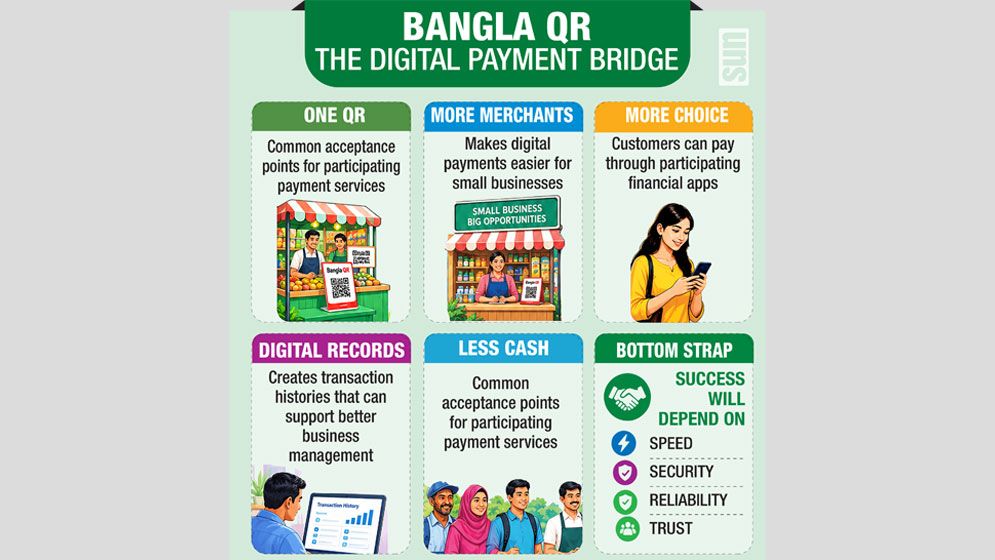
Bangladesh’s payment landscape is entering a new phase as digital transactions become increasingly embedded in everyday economic activity.
At the centre of this shift is Bangla QR, an interoperable platform designed to bring different digital payment channels under a common acceptance system.
Instead of maintaining separate QR arrangements for different providers, merchants can display a single Bangla QR code through which customers using participating financial services can make payments. This could be particularly significant for millions of small businesses that still rely heavily on cash.
The timing is important. Banks, mobile financial service providers and payment institutions are expanding their digital offerings, while consumers are becoming increasingly comfortable using smartphones for financial transactions.
The challenge now is to turn that familiarity into regular use at shops, markets, restaurants, pharmacies and other everyday payment points.
A simpler payment ecosystem
The main advantage of interoperability is reduced fragmentation. Customers can use their preferred participating financial application without first determining which QR network a merchant supports. For merchants, fewer separate arrangements can mean simpler payment management.
This could lower the entry barrier for micro and small enterprises, including grocery shops, restaurants, pharmacies, clothing outlets, home-based businesses, freelancers and online sellers. A simple QR code can provide a digital payment point without requiring sophisticated infrastructure.
The opportunity extends beyond major cities. Smaller towns and rural markets could benefit significantly if local traders, pharmacies and service providers begin accepting digital payments.
However, adoption will depend on smartphone access, network availability, digital literacy and merchant awareness.
Training should cover more than displaying or scanning a code. Merchants need to know how to verify payments, identify failed transactions and seek support when problems arise.
From payments to financial inclusion
One of the less visible benefits of digital payments is the electronic record they create. For small businesses, transaction histories can help track sales, monitor turnover and maintain accounts more systematically.
Such records do not automatically guarantee access to credit, but they could give financial institutions a clearer picture of a business’s activity when assessing customers.
Over time, this may help bring informal businesses closer to the formal financial system and support wider financial inclusion.
Digital records could also help entrepreneurs make better decisions about inventory, expansion and working capital.
At scale, this could contribute to more systematic financial management among micro and small enterprises.
Trust will determine adoption
The growth of QR payments also brings security risks. Fake QR codes, fraudulent payment requests, impersonation and social engineering could undermine consumer confidence.
Users should verify recipient details before confirming payments and never share PINs, passwords or one-time passwords.
Merchants should regularly check displayed QR codes, while financial institutions and payment providers need effective monitoring and rapid fraud-response mechanisms.
Reliability is equally important. If transactions are slow, fail repeatedly or leave users uncertain about whether money has been deducted, consumers may return to cash.
Merchants need clear payment confirmations, efficient settlement and accessible dispute-resolution channels.
Interoperability can strengthen competition
Bangla QR’s effectiveness will depend on cooperation among banks, MFS providers, payment service providers and other participants. The broader the participation, the more useful the network becomes.
A wider acceptance network can encourage consumers to make more digital payments, while increased consumer demand can persuade more merchants to join.
This network effect could also intensify competition among payment providers, shifting the focus towards transaction speed, reliability, security, customer service and ease of use.
The infrastructure could eventually support payments beyond retail, including institutional fees, healthcare, education, transport and selected government services. Such expansion would make digital payments part of ordinary economic life rather than an occasional alternative to cash.
A gradual shift from cash
Bangladesh has a deeply rooted cash culture, and cash will remain important, particularly where digital infrastructure is limited. Promotional offers may encourage people to try digital payments, but long-term adoption will depend on convenience, reliability and trust.
The greatest promise of Bangla QR lies not in the code itself but in the interoperable infrastructure behind it. A small merchant can enter the digital economy through a simple payment facility and gradually adopt electronic record-keeping and other formal financial services.
For that transition to succeed, network coverage, system capacity and service reliability must keep pace with expanding acceptance. Regulators also need clear standards for interoperability, settlement, customer protection and dispute resolution.
Bangla QR should therefore be viewed as part of Bangladesh’s broader move towards a less-cash economy. Its success will ultimately be measured not by the number of codes displayed at counters, but by whether payments remain fast, secure, reliable and easy to use.
If banks, MFS providers, merchants and regulators can maintain that trust, Bangla QR could become an important bridge between Bangladesh’s traditional cash economy and its emerging digital financial future.
The writer is the Acting Dean of the Faculty of Business Studies, University of Dhaka