


 For all latest news, follow the Daily Sun's Google News channel.


PM calls for prevention-centred health system at UNGA
Bangladesh to recruit 25,000 professional midwives by 2030
Daily Sun Report, Dhaka
Published: 26 Sep 2026, 12:00 AM
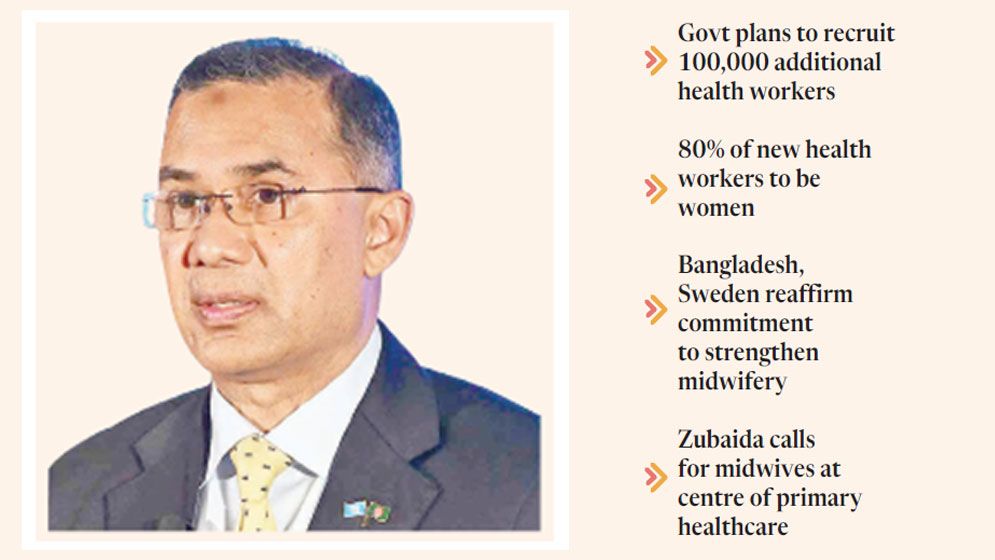
Prime Minister Tarique Rahman has called for a prevention-centred health system with primary healthcare at its core, saying Bangladesh wants to build a “Healthy Bangladesh” where healthcare begins at home and in communities.
He made the remarks on Thursday while opening a high-level side event on midwifery and primary healthcare at the United Nations headquarters in New York on the sidelines of the 81st session of the UN General Assembly.
The event, titled “From Commitment to Action: Integrating Midwifery into Primary Health Care to End Preventable Maternal and Newborn Deaths”, was co-hosted by Bangladesh and Sweden in partnership with the United Nations Population Fund (UNFPA).
“My government is transforming our health system, guided by a simple principle: ‘Prevention is better than cure.’ We want to build a Healthy Bangladesh, where healthcare begins in the home and community,” the prime minister said.
He said primary healthcare was at the heart of the government’s health reform agenda, with particular attention to women and children.
Tarique said Bangladesh had decided to recruit 25,000 professional midwives across the country by 2030 and that the recruitment process had begun. The midwives will provide essential reproductive care, support antenatal care, promote safe and respectful childbirth, identify complications early and facilitate referrals, he said.
He said professional midwives should be integrated into multidisciplinary primary healthcare teams so that women can receive continuous care from preconception and pregnancy through childbirth and the postnatal period.
“Midwifery must therefore be part of a broader platform for women’s health within Primary Health Care,” he said.
The prime minister also said his government intended to recruit 100,000 additional health workers, 80 per cent of whom would be women, to connect families with the health system, identify risks early and support timely care.
Swedish Foreign Minister Maria Malmer Stenergard also addressed the opening session, stressing the importance of international cooperation and investment in women’s health and professional midwifery.
Bangladesh experience
Dr S M Ziauddin Hyder, Special Assistant to the Prime Minister on Health Affairs, presented Bangladesh’s approach to strengthening primary healthcare through the integration and expansion of professional midwifery.
He said the country’s strategy was aimed at making midwives essential members of multidisciplinary primary healthcare teams, providing continuity of care for women while ensuring timely referral when complications arise.
The government’s commitment to recruit and deploy 25,000 midwives is being accompanied by efforts to strengthen education and training, improve deployment and establish effective referral pathways, he said.
UNFPA has described Bangladesh’s commitment to create 25,000 midwifery posts by 2030 as the country’s largest investment in its midwifery workforce. The UN agency said the commitment comes as the world faces a shortage of about one million midwives.
Dr Hyder also moderated a ministerial panel titled “A New Era of Health Workforce Scaling”, with representatives from Nepal, Slovenia, Thailand and Mexico.
Focus on prevention
Delivering the closing remarks, Dr Zubaida Rahman, Vice-President of the Ziaur Rahman Foundation, said Bangladesh was redesigning its primary healthcare system around prevention, early identification and continuity of care.
“Our vision of a Healthy Bangladesh is to move from a treatment-centered system to one that emphasizes prevention, early identification and continuity of care, with services closer to people’s homes,” she said.
She stressed the need to place professional midwives at the centre of primary healthcare and ensure continuity of care for women and newborns across communities and health facilities.
