


 For all latest news, follow the Daily Sun's Google News channel.


‘No existence on the ground’: 14-party alliance crumbles two years after AL’s fall

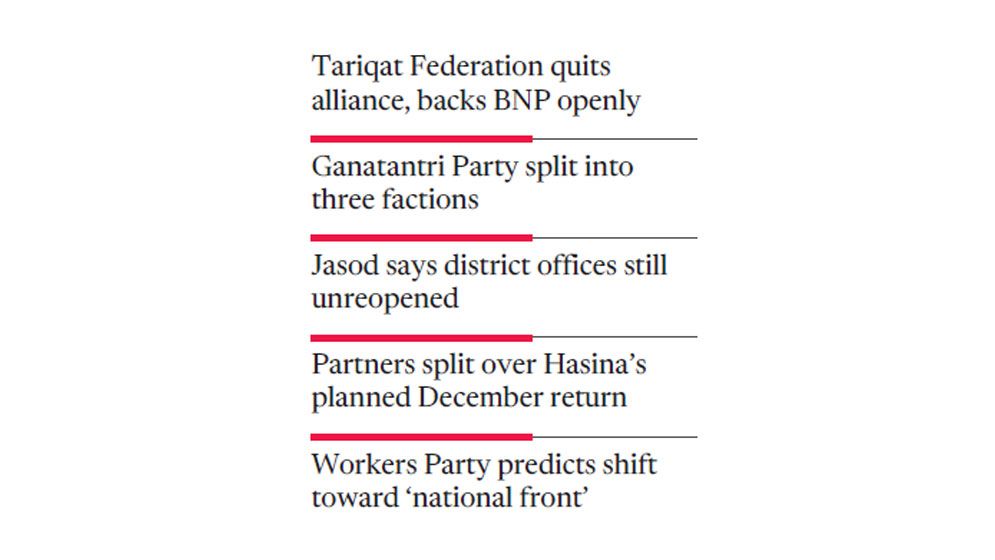
Awami League-led 14-party alliance has splintered into disarray two years after the ouster of the fascist Sheikh Hasina regime, with its own partners now openly conceding the coalition has ceased to function on the ground, severing ties with activities-banned Awami League and, in one case, campaigning for rival BNP instead.
Talks with alliance leaders reveal a coalition without coordination, a principal party stripped of political activity, and partner outfits either fractured internally or drifting toward irrelevance.
‘No existence’, says Tariqat leader
Bangladesh Tariqat Federation, once a component of the alliance, has abandoned it altogether.
The party’s Vice Chairman Syed Tayabul Bashar Maizvandary told the Daily Sun the coalition no longer exists in any practical sense.
“To be very honest, the 14-party alliance has no existence. ... I don’t think the 14-party alliance has any existence on the ground at this moment,” he said.
Far from maintaining even nominal loyalty to the alliance, the Tariqat Federation actively campaigned for the BNP in the last national election.
“We fully supported the BNP in the election. We held meetings and rallies in different places and openly supported them in various areas,” Syed Tayabul Bashar said.
He said the party judged the BNP the “right option” for the country, citing the security of people associated with dargahs, shrines and khanqahs as a decisive factor.
“We believe that our safety and security will definitely be better under the BNP,” he said, adding that the party now feels more secure with an elected government in office. “We feel safe. At least personally, I know whom I have to approach if anything happens,” he said.
Relations between the Tariqat Federation and the alliance broke down well before the party’s public switch of allegiance.
Syed Tayabul Bashar said the rupture followed disputes over the alliance’s nomination process ahead of the 12th national election, after which the party withdrew from contesting.
“Since then, our relationship was not very good. We were not present even at the initial meetings of the 14-party alliance,” he said.
The party’s priority now is to rebuild independently of any coalition. “
Our main focus now is how to rebrand our party. Instead of depending on an alliance, we want to shape our political position based on our own strength. That is our main focus now,” Syed Tayabul Bashar said.
He confirmed the party currently has no communication with the Awami League or with anyone formerly attached to the 14-party alliance.
Workers Party: Alliance cannot remain functional
Workers Party of Bangladesh General Secretary Nur Ahmed Bakul said the coalition cannot operate as a functioning bloc while its principal force, the Awami League, remains politically inactive following the ban on its activities.
He said discussions among partners on the alliance’s future have taken place repeatedly without resolution.
Bakul also detailed fractures within other partner parties.
The Ganatantri Party, he said, has split into three factions and has no visible political activity. The Bangladesher Samyabadi Dal (ML), led by Dilip Barua, has become organisationally weak.
Many smaller partners, he said, had previously remained active chiefly around Awami League programmes and coalition meetings – activity that dried up once that structure stopped functioning.
Jasod cites unreopened offices
Jatiya Samajtantrik Dal (Jasod) Office Secretary Shazzad Hossain said the party’s organisational activities have not normalised even after the elected government took office, with district-level offices still shut.
“Our offices at the district level have still not been reopened,” he said.
He alleged that informal political obstruction, which he termed “political policing,” continues at various levels, and said the practice of labelling opposition forces as “dosor (agents),” which emerged during the interim government period, has persisted.
He said local leaders are nonetheless holding meetings on their own initiative in several districts, alongside organisational meetings held by central leaders during district visits.
No common line on Hasina’s planned return
The partners are also divided over Awami League President Sheikh Hasina’s announcement that she plans to return to Bangladesh in December.
Bakul dismissed the announcement as a “pressure tactic,” saying she is attempting to exploit the geopolitical situation to generate leverage.
Syed Tayabul Bashar declined to take a political position on the matter, saying only that due process must be followed.
“Everyone should face fair justice and trial. ... Everyone should get justice through the laws of Bangladesh,” he said.
Bakul, meanwhile, predicted Bangladeshi politics could shift toward a broader “national front” built around the 1972 Constitution and the spirit of the Liberation War.
“Politics will move towards a national front. No one can do anything alone here. There will be no miracle,” he said.