


 For all latest news, follow the Daily Sun's Google News channel.


Sunamganj Lime Industry
Scores of lime kilns fuel jobs, stoke environmental concerns

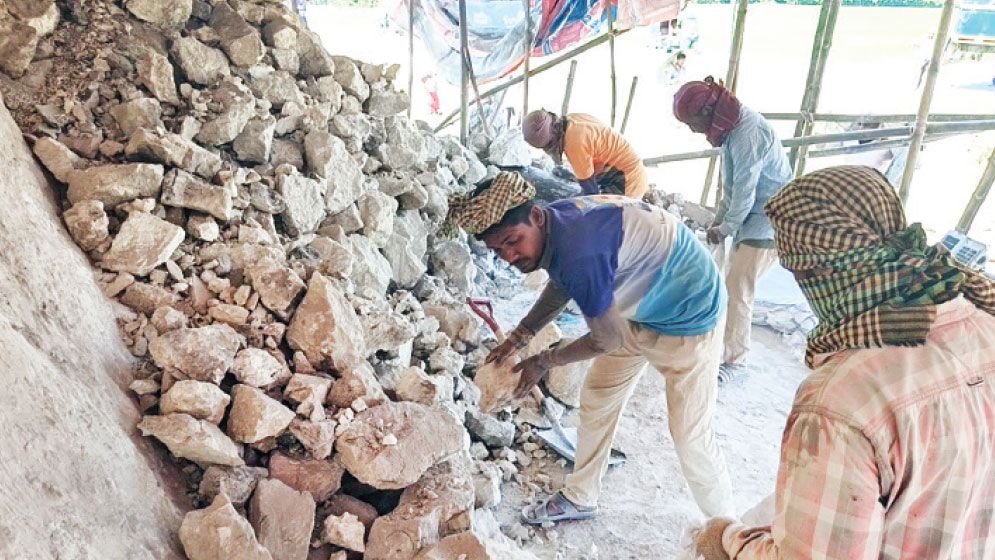
Chhatak upazila of Sunamganj, once renowned for its traditional lime industry, has seen a rapid rise in lime factories in recent years, creating jobs for more than 1,000 people but raising concerns over environmental pollution and public health.
Locally known as paju, the traditional lime kilns have been producing lime for centuries. There are now around 100 such factories in Chhatak, located mainly along the banks of rivers near the upazila headquarters and municipal town, and beside the Chhatak-Gobindaganj-Sylhet regional highway and Chhatak-Doarabazar road.
Locals said more than half of the existing factories were established in the last three to four years, with over 100 new kilns reportedly set up since 2022. Many of them, however, are operating without the required licences and environmental clearances.
The factories use limestone imported from India as raw material. Each kiln generally produces lime once a month. According to factory operators, 10  to 15 workers spend 25 to 30 days preparing a kiln, in which around 75 tonnes of limestone are placed and covered with clay. About 4,000 maunds of wood are then burned to produce roughly 1,400 maunds of lime.
Factory operators said they are increasingly using wood as fuel because of a shortage of gas. The practice has raised concerns over deforestation, air pollution and public health, while also increasing production costs.
“Many workers from Chhatak and surrounding areas have found jobs in these lime factories,” said Khaled Mia, a lime factory worker. “I previously worked as a CNG driver, but my earnings were no longer enough to support my family. I now work at a paju for a daily wage of Tk500.” Another worker, Amin Mia, said the regular production cycle has created employment opportunities for local labourers. Md Shamsu Mia, former president of the Chhatak Sand and Stone Traders Association and a paju owner, said the shortage of gas has pushed up production costs. “We are producing lime even at a loss because of the high cost of burning wood,” he said.
“If the government formulates policies, issues licences and provides necessary support, we want to run the business legally while protecting the environment. The industry has the potential to meet the country's demand and export lime abroad.”
Meanwhile, the Department of Environment has started taking action against unapproved lime factories. Md Mohaiminul Haque, assistant director of the Sunamganj Department of Environment, said officials found around 50 lime factories operating without the required approvals during inspections. “Notices have been served on the owners of those factories,” he said. He said lime factories must comply with environmental regulations, obtain environmental clearance and use approved fuels instead of environmentally harmful materials. “Many factory owners have already applied for environmental clearance,” he added.
Insiders said, with each paju producing around 1,400 maunds of lime in a production cycle, 50 factories could collectively produce around 70,000 maunds, highlighting the industry's significant economic potential while underscoring the need for proper regulation and environmentally sustainable production.