



 For all latest news, follow the Daily Sun's Google News channel.


Women living in villages along the India-Bangladesh border in Lalmonirhat pass their lives amid fear, insecurity and various forms of deprivation, according to local residents and rights activists.
From adolescence to marriage, motherhood and family life, women in the border areas face numerous social and economic challenges. The situation is particularly visible in several bordering villages of Patgram and Hatibandha upazilas.
Most border villages are located 5 to 15 kilometres away from the upazila headquarters. Patgram upazila alone shares border areas with all eight union parishads. Around 40,000 to 50,000 families live in these villages, most of whom depend on agriculture for their livelihood. Almost all women in these families are homemakers and also work in the fields.
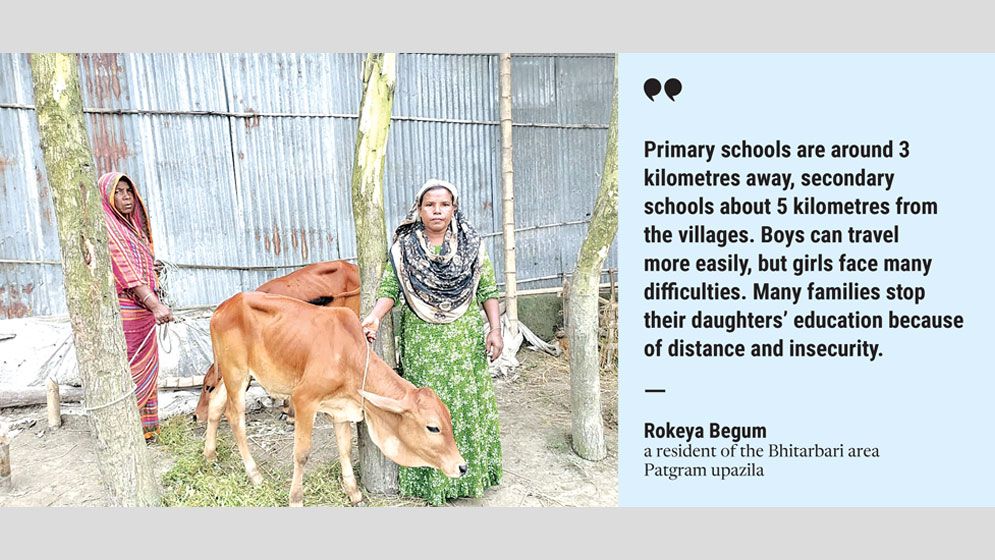
Rokeya Begum, a resident of the Vitarbari area under Srirampur union in Patgram upazila, said she lives in constant fear with her three daughters.
“Members of smuggling syndicates from different areas often come to the border villages. Sometimes members of the Indian Border Security Force (BSF) also enter our yards and create panic. When we work on farmland near the barbed-wire fence, BSF personnel often shout at us or threaten us with sticks. Women become very frightened,” she said.
Maleka Begum, another resident from the Jhalangi pocket border area of the same union, said educational institutions are located far from the villages, making it difficult for girls to continue their studies.
“Primary schools are around three kilometres away, secondary schools about five kilometres and colleges nearly 10 to 12 kilometres from the villages. Boys can travel more easily, but girls face many difficulties. Many families stop their daughters’ education because of distance and insecurity,” she said.
Locals said the rate of female education remains low in the border areas due to poverty, insecurity and social barriers. According to the 2011 census, the literacy rate in Patgram upazila was 46%, though no separate data on women’s literacy is available.
Residents also alleged that women are deprived of property rights and financial decision-making within families. Land and assets are usually registered in the names of husbands or sons, while women rarely receive ownership or control over family income.
Jolekha Begum, a farmer from Dahagram union, said women in the border areas face discrimination in almost every aspect of life. “Child marriage is still common here. Families often begin searching for husbands for girls before they even reach adulthood,” she said.
Rezanur Rahman Reza, secretary of the Dahagram-Angarpota Sangram Committee, said women in border areas not only manage household responsibilities but also work in agricultural fields near the border.
“During anti-smuggling operations, BSF personnel often chase smugglers and sometimes cross into Bangladeshi villages. This creates fear among local families, especially women and girls,” he said.
Firoza Begum, executive director of women’s rights organisation FIDA, said women in border areas face greater challenges compared to other regions.
“If we are informed about any problem faced by women, we try to address it with importance. Women face many forms of discrimination in society, but border families often suffer more because of their location and insecurity,” she said.